
Best Chess Openings for Black: Complete 2026 Guide

Disclosure: ChessAtlas is our product. We've aimed for a fair guide.
The best chess openings for Black depend on what White plays. White picks the opening move, so as Black you need two answers: one defense to 1.e4 and one defense to 1.d4. That's it. You don't need a separate weapon for every White first move - solid replies to the two main ones cover the large majority of games at club level, and the rest usually transposes back into familiar territory.
This guide covers the strongest, most playable Black openings in 2026, organized by what White does first. For each one, we'll point you to the deep-dive guide that walks through the main lines, plans, and traps. We'll also show how to pick by rating band (under 1200 vs 1800+), by style (solid vs sharp), and by how much study time you actually have.
If you're new to building a repertoire, start with one solid defense to each White first move and stop there. Going deep on two openings beats going shallow on five every time.
How to choose your Black openings
Three filters narrow the choice quickly:
- Time available. Solid systems like the Caro-Kann or Slav need maybe 8-12 moves of theory. Sharp systems like the Sicilian Najdorf or King's Indian need 15-20+ moves and regular updates. Be honest about how much you'll study.
- Style. Do you enjoy quiet maneuvering and grinding endgames, or do you want piece sacrifices and kingside attacks? Pick openings whose typical positions you actually like to play - you'll learn them faster.
- Rating band. Below 1500, opponents rarely punish small theoretical inaccuracies, so a solid system gives you more value than memorizing a sharp tabiya. Above 1800, the opposite is true: imbalance and concrete preparation start to matter.
Most club players need ONE defense to 1.e4 and ONE defense to 1.d4. That's two openings, not five. Going deep on two beats spreading thin over a dozen.
Best chess openings for Black against 1.e4
The Caro-Kann Defense (1.e4 c6)

Solid, low-theory, and built around clear strategic ideas. The Caro-Kann supports the d5 break with c6, then trades into a pawn structure where the c8 bishop gets out before being locked in. ECO codes B10-B19. Main lines include the Advance (3.e5), Exchange (3.exd5 cxd5), Classical (3.Nc3 dxe4 4.Nxe4 Bf5), and the modern Karpov-style with 4...Nd7.
Best for players who prefer slow strategic battles over sharp tactics. The Caro-Kann's structures are predictable - if you know the typical plans, you can play many positions with confidence. It's also one of the few defenses you can keep playing from beginner to grandmaster without ever switching.
Read the full guide: The Caro-Kann Defense: A Solid Choice Against 1.e4
The French Defense (1.e4 e6)

Closed, strategic, and rich in middlegame plans. In the French Defense, Black plays ...e6 preparing ...d5, accepting a slightly cramped kingside in exchange for long-term counterplay on the queenside and against the d4 pawn. ECO codes C00-C19. Main systems: Advance (3.e5), Tarrasch (3.Nd2), Classical (3.Nc3 Nf6), Winawer (3.Nc3 Bb4), and the McCutcheon (3.Nc3 Nf6 4.Bg5 Bb4).
The French rewards understanding over memorization. Pawn breaks (...c5 and ...f6), the role of the bad light-square bishop, and minority attacks are all themes that show up in nearly every game. Best for strategic players who don't mind defending cramped positions.
Read the full guide: The French Defense: A Solid and Strategic Choice Against 1.e4
The Sicilian Defense (1.e4 c5)

The Sicilian is the sharpest and most-played reply to 1.e4 at master level. Black immediately challenges White's center on the queenside and creates an imbalance from move one. ECO codes B20-B99. Major branches include the Najdorf, Dragon, Sveshnikov, Taimanov, Kan, Classical, and Scheveningen - each effectively its own opening with hundreds of theoretical pages.
The Sicilian punishes lazy preparation. White has dozens of viable systems (Open, Alapin, Closed, Grand Prix, Rossolimo, Moscow), and Black needs concrete answers to each. Best for tactical players who enjoy long-term imbalance and are willing to study deeply. If you only have 30 minutes a week to spend on openings, pick the Caro-Kann or French instead.
Read the full guide: The Sicilian Defense: A Complete Guide for Intermediate Players
The Scandinavian Defense (1.e4 d5)

Direct and refreshingly low-theory. In the Scandinavian Defense, Black trades the d5 pawn immediately for clear development. ECO code B01. After 2.exd5, Black recaptures with the queen (...Qxd5) and retreats - usually to a5 or d6 - or plays the modern 2...Nf6 gambit line.
The Scandinavian sidesteps almost the entire Open Game theory tree. White can't play their pet Italian Game or Ruy Lopez prep here. The downside: the queen comes out early, and White gets time to develop with tempo. Still a strong club-level weapon, especially for players who prefer not to memorize 15-move lines.
Read the full guide: The Scandinavian Defense: A Solid Black Weapon Against 1.e4
1...e5 (Open Game)
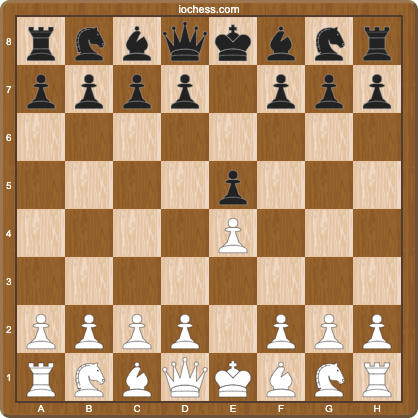
The classical principled response. Black mirrors White's center pawn and fights for symmetry. The drawback is variety: depending on White's choice, you'll need answers to the Italian Game, Ruy Lopez, Scotch, Vienna, King's Gambit, Bishop's Opening, and a few minor systems. Each branch has its own typical plans.
Best for beginners who want to learn classic tactical patterns - pins, forks, double attacks - in their natural habitat. Most chess teaching material is built around these positions, so the learning curve is gentle. The Petroff (2.Nf3 Nf6) is a solid drawing weapon at high levels but tends to be quiet for most club players.
Related reading: Italian Game vs Ruy Lopez: Which Opening Should You Play?
Best chess openings for Black against 1.d4
The Queen's Gambit Declined (1.d4 d5 2.c4 e6)
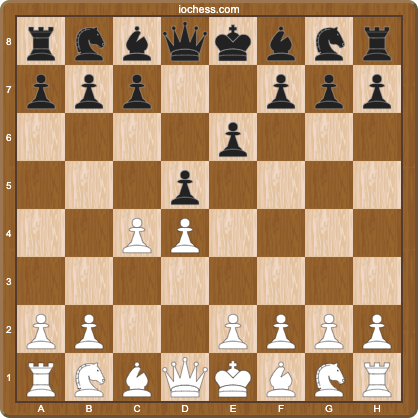
Classical, solid, and time-tested. In the Queen's Gambit Declined, Black declines the c4 pawn and prepares to develop pieces behind a stable d5/e6 center. ECO codes D30-D69. Main lines: Orthodox, Tartakower, Lasker, Cambridge Springs, Exchange Variation, and the Vienna.
The QGD is a default choice for serious 1.d4 players from beginner to grandmaster. Plans are clear: develop pieces, contest the center with ...c5 or ...c6, and aim for a minority attack or a kingside ...f5 break depending on White's setup. Less theoretically demanding than the Nimzo-Indian and easier to play with familiar plans.
Read the full guide: The Queen's Gambit: A Complete Guide to 1.d4 d5 2.c4
The Nimzo-Indian Defense (1.d4 Nf6 2.c4 e6 3.Nc3 Bb4)
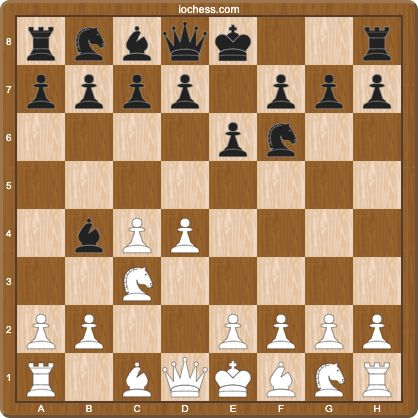
A widely respected fighting weapon against 1.d4 at master level. In the Nimzo-Indian Defense, the bishop pins the c3 knight, threatens to double White's c-pawns after ...Bxc3+, and fights for control of e4. ECO codes E20-E59. Main lines: Rubinstein (4.e3), Classical (4.Qc2), Samisch (4.a3), Leningrad (4.Bg5), and the Kasparov Variation (4.Nf3).
The Nimzo creates immediate strategic imbalance. Black often gives up the bishop pair in exchange for shattered White pawns and a strong knight outpost. You'll need a backup against 3.Nf3 (where Bb4+ isn't available) - the Queen's Indian (3...b6) or Bogo-Indian (3...Bb4+) are the standard companions.
Read the full guide: The Nimzo-Indian Defense: Black's Best Fighting Weapon Against 1.d4
The Slav Defense (1.d4 d5 2.c4 c6)
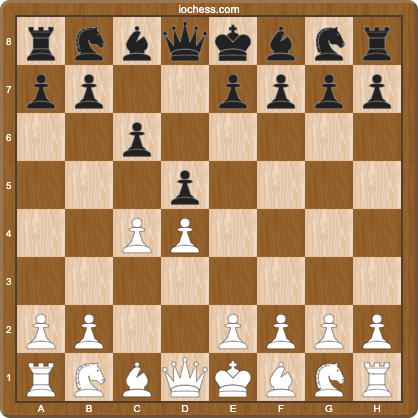
A solid alternative to the QGD. In the Slav Defense, Black supports d5 with ...c6 instead of ...e6, keeping the c8 bishop free to develop to f5 or g4 before being locked behind the e6 pawn. ECO codes D10-D19. Main systems: Exchange Slav, Slow Slav, Semi-Slav (transposing via 3.Nc3 Nf6 4.Nf3 e6), and the Chebanenko (4...a6).
The Slav is significantly less theoretical than the QGD or Nimzo, especially in the Exchange and Slow lines. Black aims for solid development and equal play. Best for players who want a low-maintenance defense to 1.d4 and don't mind a slightly more passive game.
The King's Indian Defense (1.d4 Nf6 2.c4 g6)

Sharp and aggressive. In the King's Indian Defense, Black accepts a space disadvantage in the center, fianchettoes the dark-square bishop, and aims for a kingside attack with ...f5, ...f4, and ...g5-g4. ECO codes E60-E99. Main lines: Classical (Mar del Plata), Samisch, Four Pawns Attack, Fianchetto, and Averbakh.
The KID is one of the more theoretically demanding Black openings. Each main line requires precise move orders, and White has several sharp options. Best for tactical players who love piece sacrifices on the kingside and don't mind memorizing 15+ moves of theory. Not recommended below 1500.
The Grunfeld Defense (1.d4 Nf6 2.c4 g6 3.Nc3 d5)
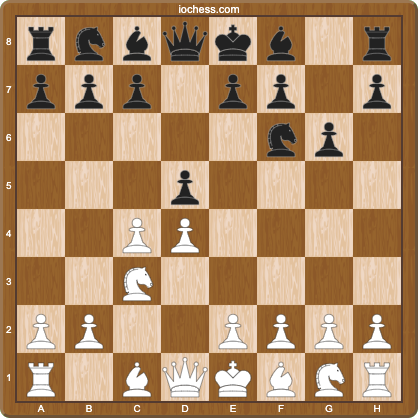
The hypermodern weapon: let White build a big center, then attack it with pieces. In the Grunfeld Defense, ECO codes D70-D99. Main lines: Exchange (4.cxd5 Nxd5 5.e4 Nxc3 6.bxc3), Russian System (4.Nf3 Bg7 5.Qb3), and Fianchetto (4.Nf3 Bg7 5.g3).
The Grunfeld is one of Black's most ambitious replies to 1.d4. Plans are concrete: pressure d4 with ...c5, undermine the e4-d4 center, and exploit weak White pawns. Like the KID and Nimzo, it requires real preparation - this isn't a system you play on general principles.
Best Black opening by rating band
| Rating | vs 1.e4 | vs 1.d4 | Why |
|---|---|---|---|
| Under 1200 | Caro-Kann or 1...e5 | QGD or Slav | Low theory, clear plans, classical structures |
| 1200-1500 | Caro-Kann or French | QGD or Slav | Solid foundations, easy to play with familiar plans |
| 1500-1800 | French, Caro-Kann, or Sicilian | QGD or Nimzo-Indian | Add tactical sharpness as opponents get stronger |
| 1800-2000 | Sicilian or French | Nimzo-Indian + QID/Bogo backup | Imbalance and theoretical depth start to matter |
| 2000+ | Najdorf Sicilian or sharp French | Nimzo + Grunfeld or KID | Tournament-level theory, full preparation |
None of these recommendations are mandatory - if you love the Sicilian at 1400 and you're willing to put in the study time, play it. Conversely, plenty of titled players use the Caro-Kann their whole career. Your style and study budget matter more than rating-band averages.
Best Black opening by playing style
- Solid grinders: Caro-Kann + Queen's Gambit Declined. Predictable structures, long strategic battles, minimal opening risk.
- Strategic positional: French + Nimzo-Indian. Closed positions, pawn-structure mastery, queenside counterplay.
- Tactical attackers: Sicilian + King's Indian Defense. Sharp imbalance, kingside attacks, piece sacrifices.
- Time-poor club players: Caro-Kann + Slav. Among the lowest-theory pairs on this list. You can build a working repertoire in a weekend.
- Hypermodern fans: Pirc/Modern (vs 1.e4) + Grunfeld (vs 1.d4). Let White build the center, then strike.
- Old-school classical: 1...e5 + QGD. The defenses many grandmasters have played at some point.
How to study your Black repertoire
Once you've picked your two openings, the study process is straightforward: learn the main lines 8-12 moves deep, drill them until recall is automatic, then expand into sidelines as you encounter them in real games. Spaced repetition, which applies the well-documented spacing effect, makes this faster than trying to brute-force memorize move trees.
For deeper guidance on each step, see:
- Best Response to 1.e4: Recommendations by Rating Level
- Best Response to 1.d4: Recommendations by Rating Level
- How to Build Your First Chess Opening Repertoire
- How to Learn Chess Openings in 30 Days
- How to Handle Transpositions in Your Opening Repertoire
- How to Retain Chess Openings with Spaced Repetition
Want to drill your Black repertoire with FSRS spaced repetition, find your real-game deviations, and stop forgetting your prep? Create a free ChessAtlas account or explore the free opening trainer.
Sources and Further Reading
- Sicilian Defence (Wikipedia) covers the main systems and its standing at master level.
- Queen's Gambit Declined (Wikipedia) documents the classical structures referenced above.
- Spaced repetition (Wikipedia) explains the memory science behind the study method recommended here.
Last updated: Jun 13, 2026


Comments