
Nimzo-Indian Defense: Black's Best Weapon Against 1.d4

Disclosure: ChessAtlas is our product. This guide is a balanced Black-perspective overview of the Nimzo-Indian Defense. Readers should weigh the perspective accordingly.
The Nimzo-Indian Defence (1.d4 Nf6 2.c4 e6 3.Nc3 Bb4) is one of the most theoretically respected weapons for Black against 1.d4. It pins the c3 knight, denies White an easy e4 push, and creates long-term structural imbalances that Black can exploit. Named after Aron Nimzowitsch, who popularized it in the 1920s, the opening has been a World Championship staple from Botvinnik and Capablanca through Karpov, Kasparov, Anand, and Carlsen. It is widely regarded as one of Black's most reliable replies to 1.d4 - see our broader best response to 1.d4 by rating level for the full Black-side decision tree.
The Core Strategic Idea
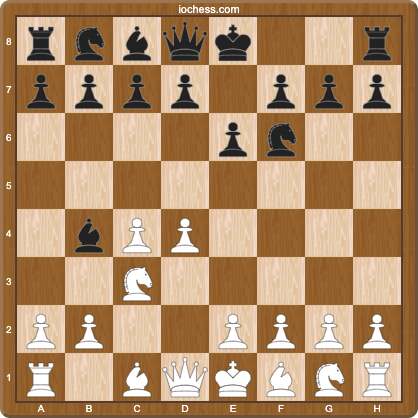
Black's Nimzo-Indian bishop serves three functions: it pins the c3 knight (preventing the natural e4 push), it can be traded for doubled pawns on c3 (giving Black a long-term target), and it anticipates ...Ne4 establishing a strong central outpost. White cannot ignore the bishop; every main line is determined by how White deals with it.
Black's follow-up plans depend on White's fourth move:
- ...Bxc3+ to double pawns for long-term structural pressure
- ...Ne4 + ...f5 attacking the c3 knight with pieces
- ...c5 / ...d5 breaks fighting for central squares
- ...b6 + ...Bb7/Ba6 classical positional pressure on the c4 pawn
White's Most Common Responses
4.Qc2: Classical Variation (modern main line)
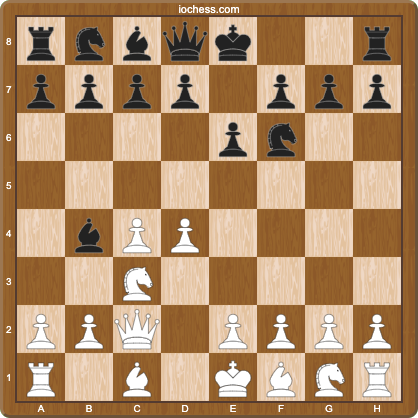
Main line: 4.Qc2 O-O 5.a3 Bxc3+ 6.Qxc3 b6 (or ...d5) with classical positional play. White gets the bishop pair and central ambitions; Black targets the c4 pawn and the static White queen.
Carlsen, Caruana, and Kramnik all play both sides of this line at the highest level. It remains a theoretical battleground in contemporary GM chess.
4.e3: Rubinstein Variation (solid classical)
Main line: 4.e3 O-O 5.Bd3 d5 6.Nf3 c5 with classical development and IQP possibilities. White's bishop goes to d3 targeting h7, Black plays actively in the center.
The Rubinstein is among White's most solid choices. Black has many viable responses: 4...c5 (Hubner Variation), 4...d5 (classical IQP setup, Karpov Variation), or 4...O-O followed by ...b6 and ...Bb7 (Queen's Indian hybrid). Choose one based on your positional preferences.
4.a3: Samisch Variation (forces the exchange)
Main line: 4.a3 Bxc3+ 5.bxc3 c5 with Black playing directly against White's doubled c-pawns. White has the bishop pair and aims for f3+e4 and a kingside attack; Black plays on the queenside with ...Nc6, ...d6, and ...Na5 targeting c4.
Sharp and imbalanced. The structure after bxc3 makes for rich middlegames. Less common at super-GM level today but still playable.
4.Nf3: Three Knights / Kasparov Variation (flexible)
Main line: 4.Nf3 O-O (or 4...b6 or 4...c5) with White keeping options open for g3 fianchetto, e3 Rubinstein-like structures, or Qc2 Classical. Less committal than 4.Qc2 or 4.e3.
Versatile but offers Black fewer concrete targets. A good modern anti-Nimzo weapon.
4.Bg5 Leningrad Variation
The Leningrad Variation, popularized by Spassky in the 1960s and 70s, attacks the f6 knight and prepares e3/Nf3. Black typically plays 4...h6 5.Bh4 c5 6.d5 d6, leading to rich middlegames where Black's bishop pair and pawn breaks (...e6, ...g5) compensate for some structural weaknesses. The Leningrad is rare at top level today but remains dangerous if Black is unprepared.
4.f3 Kmoch Variation
The 4.f3 line aims for a Samisch-style center with e4 to follow. Black equalizes with 4...d5 5.a3 Bxc3+ 6.bxc3 c5, exploiting the slow e4 push.
What if White plays 3.Nf3? (Anti-Nimzo)
White can sidestep the Nimzo entirely with 3.Nf3, refusing to put a knight on c3 where it can be pinned. This transposes to Queen's Indian (after 3...b6) or Bogo-Indian (after 3...Bb4+) territory. Pair the Nimzo with one of these as your 1.d4 backup. Both share the Nimzo's piece-pressure ideas without committing to ...d5.
How the Nimzo Compares to Other 1.d4 Defenses
- vs Queen's Gambit Declined (1.d4 d5 2.c4 e6 3.Nc3 Nf6): the QGD commits to a solid center but blocks the Bc8. The Nimzo keeps the bishop mobile and challenges e4 with a piece. More aggressive.
- vs King's Indian Defense (1.d4 Nf6 2.c4 g6): the KID plays for a kingside storm with ...e5 and ...f5. The Nimzo plays for positional pressure and structural advantages. Different styles entirely.
- vs Slav Defense (1.d4 d5 2.c4 c6): the Slav commits to a solid ...c6 + ...d5 structure. The Nimzo is more flexible and piece-active.
The right pick depends on what you want from your middlegames. If you enjoy long positional squeezes against doubled pawns and you don't mind ceding the bishop pair, the Nimzo's payoff is substantial. If you want a shorter theoretical learning curve, the QGD or Slav are easier to get into. For the full Black-side decision tree by rating, see best response to 1.d4 by rating level.
Historical Games Worth Studying
Botvinnik vs Capablanca, AVRO 1938: one of the most famous Nimzo-Indian games ever played. Botvinnik's spectacular combination in a Nimzo-Indian with doubled c-pawns has become a classic study for both sides. It is widely annotated and freely available across online game archives.
Karpov's career: Karpov used the Nimzo-Indian as his primary Black weapon against 1.d4 for two decades, from his 1975 World Championship cycle through his 1990s tournament practice. His games vs Kasparov in the 1984 to 1987 World Championship cycles contain deep Nimzo theory, especially in the Classical Variation (4.Qc2).
Modern reference: The Karpov vs Kasparov World Championship matches of the 1980s included multiple Nimzo-Indian games, with Kasparov playing both sides at the highest level. These games shaped modern theory of the 4.Nf3 and 4.Qc2 main lines and are still cited in contemporary opening manuals.
How Deep to Learn the Nimzo by Rating Band
- Under 1600: do not play the Nimzo yet. The theoretical requirements exceed what most games need. Use the Queen's Gambit Declined or the Slav instead. See also our list of 5 best openings for club players (1200-1800 ELO).
- 1600 to 1900: commit to the Rubinstein (4.e3) response. Learn one plan (...c5 or ...d5) thoroughly. A small set of core positions covers most of your games.
- 1900 to 2200: add the Classical (4.Qc2) response. Learn 4...d5 or 4...O-O + 5...Bxc3+ structures, expanding into the 4.Qc2 main lines.
- 2200+: full Nimzo coverage including Samisch (4.a3) and Kasparov (4.Nf3) sidelines, plus the f3 Kmoch and Leningrad as occasional surprises to be ready for.
The "do not play under 1600" guidance is the most important takeaway in this article. The Nimzo's strategic ideas (managing doubled pawns, exploiting weak light squares, knowing when to give up the bishop pair) require pattern recognition that takes considerable time to build. Without that base, you will reach a slightly worse middlegame on autopilot and lose to a stronger opponent's plan.
Common Mistakes
Rushing ...Bxc3+
Trading the bishop too early (on move 4 or 5) without a plan gives White the bishop pair and central chances. Generally wait until White commits to a3, or until you can follow up with ...b6 + ...Ba6 targeting c4.
Playing ...d5 and ...c5 too quickly
Both breaks are standard, but playing them together without supporting pieces leads to overextension. Pick one based on White's setup: ...d5 against 4.e3, ...c5 against 4.Qc2.
Ignoring the c4 pawn as a long-term target
In many Nimzo structures, c4 is the weakness. Plans like ...Nc6 to a5 or ...Ba6 target c4 directly. Players who forget this target drift into passive positions.
Action Plan: Add the Nimzo in 14 Days
- Day 1 to 3: Memorize the move order 1.d4 Nf6 2.c4 e6 3.Nc3 Bb4 and the main four White replies (4.Qc2, 4.e3, 4.a3, 4.Nf3). Recognize each from the position alone.
- Day 4 to 6: Study one Black response to 4.e3 (Rubinstein) for 8 to 10 moves: pick either 4...c5 (Hubner) or 4...d5 (Karpov IQP). Drill the resulting tabiya.
- Day 7 to 9: Study one Black response to 4.Qc2 (Classical): the 4...O-O 5.a3 Bxc3+ 6.Qxc3 main line.
- Day 10 to 11: Cover 4.a3 Samisch and 4.Nf3 Kasparov briefly. Know one plan against each.
- Day 12 to 13: Replay Botvinnik vs Capablanca AVRO 1938 and one Karpov-Kasparov 1984 Nimzo. Annotate the plans, not the moves.
- Day 14: Pair the Nimzo with a 3.Nf3 reply (Queen's Indian 3...b6 or Bogo 3...Bb4+) so a 3.Nf3 move order does not catch you out.
Tools to Study the Nimzo
FSRS spaced repetition on the core repertoire positions is the fastest way to lock in the move orders and the plan-keyed responses. ChessAtlas and modern Anki decks both support FSRS and let you import positions directly from PGN. For the broader tools landscape, see our complete FSRS guide and best chess opening trainers 2026. Pair the spaced repetition with regular master-game replay; the Nimzo is plan-driven, and pure move memorization without understanding the structures decays fast.
Next Steps
For broader context see how to build your first repertoire, how deep to study by rating, and the complete Black-side decision tree that compares the Nimzo with every other major Black defense by rating band. Or create a free ChessAtlas account and drill your Nimzo lines with automatic spaced repetition.
Sources and Further Reading
Last updated: Jul 24, 2026


Comments