7 Common Opening Mistakes That Cost You Games (And How to Fix Them)

Table of contents
This article focuses on tactical opening mistakes: hanging pieces in the first 10 moves, falling for common traps, reckless pawn grabs, and patterns where one careless move loses material immediately. To turn these fixes into lasting habits, anchor them inside a repertoire that actually sticks, because tactical awareness is useless without a repeatable system behind it.
Below you will see exact move sequences that fail, plus simple fixes you can use immediately. Apply these to stop losing material in the first 12 moves and castle before your king gets attacked.
7 Mistakes at a Glance:
- Fool's Mate, weakening the e1-h4 diagonal with f- and g-pawn moves
- Early Rook Activation, swinging rooks into play before castling
- Blocking Central Pawns, bishops on squares that kill your own d- or e-pawn push
- Noah's Ark Trap, a bishop suffocated by pawns in the Ruy Lopez
- Premature Attack (Ng5), flashy lunges at f7 without support
- Copycat Catastrophe, mirroring moves one tempo too long
- Wandering Queen, early queen sorties that cost tempo after tempo
1. Fool's Mate: The Ultimate King Safety Disaster
Why It Fails
Fool's Mate (1.f3 e5 2.g4 Qh4#) is the textbook example, and it is the shortest possible checkmate in chess, but the same principle bites club players too. An early f3 in the King's Indian (instead of Nf3), or g4 gambits without preparation, weaken the e1 to h4 diagonal. At club level the danger is subtler: pushing f2 to f3 to support e4 (as in the Saemisch King's Indian) without understanding the dark-square cost, or playing g4 in the Italian without h3 first.
The Fix
Control the center with e4 or d4, develop knights to f3 and c3, and avoid moving f- or g-pawns in the first 6-8 moves. Castle quickly so Qh4+ or Qh5+ checks never become dangerous, and keep a knight able to reach f6 or f3 to cover the h4 to e1 diagonal.
2. Early Rook Activation: Exposing Your Most Valuable Pieces
Why It Fails
Pushing a rook pawn then swinging a rook early, for example 1.h4 e5 2.Rh3 or 1.a4 d5 2.Ra3, backfires fast. After 1.h4 e5 2.Rh3, moves like 2...Bc5 or 2...Nf6 hit the rook with tempo. You also block Nf3, delay castling, and create a loose pawn on h4 that becomes a target in open files. The classical opening principle of developing minor pieces before rooks is one reason these tries fail (see the general guidance on chess opening principles).
The Fix
Keep rooks home until files open or after castling. Use a sound order such as 1.e4 e5 2.Nf3 Nc6 3.Bc4 Nf6, then castle, develop the remaining bishop, and only later place rooks on e1 and d1 when central files start to clear.
3. Blocking Your Central Pawns: The Bishop on the Wrong Square
Why It Fails
Placing a bishop on a square that blocks a key pawn hurts your center. For example, 1.e4 e5 2.Bd3?! Nc6 3.Nf3 Nf6 4.O-O d5 shows why Bd3 is clumsy: the d-pawn cannot advance to d4 and challenge Black's center. White gets a passive position where Black can take over the center with 5.exd5 Nxd5 and active piece play.
The Fix
Develop bishops to squares that support central breaks. After 1.e4 e5, prefer 2.Nf3 and 3.Bc4 or 3.Bb5, keeping d2-d4 available. In queen's pawn openings, place bishops on active squares like f4 (London System), g5 (Queen's Gambit), or e3 (Sicilian), where they support your central pawns rather than blocking them.
4. The Noah's Ark Trap: When Bishops Get Buried Alive
Why It Fails
A classic Ruy Lopez trap, known as the Noah's Ark Trap, shows a bishop suffocated by pawns: 1.e4 e5 2.Nf3 Nc6 3.Bb5 a6 4.Ba4 d6 5.d4 b5 6.Bb3 Nxd4 7.Nxd4 exd4 8.Qxd4 c5, and after 9.Qd5 Be6 10.Qc6+ Bd7 11.Qd5 c4, the bishop on b3 has no escape squares. Black's pawns on a6, b5, c5, and c4 form a complete net and the bishop is lost for a pawn.
The Fix
Before pushing a bishop forward, ensure a safe retreat. Create an escape square with a3 or a4 after ...a6 and ...b5, or keep the diagonal to c2 or d1 open. In the Ruy Lopez specifically, play d4 only after c3, so the b3 bishop has the c2 square to retreat to when Black plays ...c4.
5. Premature Attack: The Ng5 Lunge at f7
Why It Fails
After 1.e4 e5 2.Nf3 Nc6 3.Bc4, the flashy 4.Ng5 hits f7 with knight and bishop. The Fried Liver Attack (4.Ng5 d5 5.exd5 Nxd5?! 6.Nxf7) gives White practical chances, but it is not objectively best. Sound Black players reply 4...d5 5.exd5 Na5 (the Polerio Defense), regaining material and seizing the initiative. In many amateur games, the Ng5 player falls behind in development and the attack fizzles out.
The Fix
Earn your attack. In the Italian Game, aim for 1.e4 e5 2.Nf3 Nc6 3.Bc4 Nf6 4.d3, then castle, play c3 and d4 when prepared, and bring rooks to e1 and d1. Early Ng5 without support gives Black a comfortable game compared to quieter development.
6. The Copycat Catastrophe: Mirroring Moves Beyond Reason
Why It Fails
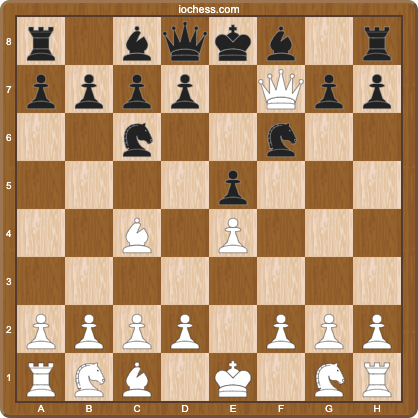
Copying moves keeps you a tempo behind. In 1.d4 d5 2.c4 c5? 3.cxd5 Qxd5 4.Nc3, White hits the queen immediately thanks to the extra move; after 4...Qa5 5.d5, White gains space and targets c5. Another example: 1.e4 e5 2.Qh5 Qh4?? 3.Qxe5+, which wins a central pawn with check and wrecks Black's setup.
The Fix
Mirror only when the move is good on its own. Break symmetry at the right time with c4 or d4 in queen's pawn games, or e4-e5 in king's pawn lines if your tactics work, and never because your opponent just did it.
7. The Wandering Queen: Early Development and the Tempo Massacre
Why It Fails
Scholar's Mate tries 1.e4 e5 2.Qh5, hoping for Qxf7#. Sound defense buries it: 2...Nc6 3.Bc4 g6 4.Qf3 Nf6, and White's queen has moved twice while Black develops. Simple moves like ...d5 also kick the queen while freeing pieces. Early queen moves before move 6 give your opponent free tempi with every developing reply.
The Fix
Follow a strict rule: develop knights and bishops first, castle, and connect rooks by move 10. Bring the queen out only when a concrete tactic works or when you can support it with at least two developed attackers, so each reply does not gain your opponent free tempi.
These patterns appear in many openings and at many ratings because they trade material for hope. Plan to castle by moves 8-10, develop four minor pieces by move 7, and avoid pawn moves that expose your king or leave pieces en prise.
- Prioritize development over stunts: finish minor pieces and castle before attacking
- Respect pawn moves: prefer e- and d-pawn pushes, avoid early f- and g-pawn advances
- Value tempi: do not move the same piece twice unless it wins material
- Protect your king: castle early and keep the squares around it solid
- Train with spaced review: import your games to spot repeated opening errors
Micro-action: review your last 10 games. For each, list the first move that broke a principle above and write the correct move order you will use next time. You can use ChessAtlas to analyze your opening mistakes systematically, and pair it with a structured game-analysis workflow so every rated game feeds your repertoire back. If you are still assembling that repertoire from scratch, start with our beginner's guide to building your first opening repertoire.
Fix Your Opening Mistakes for Good
Knowing the mistakes is half the battle. ChessAtlas imports your games from popular online platforms, its deviation finder flags exactly where you left your prep, and lets you drill the correct lines with spaced repetition until they're automatic. Pair the seven principles above with regular post-game review and you stop losing the same way twice. To put the workflow into your own games, the deviation-detection workflow guide walks through the full loop from import to drill with a real example.
Sources and Further Reading
Last updated Jun 13, 2026