Build Your First Chess Opening Repertoire

Table of contents
Playing above 1200 ELO? See our full framework for building a repertoire that sticks instead.
This guide is for beginners under 1200 ELO who have never built a real chess opening repertoire and want one that works in their next rated game. Many beginner games slip away in the first 15 moves, not because of theory gaps, but because there was no plan at all. The fix is not memorizing 30-move trees: it is learning 5-10 moves of one classical system, rooted in principles, and drilling them for two weeks.
You will finish this guide with one White opening, one defense against 1.e4, and one defense against 1.d4, about 60-90 minutes per day for 2-4 weeks, then short maintenance sessions after that. Once you cross 1200 ELO, graduate to our pillar framework.
Step 1: Learn Opening Principles Before Any Moves
Principles protect you when your opponent plays something you never prepped for, which, below 1200, happens often. Spend the first 3-5 days here:
- Control the center with pawns and active pieces (e4, e5, d4, d5).
- Develop efficiently: each minor piece out once, not twice, before move 10.
- Castle within 10 moves in almost every position.
- Don't move the queen early: she gets chased around and you lose tempo.
- No premature attacks: finish development first, then open lines.
For concrete examples of what happens when you ignore these, see 7 Common Opening Mistakes That Cost You Games.
Step 2: Pick One Opening System (Don't Overthink)
At your level the most useful opening is often the one you understand. Pick the package that matches your temperament and stick with it for 3+ months. If you want a curated shortlist with concrete recommendations for both colors, our guide to 5 beginner-friendly opening systems that actually work walks through each choice with example lines and plans.
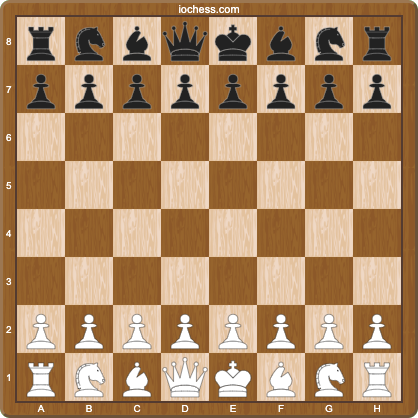
For White (pick one)
- Italian Game (1.e4): After 1.e4 e5 2.Nf3 Nc6 3.Bc4, you aim for quick castling and natural development. Best for tactical players.
- London System (1.d4): 1.d4, Bf4, e3, Nf3 against almost anything. Same setup every game. Best for players who want to play chess, not memorize theory. See our full London guide.
For Black
- Against 1.e4: 1...e5 (classical, symmetric, open games), or the Caro-Kann with 1...c6 if you prefer a solid structure. Our full Caro-Kann guide covers each main variation.
- Against 1.d4: 1...d5, straightforward and principled.
Step 3: Learn Just 5-10 Moves Deep
Shallow is a feature, not a bug. At your level, depth past move 10 is largely wasted: your opponents will often leave theory before then.
- Learn your main line to move 8.
- Prepare safe, principled replies to the 2-3 most common deviations.
- Write down the typical pawn structure where your prep ends.
- Write down one plan for after theory ends ("castle, push d4-d5 when safe").
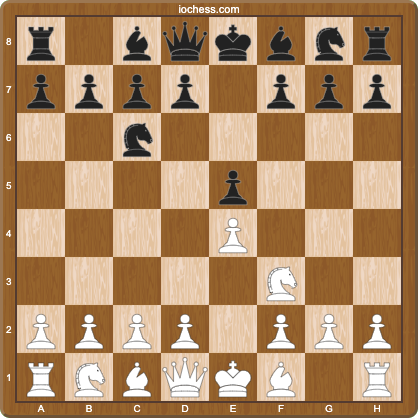
Italian Game example: 1.e4 e5 2.Nf3 Nc6 3.Bc4 Bc5 4.c3 Nf6 5.d4 exd4 6.cxd4 Bb4+ 7.Bd2 (or 7.Nc3 for the sharp Moeller). White has a broad d4+e4 center; Black exchanges and develops actively. Your plan is not "push e5 and attack f7", it is castle, complete development, then look for a timely d5 break. Keep that one plan in your head.
Caro-Kann example for Black: 1.e4 c6 2.d4 d5 3.Nc3 dxe4 4.Nxe4 Bf5: this is the Classical Variation. Black develops the bishop actively outside the pawn chain before playing ...e6. After 5.Ng3 Bg6 6.h4 h6 7.Nf3, your plan: develop naturally, castle kingside, break later with ...c5.
Step 4: Watch 2-3 Model Games per Opening
This is where principles turn into patterns. Pick 2-3 grandmaster games in your chosen opening (any 2400+ player from a collection of master games) and pause after move 10 to notice:
- Where the pieces ended up (knight squares, bishop diagonals).
- What pawn break created the plan (d5, c5, f4).
- Which tactics recur (weak f7, back-rank issues, pins on the long diagonal).
Budget 20-30 minutes per opening. Don't memorize, just observe. If you want a sharper set of candidate lines to drill once your opponent deviates, our memorization method breaks every line into position cards you can review daily.
Step 5: Pair Openings with Daily Tactics
Below 1200 ELO, most decisive moments come from tactics, not opening knowledge. Spend 15-20 minutes daily on puzzles focused on the patterns you actually see in your games: pins, forks, removing the defender, back-rank mates, and basic mating nets. When a tactic appears in one of your model games, flag it: tactical themes recur in similar pawn structures, and your opening knowledge compounds faster when it plugs directly into concrete combinations from the same setup.
Step 6: Set Up and Fill Your Repertoire Tool
Pick one tool, create folders for "White" and "Black," add subfolders per opening, and enter your main lines with short annotations (one plan per position, not a novel). Free options to start: ChessAtlas's repertoire builder (free plan, up to 200 variations), Lucas Chess (open source), and Chess Position Trainer. Paid options worth considering: Chessable (GM-authored courses) and ChessAtlas Premium ($9.99/month, $6.99/month billed annually, or $399 once). Plan on a couple of focused sessions to get the basics in: one White opening with main lines plus the top 2-3 deviations, then a second session for each Black defense. For what to look for in a trainer, see our 2026 opening trainer comparison.
Step 7: Drill Daily with Spaced Repetition
Set a 15-minute daily timer. Review lines from both sides (your moves and your opponent's). Prioritize positions where your accuracy drops. With a modern algorithm like FSRS, intervals naturally stretch from daily to weekly to monthly as you succeed, so the queue stays small as you stabilise. Keep this up for 3-4 weeks before expecting visible results in your games. Full guide: Spaced Repetition for Chess.
Step 8: Play, Review, and Iterate
Theory is only worth what you execute. Play 10-15 minute rapid games, aim for your prepared lines, and review each game against your repertoire afterwards. After every 10 games, list the top 3 offbeat replies you actually faced and add short responses. Prune lines you never see. Your repertoire should shrink before it grows: a tight 100-position deck you actually know beats a 500-position deck you sort-of remember. Tools like ChessAtlas' deviation finder automate the "what did I get wrong this time" step so you do not have to comb through games manually.
Common Beginner Mistakes
- Studying master games instead of 1000-1600 games. Your opponents don't play like top GMs: study games closer to your level so the deviations you face look familiar.
- Memorizing without understanding plans. Learn the idea behind every move or the line collapses the first time the opponent deviates.
- Picking the Najdorf or King's Indian "because GMs play it." These demand deep theory you won't have time to maintain. Start classical. Graduate later.
- Going wider before going deeper. One opening per colour, well-drilled, beats four openings half-learnt.
- Skipping the post-game review. A major single source of repertoire improvement is the game you just lost.
Takeaways
- Under 1200: one White opening, one Black defense vs 1.e4, one vs 1.d4, 5-10 moves deep, nothing more.
- Principles + 2-3 model games + daily tactics beat any theory deep-dive at your level.
- Drill 15 min/day for 3-4 weeks, play rapid games, prune what you don't see, expand what you do.
- Use a tool that schedules reviews for you (FSRS spaced repetition) so you never re-drill what you already know.
Micro-action for today: pick one White opening and one Black defense, enter 8 moves of each into ChessAtlas (free tier), schedule a 15-minute daily drill. Come back in two weeks.
Sources and Further Reading
- Chess opening (Wikipedia)
- Italian Game (Wikipedia)
- Spaced repetition (Wikipedia)
Last updated Oct 17, 2026