How to Turn Every Chess Game Into Opening Improvements: The Deviation Detection Workflow

Table of contents
Disclosure: ChessAtlas is our product, and Deviation Finder is one of its core features. This article shows both the manual workflow (any tool) and the automated version (ChessAtlas). Readers should weigh the perspective accordingly.
Most club-level games are decided in the opening or early middlegame. Unless you systematically compare the games you played against the repertoire you studied, the same gaps keep costing you points. This workflow turns every rated game into a concrete repertoire improvement.
Study is one-way: repertoire to memory. Real improvement requires the reverse loop: real games to where memory failed to patched repertoire to spaced-repetition drilling. Most players skip the second half. This guide is about closing that loop.
If you have not built a repertoire yet, start with how to build your first chess opening repertoire. This article assumes you already have one.
What Exactly Is a Deviation?
In a chess game, the first move where either you or your opponent plays outside the lines in your prepared repertoire is a deviation. The wider context of chess opening theory is what defines those expected lines. Two flavors matter:
- Your deviation: you knew the line, but you forgot it or played a worse move. This is a memory problem: the position needs more reviews.
- Opponent's deviation: your opponent left the mainline with a sideline you had not prepared. This is a coverage problem: your repertoire has a gap.
Both demand different responses. A memory gap needs more drilling on a position you already have; a coverage gap needs a new line added to the repertoire first. Treating them identically wastes drilling time on positions you simply never had. Automated tools like Deviation Finder separate them automatically; the manual workflow forces you to label them yourself before you fix them.
The Manual Workflow (PGN + Repertoire File)
You can do this with free tools only. Expect 10 to 20 minutes per game at first, less once practiced.
Step 1: Finish the Game, Then Wait
Do not analyse on tilt. Wait at least 30 minutes after a loss. The goal is to find systemic problems, not relive a specific miss. Emotional analysis tends to over-weight the move you blundered and under-weight the opening choice that put you in a bad position three moves earlier.
Step 2: Import the PGN
Download the PGN of your game from whichever site you play on (usually under your game archive or export options). Open the game in your analysis board or repertoire tool. The Portable Game Notation format is a plain-text standard that nearly every chess tool can read.
Step 3: Replay the Opening Without the Engine
Play through moves 1 to 15 and find the first move that is not in your repertoire. Mark it. This is the deviation point. Note who deviated (you or opponent) and at what move.
Step 4: Compare Against Master Games
Use an opening explorer filtered to master games. Look for the position after the deviation. Check what 2200+ players actually choose here, and what scores well for your side. For a deeper take on how a general analysis board compares to a dedicated repertoire trainer, see ChessAtlas vs Lichess.
Step 5: Validate with an Engine
Switch on Stockfish at depth 22 or higher. Check the evaluation gap between what you played and the engine's top move. As a rule of thumb:
- Within 0.3 pawns: not a mistake, just a preference. Keep your line if the plan is clear to you.
- 0.3 to 0.5 pawns: an inaccuracy. Worth knowing the better move, but not critical.
- 0.5 pawns or more: a real mistake. Fix this in your repertoire.
Step 6: Write the Correction Into Your Repertoire
Add the correct move, plus a one-line note explaining why. "Why" matters more than the move itself: without the plan, you will forget the line again in three weeks.
Step 7: Drill Within 24 Hours
Add the new position to your spaced-repetition deck immediately. Chessdriller (free, open-source) and ChessAtlas's free FSRS-powered opening trainer both handle this natively. The first review should be tomorrow, not next week. For the underlying retention method, see how to memorize chess openings.
The Automated Workflow (ChessAtlas Deviation Finder)
ChessAtlas's Deviation Finder collapses steps 2 through 5 into one click. You link your game history, and every new game is parsed against your stored repertoire. The tool surfaces:
- The exact move and position where you or your opponent left your preparation
- Whether it was your deviation (forgotten line) or the opponent's (new sideline)
- The correct repertoire continuation, ready to drill with one click
- Engine evaluation of your actual move versus the prepared move, so you can decide if the deviation cost real centipawns
The human work stays - you still decide whether to patch a sideline that only appeared once or to let it go. The bookkeeping (PGN export, manual position lookup, line matching) disappears. For most club players the time saved is the difference between running this loop weekly versus running it once a quarter and forgetting most of what you found.
Concrete Example: Scandinavian Defence Opponent Deviation
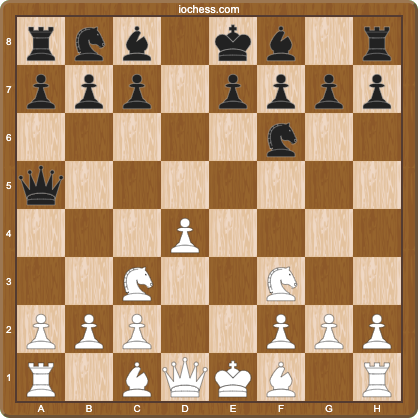
Say you play this Scandinavian Defence position regularly as White and your repertoire only covered 5...c6. Your opponent surprises you with 5...Bf5. You play sensibly and still draw, but the post-game workflow catches it: opponent deviation, position missing from repertoire. The fix is to add 5...Bf5 with a short plan note - for example "respond 6.Bc4 with the idea of Bd2 and O-O-O, attacking the queen on a5 later." Next time it happens, you are ready.
Concrete Example: Ruy Lopez Closed, Your Own Deviation
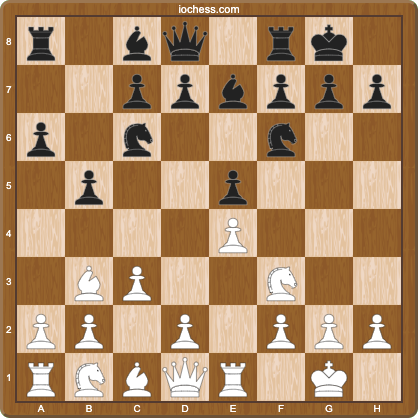
Say your Black repertoire runs the Ruy Lopez Closed with 8...d6 and the plan is 9...Na5 10.Bc2 c5 11.d4 Qc7. In a real game you play 8...d6 9...Nd7 instead, lose a tempo, and end up in a worse version of the Chigorin. This is your deviation - the line was in your repertoire, you played something else. The fix is not to add new theory but to add this exact position to the review queue with the correct move. FSRS schedules it tomorrow, in three days, in a week. The memory gets patched.
Which Deviations to Fix, and Which to Ignore
Not every deviation is worth patching. Apply these rules:
- Appears in more than one game: fix it. Recurring patterns are where you bleed the most rating.
- Appears once, at the depth you face: add a one-line note, do not over-theorise. If it reappears in the next 10 games, upgrade to a full repertoire line.
- Opponent's rare gambit or offbeat system: skip it unless it showed up because of a systematic choice (for example, your opponents at this rating band regularly play the Englund Gambit). Then cover the main refutation only.
- Move-order transposition into a line you already know: add the transposition note in your repertoire. FSRS-based tools handle it by position, so you do not duplicate work.
How Often to Run This Workflow
Rating-specific advice:
- Under 1500: Tactical misses cost you more than opening deviations. Run this workflow on one rated game per week. Spend the rest of your time on tactics.
- 1500 to 2000: Deviation detection is probably your highest-ROI study activity. Run it on every serious game. Add 2 to 3 new repertoire positions per week. See how deep to study by rating for context.
- 2000 and up: Same as above, plus opponent preparation before tournament rounds. Inspect the specific repertoire choices your tournament opponents have played in recent games and patch your lines preemptively.
A weekly batch (Sunday review of all rated games from the week) is more sustainable than per-game analysis. The exception is tournament play, where you should review each round between games to catch repertoire issues before they cost two points instead of one.
Common Mistakes to Avoid
The patterns below show up again and again in club-level post-mortems. For broader coverage of strategic and tactical errors that cost rating points, see 7 common opening mistakes that cost you games.
Fixing Everything at Once
After a tough loss, the temptation is to rewrite half the repertoire. Resist it. Pick one line, fix it properly, drill it. Rewriting five sidelines in one session produces untested theory you will not remember when it matters.
Adding Moves Without the Plan
A corrected move without a one-line plan is a future forgotten move. For every new repertoire line, write "the idea here is..." in one sentence. If you cannot, you do not understand the position well enough to play it. Study the plan first, then memorise.
Engine-Following Without Judgment
Stockfish will recommend a move that is 0.2 pawns better but requires precise preparation to your opponent's best replies for 10 more moves. At club level, the simpler 0.3-pawn-worse move you can actually execute beats the engine's favorite. Use the engine to confirm, not to choose.
Ignoring Opponent Deviation Entirely
Some players only track their own mistakes. If opponents at your rating band regularly play a sideline you have not covered, that is a coverage gap costing you points even when you draw or win. Treat opponent deviations as equally important data.
Tools That Support This Workflow
- Fully automated: ChessAtlas (game import, Deviation Finder, FSRS scheduling, deviations flagged automatically per game)
- Partially automated: repertoire trainers that offer spaced repetition with automatic deviation flagging from your imported games
- Manual: an analysis board plus Stockfish plus Chessdriller (free, open-source), or manual PGN comparison
For the broader trainer landscape see 7 best chess opening repertoire tools in 2026.
Outcome and Next Step
By following this loop you should end each week with a repertoire that genuinely reflects what you face online, not the textbook GM lines you wish you faced. After 4-6 weeks of consistent application, recurring deviations dwindle and the early middlegame phase of your games gets noticeably calmer.
Action Plan
- Take your most recent rated game and import the PGN into your analysis board or repertoire tool.
- Replay moves 1-15 with the engine off and find the first move outside your repertoire.
- Label the deviation: yours (memory) or opponent's (coverage).
- Validate the correct move with a master-games explorer plus a depth-22 Stockfish check.
- Add one correction to your repertoire with a one-line plan note explaining the idea.
- Drill the new position tomorrow with FSRS scheduling.
- Repeat after every rated game; review your patched lines weekly.
That single loop, repeated 20 to 30 times over three months, closes more rating-eating gaps than most amounts of course-watching. For deeper work, see how to analyse your games to improve your opening repertoire and chess opening mistakes analysis using ChessAtlas. Or create a free ChessAtlas account and let Deviation Finder do the import and matching for you.
Sources and Further Reading
Last updated Jul 24, 2026