
How to Memorize Chess Openings

Most players memorize chess openings the wrong way: they read a line 10 times, feel confident, then blank out on move 8 at the board. The problem is not memory capacity, it is method. This guide shows you how to memorize chess openings so they stay accessible under tournament pressure, not just the day after studying.
Prerequisites
- An account on Lichess or Chess.com so you can play and import games for feedback
- A structured repertoire source, the ChessAtlas repertoire builder is what we use; any PGN-based tool works as long as it gives you discrete positions to drill
- A spaced-repetition tool, ChessAtlas is what we use; Listudy or Chessdriller also work
- About 15 minutes per day for 2-3 weeks before the method compounds
Disclosure: ChessAtlas is our product, we've written this method to be tool-agnostic, so any SRS app will work.
Why Standard Opening Study Fails
Reading a line repeatedly is passive. It creates the feeling of knowing without building real recall. When the position arrives at the board, you need active retrieval, but passive reading never trained that skill. Two other common mistakes compound this:
- Studying too much at once: Loading 30 moves of a Najdorf line in one session floods short-term memory. Much of it tends to fade within a couple of days.
- No spaced reviews: Without scheduled repetition, you tend to forget a line before you ever play it. By the time the position arrives in a game, the memory has often already decayed.
For a deeper look at why this happens, see: Spaced Repetition for Chess Openings: The Complete FSRS Guide. For a high-level framework on building a repertoire that actually sticks (not just memorizing lines you'll forget), see How to Build a Chess Opening Repertoire That Actually Sticks.
Step 1: Understand Before You Memorize
Memorization tends to work better when attached to meaning. Before drilling a line, answer these three questions for every key position:
- What is the plan here? For example: after 1.e4 e5 2.Nf3 Nc6 3.Bc4 Bc5 4.c3 Nf6 5.d4 exd4 6.cxd4, Black can hit back with 6...Bb4+ and follow with ...Nxe4 ideas; pushing e5 too early runs into tactical counters. White's plan is to castle, develop Nc3 or blockade with Bd2 after the check, and only then consider a d5 break at the right moment.
- Why does the opponent's move make sense? Understanding their plan helps you remember the correct response automatically.
- What happens if you play the second-best move? Knowing the punishment for a mistake anchors the correct move in memory.
If you cannot answer these questions, study the position first, watch an annotated game or review collections of master games, before moving on to drilling. If you are still deciding which Black defense to build this understanding around, our decision framework for the best response to 1.e4 by rating is a good starting filter before you memorize anything.
Step 2: Break Openings into Positions, Not Sequences
A common memorization mistake is trying to remember a 15-move string as a single unit. Instead, break the line into individual positions and learn each one separately.
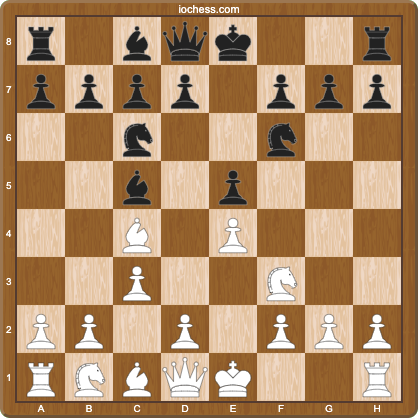
For each position, store three things:
- The best move
- One sentence explaining why (the plan or the threat you're answering)
- The key opponent reply (and your answer to it)
A 12-move line becomes 8-10 individual positions, each small enough to hold in working memory and recall quickly under a clock. How many positions you need per line depends on your rating, see how deep to study your openings by rating level for the exact targets.
One underrated skill makes every one of these position-cards easier to recall: board visualization, being able to see the position in your head without a board in front of you. The sharper your visualization, the faster you retrieve the right move under a clock, and the less you lean on rote memory. If that is a weak spot, training it directly pays off, we built DarkSquares, a blindfold-chess trainer, for exactly that; for the full landscape of options, see our guide to the best chess visualization and blindfold trainers. It pairs naturally with the position-based method above.
Step 3: Use Spaced Repetition to Lock Lines In
Spaced repetition is among the most effective memorization techniques for chess openings. Instead of reviewing the same line daily, you review each position just before you would forget it, typically after 1 day, then 3 days, then 1 week, then 2 weeks, then 1 month. Correct answers push the next review further out. Wrong answers bring the position back the next day. ChessAtlas's spaced-repetition engine uses the FSRS algorithm to schedule each position individually based on your answer history.
How to Set Up Spaced Repetition for Openings
- Choose a tool: ChessAtlas automatically generates position cards from your repertoire and schedules them with FSRS, a modern spaced repetition algorithm (open benchmark). Listudy and Chessdriller are free alternatives for players who already have a PGN repertoire. For a side-by-side breakdown of 7 opening trainers, see Best Chess Opening Trainers 2026: Honest Comparison of 7 Tools.
- Build your deck: Add one card per key position in your main lines. Start with 15-20 cards across your core openings, don't add everything at once.
- Review daily for 10 minutes: Consistency matters more than session length. Short daily sessions tend to outperform occasional long cramming sessions.
- Add new positions gradually: Introduce 3-5 new cards per week. Adding too many at once collapses the schedule and overwhelms the queue.
For the full method and the science behind it: Spaced Repetition for Chess Openings: The Complete FSRS Guide.
Step 4: Use Your Real Games as a Feedback Loop
An efficient way to find gaps in your memorization is to play a rated game and see what you forgot. Every deviation from your preparation is a position that needs more review.
Manually finding these deviations is tedious, you have to compare your game move-by-move against your repertoire. ChessAtlas's deviation finder (included with the Premium plan) does this automatically: import your games from Lichess or Chess.com and it shows exactly which positions you played incorrectly. Those positions get flagged for extra review.
Step 5: Test Under Simulated Pressure
Recognition in a calm study session is easier than recall under a ticking clock. Bridge the gap with a concrete practice protocol:
- Play 5 blitz or rapid games per week against 1700-1900 bots on Lichess or Chess.com, forcing your prepared openings. Bots at this level punish loose play without being so sharp that you miss the opening phase entirely.
- Review one game in full after each session, pick the most instructive one (usually a loss or a near-miss).
- Flag every opening deviation: the move where you left your repertoire, and the move where the position first went wrong. These are two different things, and both matter.
- Add each deviation to your SRS deck the same day, while the decision point is still fresh in your mind. This turns every practice session into a targeted memory upgrade.
- Re-play the critical position against a bot 24-48 hours later to confirm the fix stuck.
The combination of spaced-repetition study and active play under a clock is what cements memory for tournament conditions.
How Many Moves to Memorize by Rating
- Under 1200: 5-6 moves per line. Focus on the first branch points and principles, not deep theory.
- 1200-1600: 7-9 moves in main lines, with short answers to the 2-3 deviations you face most often.
- 1600-1900: 10-12 moves in main lines, 6-8 in sidelines. Cover what your specific opponents actually play.
- 1900+: Full theoretical coverage of your systems, updated regularly from recent master games.
For a full breakdown by rating: How Deep Should You Learn Your Openings?
Common Memorization Mistakes to Avoid
Mistake 1: Memorizing the Same Line Twice Under Different Move Orders
Transpositions are common: 1.d4 Nf6 2.c4 e6 3.Nc3 d5 reaches the same Queen's Gambit Declined structure as 1.d4 d5 2.c4 e6 3.Nc3 Nf6. Study by position, not by exact move order, and you automatically handle transpositions without doubling your workload.
Mistake 2: Only Memorizing Your Own Moves
Memorizing only your moves leaves you unprepared when your opponent plays differently. For every position in your deck, also review what the opponent should play, and your reply to their main alternatives.
Mistake 3: Cramming Before a Tournament
Loading 50 new positions 48 hours before a tournament is among the least effective approaches. The forgetting curve tends to hit hardest in the first 24 hours. Add new lines at least 2 weeks before you need them, so spaced repetition has time to consolidate the memory.
Start Memorizing Today
Pick one opening, your main weapon as White, or your primary defense against 1.e4. Break the first 8-10 moves into individual position cards. Review them daily for 10 minutes using a spaced repetition tool.
ChessAtlas makes this automatic: build your repertoire and it generates position cards and schedules the reviews. Import your recent games and the deviation finder (Premium) tells you which lines to prioritize based on what you actually played.
For a complete guide to building your first repertoire from scratch: How to Build Your First Chess Opening Repertoire.
Sources and Further Reading
- Spaced repetition - Wikipedia
- Forgetting curve - Wikipedia
- Chess opening - Wikipedia
Last updated: Jul 24, 2026


Comments