Spaced repetition for chess openings
Our spaced repetition system uses the FSRS algorithm to schedule your reviews at the perfect time, maximizing retention while minimizing study time.
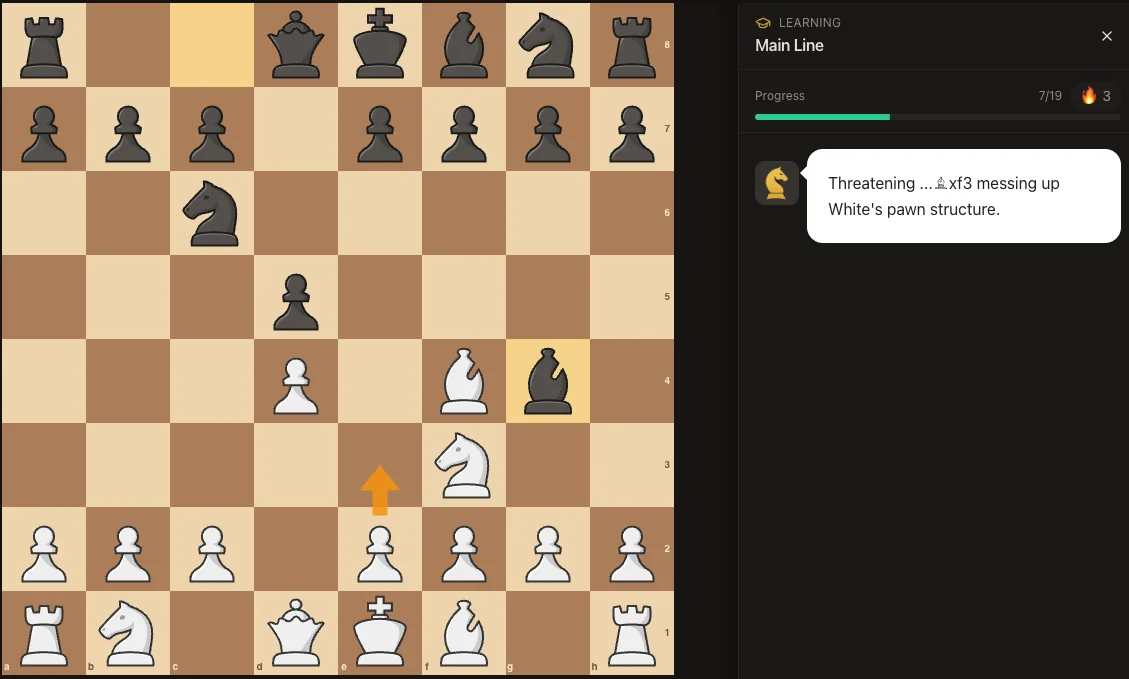
What is Spaced Repetition?
Spaced repetition is a learning technique that spaces out your reviews over increasing intervals. Instead of cramming, you review material just before you're about to forget it, which dramatically improves long-term retention.
Backed by Science
The forgetting curve, discovered by Hermann Ebbinghaus in 1885, shows how information is lost over time when there is no attempt to retain it. Spaced repetition fights this curve by reviewing at optimal intervals.

How FSRS Works for Chess
FSRS (Free Spaced Repetition Scheduler) is a modern algorithm that uses machine learning to model your memory and schedule reviews at optimal intervals. We've adapted it specifically for chess opening training:
Learn New Lines
Add variations to your repertoire. Each line becomes a reviewable card.
Practice & Get Scored
Play the line from memory. ChessAtlas scores it automatically from the moves you got right - there is no rating button to press.
Smart Scheduling
Based on that score, FSRS calculates when you should review next.
Long-term Retention
Easy lines get longer intervals. Difficult ones come back sooner.

Why It's Better Than Cramming
Research (Karpicke & Roediger, 2008) shows spaced retrieval practice roughly doubles long-term retention compared to passive review. For chess players, this means:
ChessAtlas vs Traditional Study
| Feature | Traditional Study | ChessAtlas |
|---|---|---|
| Review Scheduling | Manual, often forgotten | Automatic FSRS optimization |
| Long-term Retention | Poor without constant review | Excellent with minimal effort |
| Time Efficiency | Hours of repetitive drilling | Only the lines that are due |
| Progress Tracking | None | Detailed analytics & streaks |
Traditional Study
Manual, often forgotten
ChessAtlas
Automatic FSRS optimization
Traditional Study
Poor without constant review
ChessAtlas
Excellent with minimal effort
Traditional Study
Hours of repetitive drilling
ChessAtlas
Only the lines that are due
Traditional Study
None
ChessAtlas
Detailed analytics & streaks
Frequently Asked Questions
What is spaced repetition for chess?
Spaced repetition is a learning technique that schedules reviews at increasing intervals. For chess, it means reviewing opening lines just before you would forget them, dramatically improving long-term retention with less study time.
What is the FSRS algorithm?
FSRS (Free Spaced Repetition Scheduler) is a modern spaced repetition algorithm that uses machine learning to model your memory and calculate optimal review intervals based on how well you remember each item. It is proven to be more accurate and efficient than older algorithms.
How much time do I need to practice daily?
It depends on the size of your repertoire and how many lines are due that day, not on a fixed quota. The algorithm ensures you only review lines that need attention, making study time highly efficient.
Is spaced repetition better than traditional chess study?
Yes. Karpicke and Roediger (2008) found that spaced retrieval practice roughly doubled long-term retention compared to passive review, and the broader testing-effect literature consistently shows large gains over cramming. Instead of forgetting lines after a few days, you build lasting knowledge that survives tournament pressure.
How does ChessAtlas track my progress?
ChessAtlas tracks accuracy, streaks, and mastery level for each line in your repertoire. You can see detailed statistics showing which variations you know well and which need more practice.
Explore Related Features
Opening Trainer
Practice your lines interactively until every move becomes automatic.
Repertoire Builder
Create and organize your complete opening system with our intuitive builder.
Deviation Finder
Find where you deviated from your preparation in your actual games.
Memorize Openings
Stop forgetting your lines: a step-by-step method to memorize openings and actually remember them.
Further reading
FSRS vs SM-2 for Chess: Why FSRS Wins by 20-30%
Head-to-head on accuracy and review load for two dominant SRS algorithms.
How to Memorize Chess Openings
Why brute-force memorisation fails, and what works instead.
Spaced Repetition for Chess Openings
The active-recall science behind why SRS beats rote review for chess.
Start Training Smarter Today
Improve your opening preparation with scientifically-proven spaced repetition.