
Chess Opening Mistakes: Analysis Using ChessAtlas

Disclosure: This article describes features of ChessAtlas, a product built by our team.
Early errors decide a large share of club games. You memorize lines, then crumble after a small deviation on move 6. This guide shows how to spot, measure, and fix problems in the first 10 to 15 moves using ChessAtlas. With game imports, engine evaluations, spaced repetition, and course libraries, you replace guesswork with data. For a broader look at common tactical errors, see 7 Common Opening Mistakes That Cost You Games.
What Are Chess Opening Mistakes?
The most common opening mistakes fall into clear categories:
- Memorization without understanding, leads to panic when opponents deviate
- Premature attacks, waste time and leave pieces undeveloped
- Violating core principles, poor central control, slow development, delayed castling
- Wrong move order, transposing into a worse version of the same system
- Not knowing critical branch points, failing to recognize when the position changes character
Memorization without understanding is the through-line: when an opponent deviates from theory you have only memorised, you have no anchor for the next move. These categories line up with the established opening principles of development, central control, and king safety. Drilling positions and plans (not just sequences) is what makes a repertoire survive contact with real opponents.
Why Does Analyzing Opening Mistakes Matter?

Opening accuracy sets the tone for the entire game. The position you reach by move 12 dramatically constrains what is possible in the middlegame and endgame: a worse pawn structure, a misplaced piece, or a missing tempo on castling all compound into the kind of mistake you cannot undo. Catching the same opening mistake twice means you spend the rest of every game playing catch-up, even when your tactics and endgame work is solid.
The Italian Game: A Case Study in Critical Branching
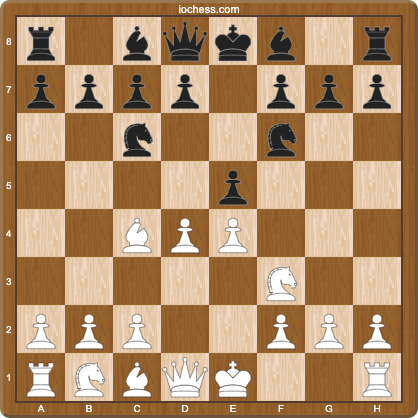
The Italian Game is one of the most common opening-mistake zones for players under 1800. Consider this critical position after 1.e4 e5 2.Nf3 Nc6 3.Bc4 Nf6 4.d4. Black has three reasonable-looking responses, but they lead to completely different types of positions:
- 4...exd4 (main line), leads to sharp Scotch Gambit / Max Lange territory after 5.O-O or 5.e5 d5 6.Bb5 Ne4, where deep theory matters
- 4...Nxe4, the centre fork-trick: after 5.Nxe4 d5 Black forks bishop and knight and regains the piece with 6.Bd3 dxe4 7.Bxe4, reaching a comfortable, roughly equal position
- 4...Nxd4?!, an inaccuracy: after 5.Nxd4 exd4 6.Qxd4, White's queen sits on an ideal central square. Black has spent two knight moves to trade pieces and now has to play accurately to avoid further tempo loss to ideas like Qd5 or Qe3.
Real example: A player reviewing Italian Game positions might find they consistently struggle after 4...exd4 because they don't know Max Lange theory deeply enough. Switching to the quieter 4.c3 system and drilling 4...Nf6 5.d4 exd4 6.cxd4 Bb4+ 7.Bd2 branches often leads to noticeably better practical results against unprepared club opponents. ChessAtlas' deviation finder makes this pattern immediately visible across all your games.
In ChessAtlas, the deviation finder surfaces these moments by flagging any move that deviates from your repertoire. You can replay each deviation directly in the board view and add the correct line to your spaced-repetition queue with one click. Over a month of imported games, the same few branch points tend to show up again and again, and those are the positions that most reward drilling.
Common Mistake Categories by ELO
Under 1000: The Scholar's Mate Trap and Its Relatives
Players in this range routinely lose to tactical ambushes in the first six moves, with Scholar's Mate (1.e4 e5 2.Bc4 Nc6 3.Qh5 Nf6?? 4.Qxf7#) and the related 2.Qh5 attempts the most common. The correct defenses are 3...g6 4.Qf3 Nf6 (kicking the queen and developing) or 3...Qe7 (covering f7 directly). Be careful: 3...g6 only works if you follow up correctly: leaving e5 hanging via something like 4...Nf6?? can lose material. ChessAtlas' opening trainer lets you drill exactly this defensive pattern until the correct queen move is automatic.
1000-1500: Move Order Errors and Unknown Deviations
At this level, the problem shifts to move order. For example, in the London System as White, playing 2.Bf4 before 2.Nf3 allows Black's 2...c5 3.e3 Qb6, attacking both b2 and d4. White then has to find 4.Nc3 or 4.Qc1 with a slightly awkward queen, when the cleaner move order 1.d4 d5 2.Nf3 Nf6 3.Bf4 sidesteps the whole problem. This kind of move-order subtlety is exactly what deviation detection surfaces.
1500+: Knowing Critical Theoretical Branch Points
Above 1500 on the Elo scale, the errors are more subtle: forgetting the correct piece placement in a specific variation, misremembering the key pawn break, or reaching a known bad endgame because of a careless exchange on move 12. These are the positions ChessAtlas' spaced repetition targets: the positions you know in principle but forget under time pressure.
How ChessAtlas Helps Analyze Opening Mistakes
ChessAtlas offers a complete workflow for finding and fixing opening errors:
1. Game Import and Deviation Detection
Import your recent games from your online chess accounts with one click via game import. ChessAtlas automatically identifies where opponents deviated from your repertoire and where you made suboptimal choices. You'll see a clear report: "Move 8 in the Caro-Kann Classical, you played Bd6 instead of your prepared Be7. This happened in 4 of your last 6 games." For the complete workflow, how to read the report, decide whether your move or the opponent's was the real break, and feed the position straight into your training queue, see our full deviation detection workflow.
2. Spaced Repetition for Pattern Recognition
After errors are tagged, ChessAtlas schedules those positions for spaced repetition using the open-source FSRS algorithm. You see the same traps and structures at adaptive intervals, locking in corrections before they fade, a direct application of the well-documented spacing effect.
This directly addresses the cycle most club players are stuck in: they look at the engine analysis after a loss, nod, and never see the position again until they make the same mistake six games later.
3. Course Libraries and Strategic Understanding
The ChessAtlas course library explains why moves work, not just what to play. Concepts like tempo, central tension, and typical pawn breaks are tied to concrete positions you missed.
4. Statistical Tracking and Progress Monitoring
ChessAtlas tracks your accuracy by opening family and flags lines where your score lags. You can review:
- Common blunders per line
- Evaluation swings in moves 1-12
- Performance by color
- Current streak and retention rate
Common Mistakes by Opening System
Playing the French Defense (1.e4 e6 2.d4 d5)?
The most common mistake for Black in the French Defence: in the Advance Variation (3.e5), playing 3...Bd7 or 3...Nh6 instead of the principled 3...c5. Delaying the counterattack on c5 lets White build a stable space advantage that is hard to challenge later. Correct plan: 3...c5 4.c3 Nc6 5.Nf3 Qb6, pressuring d4 and b2 simultaneously.
Playing the London System (1.d4 d5 2.Nf3 Nf6 3.Bf4)?
The most common mistake for White: playing e3 too early before stabilising the centre. Many London players also miss the plan of h3 and Bh2 when the Bf4 is attacked by ...Nh5 or ...e5, surrendering the bishop pair when it could simply be tucked safely back.
Playing the Sicilian Defense (1.e4 c5)?
Against the Alapin (2.c3) of the Sicilian Defence, the most common Black mistake is playing 2...d5 automatically and then drifting after 3.exd5 Qxd5 4.d4. Better preparation: know both 2...d5 and 2...Nf6 3.e5 Nd5, and pick whichever you have studied more carefully. Mixing them up by structure is where most rating points are lost.
Real-World Applications

Building a Personalized Repertoire
Use your own game data, not just theory books. If your results collapse in the Italian after 4.d4 exd4, ChessAtlas shows you this pattern and you can switch to drilling 4.c3 instead. You're studying what you actually face, not what GMs face.
Tournament Preparation
Target predictable gaps in your opponents' play. If a known opponent meets 1.e4 with 1...e6 and scores poorly in the Winawer (3.Nc3 Bb4 4.e5), prepare the critical line 4...c5 5.a3 Bxc3+ 6.bxc3 Ne7 7.Qg4 in depth.
Coaching and Self-Improvement
Turn mistake patterns into focused lessons. Instead of generic "play the principles" advice, drill specific positions that cost points. If most of your evaluation drops happen between moves 8 and 12, that is exactly where to focus your next week of study.
Common Misconceptions
"All opening mistakes are equally serious"
Early queen adventures can lose immediately. Slightly misplaced pieces may only matter at higher levels. Triage issues, fix tactical leaks before polishing positional preferences.
"More theory prevents mistakes"
Memorising 20 moves helps little if you misread positions after move-8 deviations. Understanding why a piece belongs on a certain square lets you find the correct move even in uncharted territory.
"Opening mistakes only matter for advanced players"
They matter everywhere, just differently. Beginners fall to Scholar's Mate patterns; 1500-rated players lose edges with inaccurate move orders; 1800+ players miss critical branch points in sharp theoretical lines.
Key Takeaways
- Import your games and flag moves where evaluation drops significantly
- Drill problem positions with spaced repetition until you play corrections in under 10 seconds
- Track win rate by opening family and replace underperforming lines
- Study ideas, not just moves: focus on pawn breaks, king safety, and development tempi
- For the Italian: know whether you want 4.d4 (sharp, Max Lange territory) or 4.c3 (solid) and prepare both Black responses thoroughly
Start Fixing Your Opening Mistakes Today
Micro-action: Create a free ChessAtlas account, import your last 20 games, and identify your two biggest evaluation drops. Look at the move that caused each drop: was it a deviation from your planned line or a blunder in an uncharted position? Schedule both positions for spaced repetition.
For more study ideas, see our guide on why spaced repetition is the most effective way to learn openings, or read how to analyze your games to improve your opening repertoire.
Sources and Further Reading
- Chess opening (principles) on Wikipedia covers the development, center, and king-safety principles the mistake categories are built on.
- The spacing effect on Wikipedia documents the memory research behind spaced-repetition drilling.
- The Free Spaced Repetition Scheduler (FSRS) describes the algorithm used to schedule the flagged positions.
Last updated: Jul 24, 2026


Comments