
The King's Indian Defense: An Aggressive System Against 1.d4

Beating 1.d4 with Black is hard: White has extra space and often dictates the pace. The King's Indian Defense flips that script with sharp, unbalanced play and decisive results. You'll learn the key setups, typical pawn storms, and ways to counter White's space. Expect practical plans, famous model games, and clear triggers for strikes like ...e5 and ...f5.
Use this guide to add a reliable attacking option to your repertoire, backed by world champions, and start playing for wins in active games against 1.d4.
What Is the King's Indian Defense?
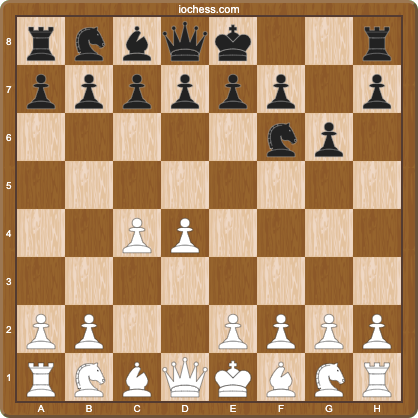
The core move order is 1.d4 Nf6 2.c4 g6, followed by ...Bg7 and ...d6. The Encyclopaedia of Chess Openings assigns E60 to E99 to these lines, covering setups from Classical to Samisch. Black fianchettos the dark-squared bishop, castles quickly, and keeps the center flexible for a later break.
Its key fingerprint is ...d6 rather than an early ...d5. That separates it from the Grunfeld, where Black hits the center immediately with ...d5 and often ...c5. The KID is built on a kingside fianchetto and delayed central tension. Compared with the more positional Nimzo-Indian Defense (also a 1...Nf6 2.c4 e6 system), the KID trades the Nimzo's structural battle on c3 and c4 for a sharper opposite-wings race.
The Hypermodern Philosophy
The KID is a classic expression of hypermodern play: it invites White to build a big center with e4 and d4, then challenges it. Black allows White to occupy the center with pawns, then counters with pieces and timely breaks. That tradeoff yields fast development and active piece play aimed at the d4 and e4 complex.
Black develops smoothly with Nf6, Bg7, and short castling. When central targets are fixed, typical strikes include ...e5 to hit d4 or ...f5 to chip at e4. The best moments often come after White commits with d5.
Why Does the King's Indian Defense Matter?
Fighting for Wins with Black

Games rarely drift into sterile equality. Across master games, White scores somewhat above 50%, but decisive results are common and draw rates tend to run lower than in more classical Black defenses. If you need winning chances with Black, the KID delivers.
These positions are double-edged by design: opposite-side play, contact on e4 and d4, and recurring pawn storms. That risk profile suits event standings where Black must play for a full point.
A Weapon Used by World Champions
Bobby Fischer, Garry Kasparov, Hikaru Nakamura, and Teimour Radjabov all trusted the KID against 1.d4. Their games feature classic motifs, from Fischer's thematic ...f5 breaks to Kasparov's kingside waves in the Mar del Plata. Studying these games gives you ready-made blueprints you can transplant into your own play.
Building Tactical and Strategic Skills
KID positions train key skills: piece maneuvers behind pawn storms, timely breaks like ...c5 and ...e5, and handling opposite-side attacks. Recurring sacrificial themes (a knight or bishop hitting h3, an exchange on e4 to expose the white king, or a rook lift to f6 or g6) appear across many model games, making pattern recognition highly transferable.
How Does the King's Indian Defense Work?
A common setup arises after 1.d4 Nf6 2.c4 g6 3.Nc3 Bg7 4.e4 d6 5.Nf3 O-O. White chooses between space with d5, restraint with Be2 and O-O, or heavy centers with f3. Black completes development, eyes ...e5 or ...c5, and prepares kingside play.
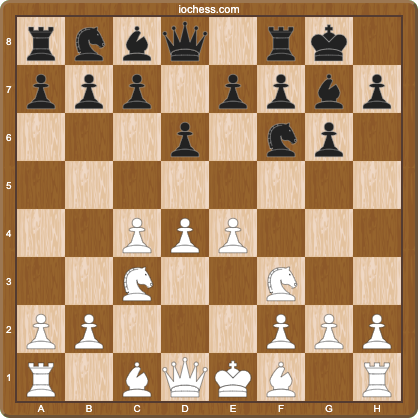
After White plays d5, the structure locks. Black usually answers with ...a5 to slow b4, ...Na6 to c5 to pressure e4, and, crucially, ...f5. If allowed, ...f4, ...g5, and ...h5 to h4 follow, aiming pieces at h2 and the dark squares.
The Race Dynamic
Plans often diverge: White pushes c4 to c5 and b2 to b4 to b5 to crack the queenside; Black drives ...f5 to f4, then ...g5 and ...h5 to attack the king. Tempo matters more than material; a single tempo can decide whether c5 lands before ...f4, or vice versa.
Piece placement mirrors these aims. White routes knights to c4 and d3 to guard e5 and b4, while Black aims for Ne8 to f6 reroutes (or the famous Nf6 to e8 step that clears f-pawn), Qe8 to h5, and rook lifts via Rf7 to g7 or Rf6 to g6.
Key Variations
In the Classical Variation (Be2 and O-O), Black counters with ...e5, ...Nc6, and either ...Ne7 to g6 or ...Na6 to c5, finishing with the thematic ...f5. The Samisch (f3, Be3) clamps e4, so Black hits back with ...c5, ...Nc6, and queenside play. In the Four Pawns Attack (f4), White expands with c4, d4, e4, and f4; Black replies energetically with ...c5, ...e6, and breaks like ...b5 to undermine c4.
Real-World Examples of King's Indian Aggression
The Four Pawns Attack: Challenging White's Center
After 1.d4 Nf6 2.c4 g6 3.Nc3 Bg7 4.e4 d6 5.f4 O-O 6.Nf3 c5 7.d5 e6 8.Be2 exd5 9.cxd5, White's pawns dominate space. Black strikes those targets: 9...b5 undermines c4-equivalent squares and 9...Bg4 pins and pressures e4. Grandmaster practice shows Black's counterplay rolling once the center is fixed and the queenside is opened.
Watch for timely ...Re8, ...Na6 to c7 to b5, and breaks with ...b4 to crack White's center. If White delays kingside safety, sacrifices on e4 often appear.
The Panno Variation: Modern Flexibility
After 1.d4 Nf6 2.c4 g6 3.Nc3 Bg7 4.e4 d6 5.f3 O-O 6.Be3 Nc6 7.Nge2 a6 8.Qd2 Rb8, Black readies ...b5 to meet White's kingside ideas. This plan blunts the Bh6 trade and prepares counterplay on the b- and c-files once ...b5 to b4 opens lines.
Key nuances include ...Na5 to target c4 and ...e5 only after White commits with d5. Panno setups showcase flexible KID play, switching wings when White overextends.
The Mar del Plata Variation: Classic Confrontation
In 1.d4 Nf6 2.c4 g6 3.Nc3 Bg7 4.e4 d6 5.Nf3 O-O 6.Be2 e5 7.O-O Nc6 8.d5 Ne7, the knight steps off c6 to clear the c-pawn and prepare ...f5. Typical piece routes include Nf6 to e8 (or to d7) to clear the f-pawn, Qe8 to h5, and a rook lift to f7 or g6.
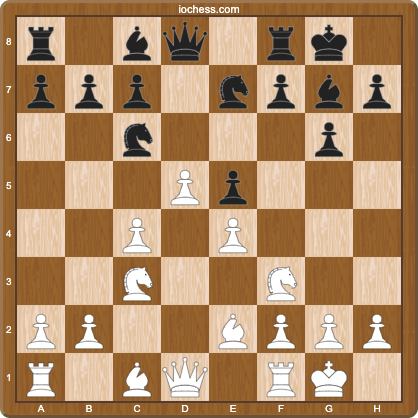
White races queenside play with b4 then c5 and aims knights at c4 and d3. The first successful breakthrough, c5 or ...f4, usually decides where the king falls.
Common Misconceptions About the King's Indian Defense

Misconception 1: It's only about mindless attacking
Effective KID play balances attack and restraint. You must know when to hit with ...f5 and when to slow b4 with ...a5 or prepare ...c6 against c5. The Panno lines prove that queenside counterplay can outscore a rushed kingside assault.
Misconception 2: White always gets a better position
Yes, White often builds a big center. But the KID's imaginative resources (pawn breaks, piece maneuvers, and timely sacrifices) create dynamic compensation. Model games regularly show Black's activity outweighing the structural concession.
Misconception 3: It's too risky for practical play
Results from master games show Black holding a respectable share of points in the KID, comparable to other sound defenses. With knowledge of standard plans and traps, the risk becomes controlled aggression rather than a gamble.
Building the King's Indian Into Your Repertoire
Start with the main tabiyas: Classical (Be2), Samisch (f3, Be3), and Four Pawns (f4). Replay Fischer's and Kasparov's KID wins; many free resources walk through key ideas like ...f5 timing, the Na6 to c5 maneuver, and rook lifts on the f-file.
Use spaced-repetition tools to memorize move orders, typical pawn breaks, and piece routes. Tag your own games by variation, then review critical moments: Was ...e5 or ...c5 best? Did ...a5 stop b4? Which side won the race after d5? Spaced repetition for chess explains how to lock in these patterns.
For the broader picture of how this fits a Black repertoire, see our guide on how to build your first opening repertoire, and to compare the KID with every other major Black defense at your rating, the full Black-side opening guide. If you want a quieter, more positional Indian alternative against 1.d4, the Nimzo-Indian Defense uses the same 1...Nf6 entry but plays for piece pressure on c3 and c4 instead of the KID's wing race. Pair that with a puzzle set focused on KID themes: tactics on h3, exchanges on e4, and sacrificial breaks with ...f4 or ...g5.
Action plan: install the KID in 30 days
- Pick one main system to face (Classical, Samisch, or Four Pawns) and learn 8 to 10 moves of the main line.
- Annotate three classic Mar del Plata wins by Kasparov, Nakamura, or Radjabov, paying attention to the ...f5 trigger and the queenside race.
- Drill 20 puzzles featuring ...f5 and ...Na6 to c5 ideas to lock in pattern recognition.
- Play 10 online games as Black against 1.d4 reaching the KID; tag each by variation.
- Review every game where you lost the race: did ...f4 arrive a tempo late, or did White's c5 break first?
- Add a mini-file on sidelines (Averbakh, Fianchetto, Makogonov) so a surprise move order does not throw you out of book.
Key takeaways
- Core setup: 1.d4 Nf6 2.c4 g6, then ...Bg7, ...d6, and castle before striking with ...e5 or ...f5.
- Expect a race: White attacks the queenside with c5; Black hits the kingside with ...f5 to f4 and ...g5 to h5.
- Use move-order tricks: ...a5 to slow b4, Na6 to c5 to pressure e4, and Qe8 to h5 to target h2.
- Study models: Fischer, Kasparov, and Nakamura games show reliable plans and winning patterns.
- Train patterns: practice exchanges on e4, rook lifts via f7 to g7, and timely breaks with ...c5 or ...b5.
Sources and Further Reading
Last updated: Jul 24, 2026


Comments