
How to Defend Against Scholar's Mate: Beat the 4-Move Checkmate Every Time

Disclosure: ChessAtlas is our product. This guide works with any chess platform; we just happen to build one. Readers should weigh the perspective accordingly.
Scholar's Mate, the classic 4-move checkmate, ends games by hitting f7 with a queen and bishop battery. The pattern you need to recognize: 1.e4 e5 2.Bc4 aiming at f7, then Qh5 (or Qf3 later) threatening Qxf7#. At the beginner level this still catches many players in online play. Good news: three correct moves shut it down, and leave White's queen so exposed that you often end up winning from the attempt.
The three defensive moves are ...Nc6, then ...g6 or ...Qe7, then ...Nf6. Learn them once, drill them for 10 minutes, and Scholar's Mate becomes a free win for you for the rest of your chess life.
The Actual Mate Pattern
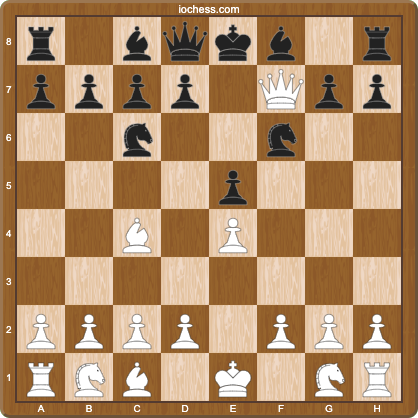
The setup is simple: White gets a queen and bishop aimed at f7, which is defended only by Black's king. If Black develops the knight to f6 (which feels natural), it does not stop the attack because the bishop on c4 still supports the queen on f7. The queen captures f7 with check, the king cannot capture (the bishop defends), and the king has no escape square. Checkmate.
The 3-Move Defense That Always Works
Move 1: After 2.Bc4, play 2...Nc6 (not 2...Nf6)
The key is ORDER. Never play ...Nf6 before neutralizing the f7 threat. Play 2...Nc6 first. This develops a piece and, crucially, defends the e5 pawn against future Qxe5+ tricks.
If instead you played 2...g6?? (hoping to preempt the queen sortie), White plays 3.Qh5! threatening Qxe5+ - winning the e5 pawn with check and a fork on the rook on h8. Avoid ...g6 before ...Nc6.
Move 2: After 3.Qh5, play 3...g6 (or 3...Qe7)
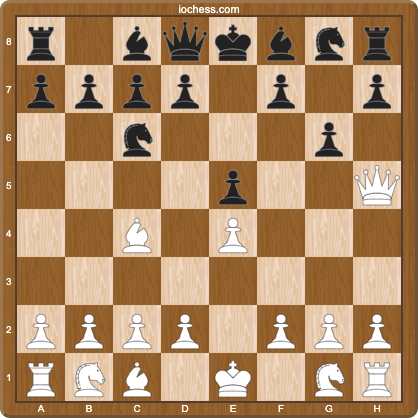
Option A, 3...g6 (most common): attacks the queen with the pawn, forces White to move the queen again, and blocks the bishop's diagonal toward f7. Solid, active, and prepares ...Bg7 for the dark-squared bishop.
Option B, 3...Qe7 (the direct defense): your queen defends both e5 and f7 in one move. The tradeoff is a temporarily blocked bishop on f8, but the position is fully defensible and Black has developed both knights shortly after.
Move 3: After 4.Qf3 (or similar), play ...Nf6
Now the knight develops to f6 and defends f7 from this side. The threat is completely extinguished. You have developed two pieces (Nc6 and Nf6), gained a tempo (White's queen had to move around), and are ready to castle. White has moved the queen three times and developed nothing else.
Why the ...Nd4 Trap Loses
A tempting but wrong idea: after 1.e4 e5 2.Bc4 Nc6 3.Qh5 g6 4.Qf3, instead of 4...Nf6, Black plays 4...Nd4?? hoping to attack the queen on f3 AND threaten ...Nxc2+ forking the king on e1 and the rook on a1. This loses to 5.Qxf7# because you never defended f7. The knight on d4 does not defend f7, and the bishop on c4 still supports the queen's capture.
The same lesson applies to other tempting counter-attacks: 4...Bc5?? develops the bishop but again ignores f7 and runs into 5.Qxf7# when White's queen sits on f3. Until f7 is defended (with ...Nf6 after the queen retreats, or with ...Qe7 earlier), every Black move that ignores it is a potential losing blunder. Defend first, attack later.
Punishing White for the Attempt
Once the immediate threat is contained, take the initiative. White has moved the queen 2 to 3 times and developed almost nothing. Your moves should exploit that.
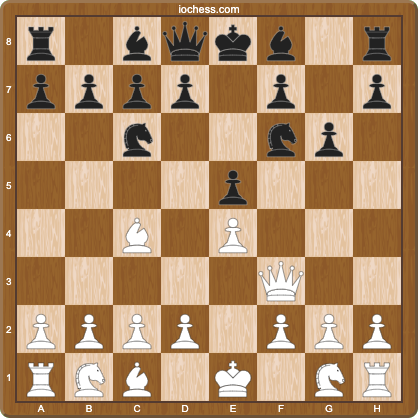
- ...Nd4 (only after Nf6 has covered f7) attacks the queen on f3 and threatens ...Nxc2+, which would fork White's king and the rook on a1. White must move the queen or block with a piece, losing more time.
- ...d5! is often strong because it hits both e4 and the Bc4. If White captures 5.exd5, Black plays ...Nxd5 with great central control.
- ...Bg7 completes the kingside fianchetto (after ...g6) and pressures the long diagonal.
- Short castle by move 6 or 7, then coordinate rooks on the e and d files.
The Longer-Term Prevention: Pick a Defense that Avoids This Pattern
If you want to bypass Scholar's Mate concerns entirely, play a defense that does not go 1...e5. The Caro-Kann (1...c6) and the French Defense (1...e6) both close the c4-f7 diagonal with an early pawn move, making the battery harmless. The Sicilian (1...c5) avoids the pattern for a different reason: White's e-pawn never gets uncontested, and the queen sortie costs too much tempo to be worth attempting.
See the 5 best openings for beginners for rating-appropriate picks. Once you have beaten Scholar's Mate and want to choose a 1.e4 e5 weapon for White, see Italian Game vs Ruy Lopez.
Common Mistakes
Playing ...g6 before defending e5
Playing 2...g6?? or 3...g6 (before ...Nc6) allows Qxe5+ winning the e5 pawn and then picking up the rook on h8 after the exchange. Always play ...Nc6 first.
Playing ...Nf6 before dealing with the battery
After 1.e4 e5 2.Qh5 Nc6 3.Bc4 Nf6?? (this move-order variant is the Wayward Queen Attack, also called the Parham Attack) White mates immediately with 4.Qxf7#. Knights on f6 do not defend f7 against a queen+bishop battery. Defend f7 first (with ...g6 or ...Qe7), then develop the knight.
Over-defensive passive play
Surviving the first wave but then making shuffling moves gives White time to develop. After the queen retreats, play actively: ...d5, ...Nd4, castle, coordinate rooks. The time-wasted queen excursion is your practical advantage; use it.
At What Rating Does Scholar's Mate Disappear?
Scholar's Mate attempts drop off sharply once Black players learn the three defensive moves, and the trap becomes rare in rated club play above the beginner level. The Fried Liver Attack is a different and much more dangerous early attack on f7 that persists to higher rating bands; it arises from the Italian Game (after 1.e4 e5 2.Nf3 Nc6 3.Bc4 Nf6 4.Ng5 d5 5.exd5 Nxd5?) and continues to claim victims well into the 1500s. See 7 common opening mistakes that cost you games for the next traps to learn and the strategic side of early-game errors.
Drill the Three Lines Today
Set up a board (physical or any online analysis board) and play through these three sequences three times each:
- 1.e4 e5 2.Bc4 Nc6 3.Qh5 g6 4.Qf3 Nf6 (the mainline defense)
- 1.e4 e5 2.Bc4 Nc6 3.Qh5 Qe7 4.Nf3 Nf6 (the direct queen-defense)
- 1.e4 e5 2.Qh5 Nc6 3.Bc4 g6 4.Qf3 Nf6 (move-order variant, same defense)
Ten minutes is enough. After that, the pattern lives in your memory and Scholar's Mate never catches you again. To make the lines stick for the long term, see our complete FSRS guide for chess openings.
What You Have Achieved
By the end of this 10-minute drill you can: (1) recognize the queen and bishop battery on the c4-f7 diagonal as soon as it appears, (2) play ...Nc6 and then ...g6 (or ...Qe7) and then ...Nf6 automatically without thinking, and (3) immediately switch from defense to counter-attack once the queen retreats, exploiting White's lost tempo with ...d5, ...Nd4, and quick castling. That covers Scholar's Mate, the Wayward Queen Attack / Parham (1.e4 e5 2.Qh5), and the most common move-order tricks beginners try at the same time.
Next Steps
Once Scholar's Mate is solved, the next priority is a full opening repertoire so you reach middlegames you understand. See our beginner's guide to building your first repertoire, 7 common opening mistakes that cost you games, and the 2026 tools landscape in 7 Best Chess Opening Repertoire Tools in 2026. Or create a free ChessAtlas account and drill your opening lines with automatic spaced repetition from day one.
Sources and Further Reading
- Scholar's mate (Wikipedia)
- Fried Liver Attack (Wikipedia)
- Caro-Kann Defence (Wikipedia)
Last updated: Jul 24, 2026


Comments