
Best Chess Openings for Beginners (5 Systems)

The best chess opening for a beginner is one you can understand and use immediately, not one that requires memorizing 20 moves of theory. This guide covers 5 simple opening systems that teach correct principles and stay effective as you improve past your first 100 games. Already at club level? See Best Chess Openings for Club Players (1200-1800).
Disclosure: This article is published by ChessAtlas, our own chess training app. We have aimed to keep the opening recommendations objective and grounded in standard chess principles.
TL;DR, Quick Picks:
- Italian Game (White): clear plans, tactical bite on f7, stays effective past 1500
- London System (White): same setup every game, nearly zero theory
- 1...e5 (Black vs 1.e4): open positions, teaches principles fastest
- Caro-Kann (Black vs 1.e4): solid, active bishop on f5, low theory
- Queen's Gambit Declined (Black vs 1.d4): reliable, clear structural plans
What Makes an Opening Good for Beginners?
As Wikipedia's overview of opening principles sets out, sound opening play rests on center control, rapid development, and king safety. A good beginner opening makes those three principles easy to follow:
- Clear plans: You can explain in one sentence what you are trying to achieve after the opening.
- Low theory: You can play well by following principles rather than memorizing long forced sequences.
- Open, instructive positions: Open positions produce frequent tactics, which is how beginners build pattern recognition.
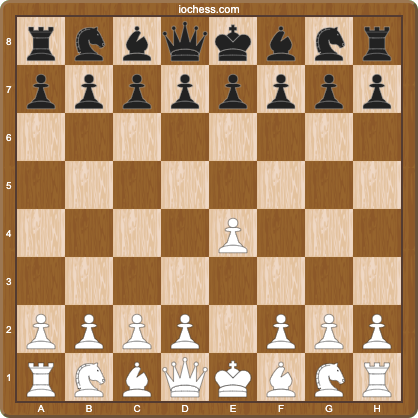
1. The Italian Game (White), A Strong All-Round Beginner Opening
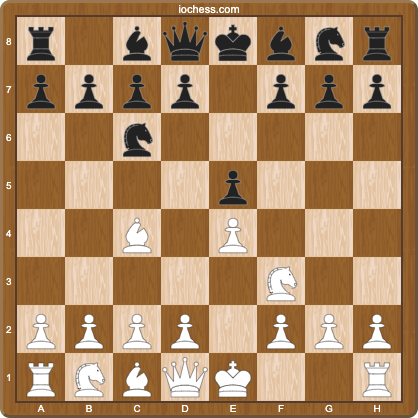
Moves: 1.e4 e5 2.Nf3 Nc6 3.Bc4
The plan in one sentence: Develop quickly, castle kingside, then break with d4 to open the position and use your space advantage.
Per Wikipedia's Italian Game article, this is one of the oldest recorded openings, with analysis dating to the 16th century. Every move follows a principle: 1.e4 controls the center, 2.Nf3 develops the knight and attacks e5, 3.Bc4 develops the bishop and targets f7, the weakest square in Black's early position. You can play it well by simply completing development and castling, without deep memorization.
What to know: After 3...Bc5, play 4.c3 and 5.d4 to challenge the center. After 3...Nf6 (the Two Knights), play 4.d3 for a solid game or 4.Ng5 for sharp complications if you want tactics.
For a full breakdown: Italian Game vs Ruy Lopez: Which Should You Play?
2. The London System (White), A Low-Maintenance Opening
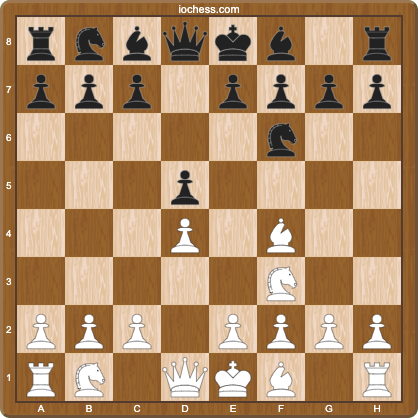
Moves: 1.d4 followed by Nf3, Bf4, e3, Bd3, and O-O
The plan in one sentence: Build a solid setup with the same piece placement every game, then use your stable structure to outplay opponents positionally.
As Wikipedia's London System article explains, it is a system opening in which White aims for the same structure against almost any Black response. That keeps the theory load very low: learn the setup once and it applies whether Black plays the King's Indian, Slav, Queen's Gambit Declined, or Dutch. It suits players with limited study time.
What to know: Play Nf3 before Bf4, if you develop the bishop too early, Black can attack it with ...Qb6. The correct order is 1.d4 d5 2.Nf3 Nf6 3.Bf4.
Full guide: The London System: The Perfect Low-Maintenance Opening.
3. Open Games with 1...e5 (Black), A Natural Beginner Defense Against 1.e4
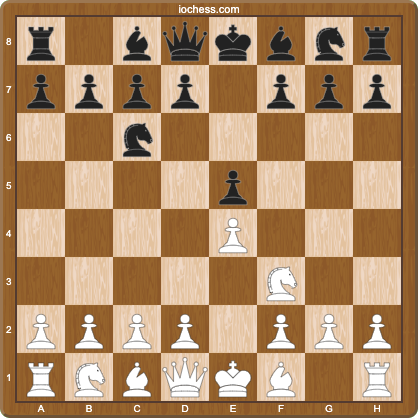
Moves: Respond to 1.e4 with 1...e5, then develop with ...Nc6, ...Nf6, and castle.
The plan in one sentence: Mirror White's center, develop all pieces quickly, castle kingside, and play for active piece activity in an open game.
According to Wikipedia's Open Game article, answering 1.e4 with 1...e5 defines the Open Games, the long-standing group of double king-pawn openings. These positions put the four core skills directly in front of you: fighting for the center, developing efficiently, recognizing tactics, and handling open files and diagonals.
What to know: Watch out for the Scholar's Mate attempt: 2.Bc4 Nc6 3.Qh5. The fix is simple, play 3...g6 4.Qf3 Nf6, which develops the knight to f6 and stops Qxf7. Never panic when you see the queen come out early.
4. The Caro-Kann Defense (Black), A Solid Beginner Defense Against 1.e4
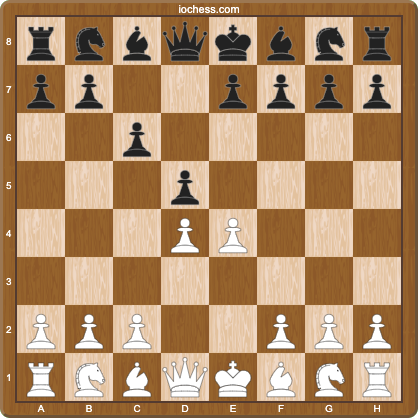
Moves: 1.e4 c6, then 2...d5 on the next move.
The plan in one sentence: Establish a solid center with ...d5, develop the c8 bishop early with ...Bf5, then castle and look for the central break ...c5.
As Wikipedia's Caro-Kann Defence article notes, the opening gives Black a clear, structural game. Unlike the French Defense, where the c8 bishop gets shut behind the pawn chain, the Caro-Kann develops that bishop early with ...Bf5. The result is a sound, active position without sharp memorized lines.
What to know: After 3.Nc3 dxe4 4.Nxe4, play 4...Bf5 immediately, the key move that defines the Classical variation. For full plans: The Caro-Kann Defense Guide.
5. The Queen's Gambit Declined (Black), A Reliable Defense Against 1.d4
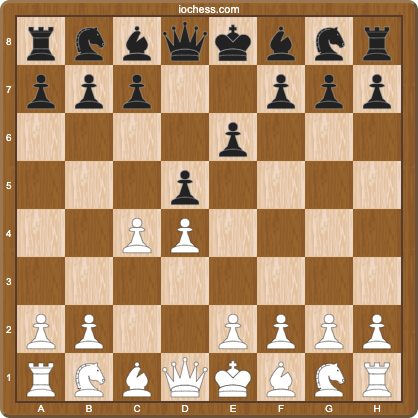
Moves: 1.d4 d5 2.c4 e6
The plan in one sentence: Maintain the center with ...d5, develop naturally with ...Nf6, ...Be7, and castle, then look for the breaks ...c5 or ...e5 when ready.
Against 1.d4, the Queen's Gambit Declined is one of the oldest and most respected defenses. As Wikipedia's Queen's Gambit Declined article records, it has appeared in World Championship play for over a century. The position stays closed long enough to develop properly, the structure is easy to read, and the plans are clear.
What to know: After 3.Nc3 Nf6 4.Bg5, play 4...Be7, solid and natural. This is the Orthodox Defense, the most popular main line. Full guide: The Queen's Gambit: A Complete Guide.
Opening Principles Come First
Before memorizing any of these lines, internalize the core opening principles that underpin all of them:
- Control the center with pawns (e4, d4 for White; ...e5, ...d5 for Black)
- Develop all minor pieces, knights and bishops, within the first 8-10 moves
- Castle by move 10 in most positions to protect your king
- Don't move the same piece twice in the opening unless there is a concrete reason
- Don't bring the queen out early, it will be chased and you'll lose tempos
These principles solve the majority of beginner opening problems before you ever consult theory. For mistakes to avoid: 7 Common Opening Mistakes That Cost You Games.
How to Practice These Openings
- Learn one system at a time. Pick one White opening and one Black defense against 1.e4. Add the 1.d4 defense only after you're comfortable with the first two.
- Play 20-30 rapid games with each opening before studying more theory. Real games reveal what you actually need to know.
- Use spaced repetition to lock in the key positions. ChessAtlas lets you build a small repertoire and schedule daily 10-minute reviews, free to start.
- Review your games. After each game, check the first 10 moves. Find the first moment you felt uncertain, that is exactly what to add to your study deck.
For a step-by-step path, see our beginner's guide to building a first repertoire, the pillar guide on making your repertoire stick, and how deep to learn your openings by rating.
Key Takeaways
- Italian Game, a strong White opening for beginners: clear plans, tactical positions, very low theory requirement
- London System, useful if you prefer 1.d4: same setup every game, minimal memorization
- 1...e5 against 1.e4, a natural beginner Black response: teaches principles through open, direct positions
- Caro-Kann, a solid beginner defense: sound structure, early bishop development, no sharp theory
- Queen's Gambit Declined, a reliable answer to 1.d4: clear plans, hard to go badly wrong
Start with one opening from this list. Play 20 games with it, then add one more. Expand based on what opponents actually throw at you. Within a few months, these systems will feel automatic and you'll be ready for more complex theory.
Sources and Further Reading
- Chess opening on Wikipedia explains the opening principles (center control, development, king safety) that underpin every system in this guide.
- Italian Game on Wikipedia details the 1.e4 e5 2.Nf3 Nc6 3.Bc4 lines recommended for White.
- Caro-Kann Defence on Wikipedia covers the solid 1...c6 structure suggested for Black against 1.e4.
Last updated: Jul 24, 2026


Comments