
The English Opening: A Complete Guide to 1.c4 for Strategic Players

Disclosure: ChessAtlas is our product. This is a White-perspective guide to the English Opening; it works with any platform. Readers should weigh the perspective accordingly.
The English Opening (1.c4) is a hypermodern system that controls d5 from the flank without committing the d- and e-pawns yet. It is named after Howard Staunton, who adopted it in his matches of the 1840s (Wikipedia). The English offers rich strategic play, frequent transpositions to Queen's Gambit and Indian structures, and a lighter theoretical burden than 1.e4. World champions including Botvinnik, Kasparov, and Carlsen have all employed it at the highest level (Wikipedia).
If you want to play White with clear strategic plans but prefer to avoid the heavy theory of the Sicilian, 1.c4 is a clean choice.
The Core Idea
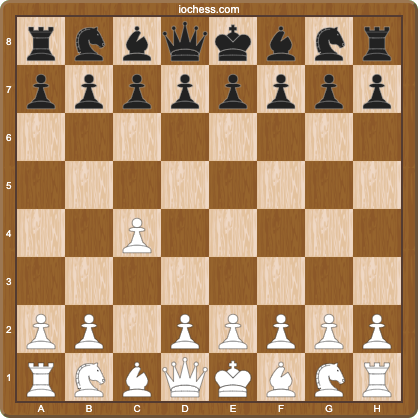
White's strategy is to restrain Black's ...d5 with pieces (Nc3 plus a Bg2 fianchetto), then break at the right moment with d4 or occasionally f4. Because White chose the move order, the English often transposes into Queen's Gambit Declined, Catalan, or Indian structures, but on favorable terms. This flexibility is a large part of why the opening has stayed popular at every level of play for well over a century.
Black's Three Main Responses
1...e5: The Reversed Sicilian
Main line: 1.c4 e5 2.Nc3 Nf6 3.g3 d5 (or 3...Bb4) 4.cxd5 Nxd5 5.Bg2 with a position that mirrors the Sicilian with colors reversed, White has the extra tempo. Plans include Nf3, O-O, d3, a3, Rb1, b4 queenside expansion.
Black players who use the Sicilian themselves often find the Reversed Sicilian familiar but one tempo down. That extra tempo for White is typically enough to claim a small edge.
1...c5: Symmetrical English
Main line: 1.c4 c5 2.Nc3 Nc6 3.g3 g6 4.Bg2 Bg7 5.Nf3 (or 5.e3) with a symmetric maneuvering game. White can break the symmetry at any moment with d4, transposing to a Maroczy Bind structure (pawns on c4 and e4).
Requires patient positional play. Small advantages convert only in the middlegame or endgame.
1...Nf6: Flexible / Transpositional
Main line: 1.c4 Nf6 2.Nc3 e6 (or 2...g6 aiming for KID structures) 3.Nf3 d5 4.d4 transposing into QGD territory. White can also play 3.g3 to steer into Catalan-like positions without allowing the Nimzo-Indian.
The 1.c4 move order denies Black the Nimzo-Indian (because Nc3 + e2-e4 can come before Black plays ...Bb4). This is one reason many strong players prefer 1.c4 over 1.d4: they skip Nimzo theory entirely.
Key Strategic Structures
- Botvinnik System: c4+d3+e4+Nc3+Nge2+g3+Bg2. A universal system against many Black setups, named after world champion Mikhail Botvinnik, who used it against a range of Black defenses. The fixed pawn chain gives White a clear long-term plan of kingside expansion.
- Maroczy Bind: pawns on c4 and e4, a classic restraining formation against ...c5 and ...g6 setups. It constrains Black's counterplay and keeps the c5 break under firm control.
- Catalan transposition: 1.c4 Nf6 2.Nc3 e6 3.Nf3 d5 4.g3 leads to Catalan structures without allowing the sharp 1.d4 Nf6 2.c4 e6 3.Nc3 Bb4 Nimzo.
- Hedgehog: Black builds a cramped but flexible setup with pawns on a6, b6, d6, e6. White probes with a4, d4-d5 breaks, and kingside aggression.
Historical Games Worth Studying
Botvinnik's championship career: Mikhail Botvinnik used 1.c4 throughout his time as world champion, especially against hypermodern defenses (Wikipedia). His games are the classic model of the Botvinnik System in action.
Fischer vs Spassky 1972 Game 6: one of the most celebrated games in chess history. Fischer opened 1.c4 and the game transposed into a Queen's Gambit Declined after 1.c4 e6 2.Nf3 d5 3.d4 Nf6 4.Nc3 Be7 5.Bg5 O-O 6.e3. Fischer won decisively (Wikipedia). The game shows how 1.c4 gives White transpositional flexibility even when the final structure is a standard QGD.
Modern elite practice: 1.c4 remains a regular part of top-level repertoires, valued for steering games away from an opponent's most heavily prepared 1.e4 and 1.d4 lines (Wikipedia).
Why Players Choose the English
- Avoids specific Black defenses, no Nimzo-Indian, no Grünfeld, no Sicilian via move-order tricks
- Low forcing theory, most games reward understanding over memorization
- Transpositional flexibility, can reach QGD, Catalan, Maroczy structures on your terms
- Elite track record, used by world champions from Botvinnik to Carlsen
Common Mistakes
Rushing d4 without preparation
Playing d4 too early (before completing fianchetto and knight development) can allow Black to equalize via ...d5 with tempo. Build up first: Nc3, Nf3, g3, Bg2, O-O, then evaluate the d4 or e4 break.
Playing the English like the Italian
1.c4 is strategic and patient, not tactical. Players who try to attack immediately with an early c4+e4 without Nc3+Bg2 structure often end up with loose pieces and no real plan.
Ignoring Black's ...d5 break
...d5 is Black's liberating move. White must either prevent it with Nc3 + early c4 pressure, allow it and play cxd5 with a slight space edge, or accept a transposition to QGD-like structures. Ignoring the break entirely lets Black equalize.
Rating-Specific Advice
- Under 1600: if you play 1.d4, the English is an optional second weapon. If you play 1.e4, consider switching entirely, the English requires less theory.
- 1600 to 2000: learn the Botvinnik System and the Symmetrical main line. 10 to 15 tabiyas cover most games.
- 2000+: add the Hedgehog defense coverage and the Catalan transposition. Study recent elite practice.
Related Articles
- Queen's Gambit complete guide, what the English often transposes into
- Nimzo-Indian Defense, the defense you avoid by playing 1.c4 instead of 1.d4
- How to Build a Chess Opening Repertoire That Actually Sticks, the broader framework
- How deep to study by rating
Your Micro-Action Today
Pick one Black defense to prepare against: 1...e5 (Reversed Sicilian) OR 1...c5 (Symmetrical). Write the first 10 moves of the main line. Play through a master game in that line. Drill tomorrow. Next week, add the other defense.
Or create a free ChessAtlas account and drill your English Opening repertoire with automatic FSRS scheduling.
Sources and Further Reading
Last updated: Jun 5, 2026


Comments