
The Scotch Game: A Dynamic Alternative to the Italian and Ruy Lopez

Disclosure: ChessAtlas is our product. This is a White-perspective guide to the Scotch Game; it works with any platform. Readers should weigh the perspective accordingly.
The Scotch Game (1.e4 e5 2.Nf3 Nc6 3.d4) opens the center immediately and forces concrete decisions from both sides. Garry Kasparov revived it at World Championship level against Anatoly Karpov in 1990 and continued using it through the 1990s (Wikipedia). For players who prefer not to memorize the deep theory of the Ruy Lopez, the Scotch offers sharper, more tactical positions with a lighter preparation burden.
For full variations and traps, see our Scotch Game landing page.
Why Play the Scotch?
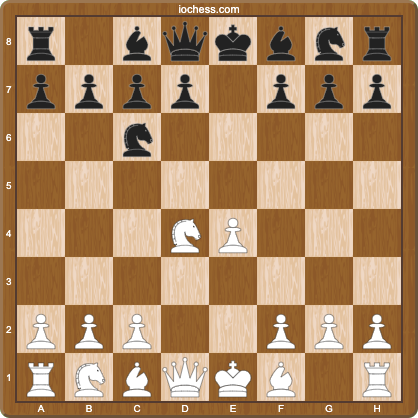
Three practical reasons the Scotch is attractive at club level:
- Less theory than the Ruy Lopez. You do not need to master Berlin endgames, Marshall counterattacks, and the many subsystems of the Closed Spanish. The Scotch covers fewer branches with clearer ideas.
- Open positions that reward calculation. The early d-pawn trade clears the center and puts both sides' pieces on the most active squares quickly.
- Top-level validation. Kasparov's use at the 1990 World Championship demonstrated that the Scotch is viable at elite level.
Main Variations
4...Nf6 (Schmidt Variation)
Main line: 1.e4 e5 2.Nf3 Nc6 3.d4 exd4 4.Nxd4 Nf6 5.Nxc6 bxc6 6.e5 Qe7 7.Qe2 Nd5 8.c4 Ba6 and both sides have clear plans. White has the better structure and piece mobility; Black has the bishop pair. This is the variation Kasparov revived in 1990.
Key idea for White: the e5 push on move 6 creates a structural imbalance that suits dynamic play. Black's doubled c-pawns are long-term weaknesses.
4...Bc5 (Classical)
Main line: 1.e4 e5 2.Nf3 Nc6 3.d4 exd4 4.Nxd4 Bc5 5.Be3 Qf6 6.c3 Nge7 7.Qd2 and White aims for the familiar Nxc6 and Nc3-Nd5 maneuvering. Simpler than the Schmidt, fewer theoretical requirements.
Scotch Gambit (4.Bc4)
Main line: 1.e4 e5 2.Nf3 Nc6 3.d4 exd4 4.Bc4 (instead of 4.Nxd4). White sacrifices the d-pawn for development and open lines. After 4...Bc5 5.c3 Nf6 6.cxd4 Bb4+ 7.Bd2, White plays for attack with O-O and Re1.
Sharp, visually impressive. With careful play Black can equalize, but at club level the Scotch Gambit scores well because Black players often do not know the correct defensive sequences.
Göring Gambit (4.c3)
Main line: 1.e4 e5 2.Nf3 Nc6 3.d4 exd4 4.c3 (instead of 4.Nxd4). White sacrifices another pawn for even faster development. After 4...dxc3 5.Nxc3, White has two pawns less and substantial piece activity.
A romantic gambit. Use as a surprise weapon in blitz; not recommended as a main repertoire above 1800.
How the Scotch Compares
| Opening | Style | Theory load | Best for |
|---|---|---|---|
| Italian Game (3.Bc4) | Slow, positional | Moderate | Under 2000 |
| Ruy Lopez (3.Bb5) | Strategic, deep | Heavy | 2000+ with study time |
| Scotch Game (3.d4) | Open, tactical | Light | 1400 to 2200 |
| Scotch Gambit (4.Bc4) | Sharp, attacking | Light | Tactical players |
The Scotch is the "easy button" for 1.e4 e5 players: enough theory to have a serious opening, not enough to drown in it.
Historical Context
The Scotch was a staple of 19th-century romantic chess, and it takes its name from the Scotland-England correspondence match of 1824-1828 (Wikipedia). It declined in the early 20th century as players preferred the Ruy Lopez's deeper strategic content. Kasparov's revival in his 1990 World Championship match against Karpov renewed elite interest (Wikipedia). Since then, the Scotch has appeared regularly in super-grandmaster practice, typically as a surprise weapon or when the player wants to avoid Berlin and Marshall theory in the Ruy Lopez.
Common White Mistakes
Not committing to the structural imbalance in the Schmidt
After 5.Nxc6 bxc6 6.e5, some players fear the Black bishop pair and retreat passively. The correct plan is aggressive: Qe2, Nc3, O-O-O or O-O depending on circumstances, and play actively against the doubled c-pawns. The structure favors you if you press.
Playing the Scotch Gambit without preparation
The Scotch Gambit requires knowing the exact refutations to Black's drawing tries (4...Nf6 5.e5 d5 6.Bb5). Without preparation, Black equalizes easily. Either commit to the gambit theory or stick to 4.Nxd4 mainline Scotch.
Retreating the knight passively
After 4.Nxd4, many players retreat Nf3 or Nb3 when attacked. Usually the right move is Nxc6 (clarifying the structure) or a central regrouping. Returning the knight to passive squares concedes White's opening advantage.
Rating-Specific Advice
- Under 1400: Play the Scotch Gambit (4.Bc4). Attack-oriented, low theory, wins many games on tactics alone.
- 1400 to 1800: Scotch Classical (4.Nxd4 + 5.Be3 structure). Clear plans, moderate theory.
- 1800 to 2200: Add the Schmidt Variation mainline (5.Nxc6). Learn Kasparov's games for the 6.e5 plans.
- 2200+: Full Scotch theory plus the Göring Gambit as a backup surprise weapon.
Related Articles
- Italian Game vs Ruy Lopez: which to play, the other 1.e4 e5 choices
- Italian Game landing page
- Ruy Lopez landing page
- How to Build a Chess Opening Repertoire That Actually Sticks
- How deep to study by rating
Your Micro-Action Today
Pick one Scotch variation based on your rating. Write the first 10 moves of the main line. Play through a Kasparov Scotch game from 1990 to 1995 from a collection of master games. Drill tomorrow.
Or create a free ChessAtlas account and drill your Scotch lines with FSRS spaced repetition.
Sources and Further Reading
Last updated: Jun 13, 2026


Comments