
The Queen's Gambit: A Complete Guide to 1.d4 d5 2.c4

Learn the Queen's Gambit with spaced repetition
Practice every line - Accepted, Declined, Exchange, Tarrasch - in our repertoire builder, with FSRS spaced repetition so the lines stick.
This guide covers the chess opening Queen's Gambit (1.d4 d5 2.c4), not the 2020 Netflix series of the same name.
1.d4 d5 2.c4 has shaped elite play for centuries. According to the documented history of the Queen's Gambit, the move sequence appears in the Göttingen manuscript of around 1500 and was later refined by world champions such as Capablanca, Karpov, and Kasparov. This guide shows the key ideas, move orders, and traps. For a complete-repertoire view, see how to build your first repertoire, and for Black's major 1.d4 replies, see the best response to 1.d4 by rating.
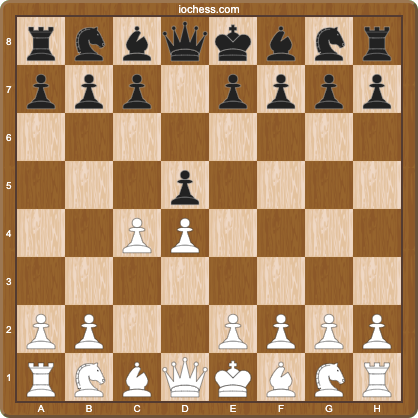
Origins and Main Variations
The opening starts 1.d4 d5 2.c4, where White challenges the d5-pawn. Despite the name, it is rarely a real pawn sacrifice. After 2...dxc4, White typically plays 3.Nf3 and 4.e3, regaining the pawn with Bxc4. Black can try to hold with ...b5 and ...a6, but that costs time and leaves weaknesses. It is grouped with the closed openings in the standard ECO-based classification.
Two main paths define the opening:
- Queen's Gambit Declined (QGD): 2...e6 or 2...c6, leading to Orthodox, Tartakower, and Exchange lines, covered on our Queen's Gambit Declined page
- Queen's Gambit Accepted (QGA): 2...dxc4, giving Black a temporary pawn and freer light-squared bishop, with full plans on our Queen's Gambit Accepted page
Why the Queen's Gambit Matters
It offers White concrete, repeatable plans rather than memorized tricks, which is one reason it has been a mainstay of World Chess Championship practice. In the Exchange Variation, cxd5 exd5 sets up the minority attack with b4 and b5 targeting c6. In the Accepted, White develops with Bxc4, castles fast, and pushes e4 or d5. If you're weighing it against White's other first moves (Italian, Ruy Lopez, Scotch, London), our complete White-side decision tree places it in context by rating band.
The Queen's Gambit is a gateway to core positional themes: isolated queen's pawns in Tarrasch lines, hanging pawns in Orthodox and Tartakower setups, and the minority attack in Exchange structures. The minority attack, in which White advances the b-pawn to fix a weakness on c6, is defined as a distinct strategic method, and it recurs across many openings, making study time pay off broadly.
How Does the Queen's Gambit Work?
The Queen's Gambit Accepted: 2...dxc4
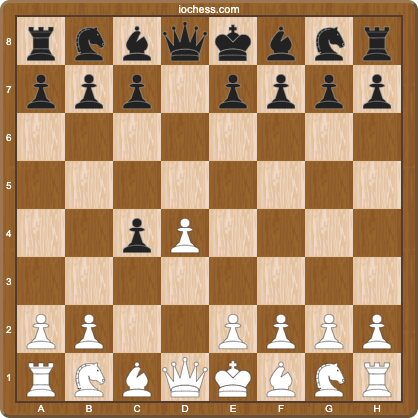
After 1.d4 d5 2.c4 dxc4 3.Nf3 Nf6 4.e3 e6 5.Bxc4, White has regained the pawn with a development lead. The documented main line of the Accepted follows this same path. Black should coordinate ...Nf6, ...e6, and ...c5, and be ready for White's e4 or d5 breaks. A well-timed ...c5 trades off White's central space, while ...b5 must be timed to avoid Qa4+ forks. The full lines are on our Queen's Gambit Accepted page.
Pawn-grab trap: After 2...dxc4, if Black tries to hold the pawn with 3...b5 4.a4 c6 5.axb5 cxb5, White plays 6.Nc3 and Black cannot keep the extra pawn without serious weaknesses.
The Queen's Gambit Declined: 2...e6
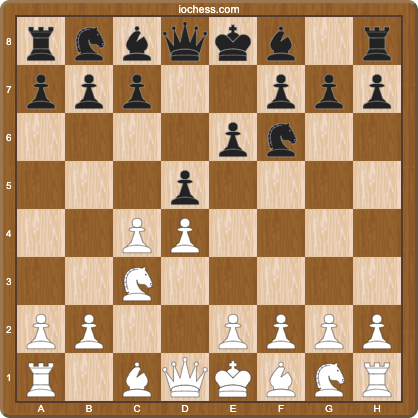
Declining with 2...e6 maintains a central foothold but concedes some space. The main line continues 3.Nc3 Nf6 4.Nf3 Be7 5.Bg5 (the Classical variation), where White pins the f6 knight. Black develops with ...O-O, ...Nbd7, and must handle White's minority attack or central pressure in Bg5 systems. These lines are detailed on our Queen's Gambit Declined page.
Key Black defenses within the QGD:
- Orthodox Defense: ...Be7, ...O-O, ...Nbd7 (solid and reliable)
- Tartakower/Makogonov/Bondarevsky: ...h6, ...O-O, ...b6, ...Bb7 (fianchettoing the queen's bishop for long-diagonal pressure)
- Cambridge Springs: ...Nbd7 then ...Qa5 (active queen play pinning along the a5-e1 diagonal)
- Lasker Defense: ...Ne4 Bxe7 Qxe7 (easing Black's position by trading the dark-squared bishops and a pair of knights)
The Exchange Variation: cxd5 exd5
After 1.d4 d5 2.c4 e6 3.Nc3 Nf6 4.cxd5 exd5, we reach the Carlsbad structure. White's famous minority attack: play b4, b5, bxc6 to create a weak pawn on c6. Black counters with kingside activity, typically ...f6 and ...e5, or a rook lift with ...Re8-e6. Petrosian's matches with Spassky showcased the minority attack and remain a study model today (see Tigran Petrosian's match record).
The Tarrasch Defense: 2...e6 3.Nc3 c5
The Tarrasch Defense (1.d4 d5 2.c4 e6 3.Nc3 c5) leads to an IQP (Isolated Queen Pawn) structure after 4.cxd5 exd5 5.Nf3 Nc6 6.g3. Black gets active central pressure while White blockades the d5 pawn and aims to convert a favorable endgame.
Sidelines: Chigorin, Baltic, and Albin
Black also has offbeat but serious tries that sidestep the heavily analyzed main lines. Each shifts the pawn structure early and rewards specific preparation, so they work best when you have studied the resulting middlegame in advance:
- Chigorin Defense (2...Nc6): pressures d4 and accepts doubled pawns for piece activity; White plays 3.Nf3 and aims for f3-f4-e4 central breaks
- Baltic Defense (2...Bf5): develops the c8-bishop before ...e6 so it never gets locked in; ambitious but slightly risky after 3.cxd5 Bxb1 lines that hand White the bishop pair
- Albin Counter-Gambit (2...e5): fights for space with 3.dxe5 d4, where Black's advanced d-pawn can cramp White, or fall, depending on precise play
Common Traps in the Queen's Gambit
Trap 1, Elephant Trap (QGD). After 1.d4 d5 2.c4 e6 3.Nc3 Nf6 4.Bg5 Nbd7, a greedy White playing 5.cxd5 exd5 6.Nxd5?? runs into 6...Nxd5! 7.Bxd8 Bb4+ 8.Qd2 Bxd2+ 9.Kxd2 Kxd8, and Black emerges a piece up. This documented opening trap (the Elephant Trap) is why White plays 6.e3 or 6.Bxf6 instead.
Trap 2, QGA development trap. After 1.d4 d5 2.c4 dxc4 3.e3 b5?, holding the pawn backfires to 4.a4 c6 5.axb5 cxb5 6.Qf3!, hitting a8 and b5 at once. The correct move is 3...e5 or 3...Nf6, not a premature pawn grab.
Trap 3, Noah's Ark-style motif in QGA. After 1.d4 d5 2.c4 dxc4 3.Nf3 Nf6 4.e3 e6 5.Bxc4 c5 6.O-O a6 7.Qe2 b5 8.Bb3 Bb7 9.Rd1 Nbd7 10.Nc3 Qb8?!, the Bb7 can get stuck behind its own pawn wall when White strikes with 11.d5!?. The motif is classic: a bishop trapped by the very pawns meant to support it. Watch the diagonal traffic when both sides lock pawns on c5/d4/e6/b5.
Beyond the Queen's Gambit: Black's Other 1.d4 Choices
Black can avoid the Queen's Gambit entirely with 1...Nf6, leading to Indian Defenses that overlap this landscape via transposition. These setups change the structure and flavor of the game while keeping many of the same break points. For a broader map by rating band, see the best response to 1.d4 by rating:
- Nimzo-Indian Defense (1.d4 Nf6 2.c4 e6 3.Nc3 Bb4): same 2...e6 reply as the QGD, but 3...Bb4 immediately pins the c3 knight and creates concrete imbalances rather than slow positional play.
- King's Indian Defense (1.d4 Nf6 2.c4 g6): opposite-wings attacking play. Black allows a big center and counter-attacks with ...f5 and a kingside pawn storm.
- London System (1.d4 + 2.Nf3 + 3.Bf4): the low-theory White alternative for players who want one system. See our London System guide.
Real-World Examples

Modern World Championship matches feature the Queen's Gambit Declined regularly, and its Exchange and IQP positions demand deep endgame understanding from both sides. Many titled players also build full White repertoires after 1.d4 d5 2.c4: against the Tarrasch (2...e6 3.Nf3 c5) the concrete 9.dxc5!? can claim an edge, and in Chigorin lines (2...Nc6) the f3-f4 then e3-e4 central plan is well tested. The common thread is that sound structure, not memorized tricks, carries the opening at every level, which is exactly why it has survived a century of analysis.
ELO-Specific Advice
- Under 1200: Just play 1.d4 d5 2.c4 and recapture with the bishop after ...dxc4. Develop every piece, castle early, and don't worry about deep theory yet; clean development beats any opening trick at this level.
- 1200-1600: Learn the minority attack in Exchange variations and the IQP concepts from Tarrasch. These patterns repeat constantly, so rehearse the b4-b5 break until it is automatic and learn which pieces to trade.
- 1600+: Add Tartakower, Cambridge Springs, and Lasker defenses, and study the Chigorin if you enjoy tactics. For the full Black-side tree across every reply, see our Black openings hub by rating.
Common Misconceptions
Misconception 1: The Queen's Gambit Is a Risky Sacrifice
After 2.c4, Black cannot keep the extra pawn without positional damage. In the Accepted, White regains c4 with Bxc4 and leads in development. Attempts to hold with ...b5 and ...a6 often fall to Qa4+, a4, or pressure on the a- and c-files.
Misconception 2: Only One Main Line Exists
The Queen's Gambit branches into many systems: Exchange Variation, Tartakower, Cambridge Springs, Lasker, and more. Each has distinct plans, so preparation must cover multiple structures rather than one memorized line.
Misconception 3: It's Only for Positional Players
The Albin Counter-Gambit (2...e5) produces sharp tactics immediately. Even in declined lines, IQP positions and sacrifices on f7 or h7 appear often, so attackers find plenty to work with.
Misconception 4: The Queen's Gambit is the Netflix Show
The 2020 Netflix series The Queen's Gambit is a fictional drama about a prodigy named Beth Harmon. The chess opening here predates that show by roughly 500 years and refers strictly to 1.d4 d5 2.c4.
- White's main plans: Exchange minority attack with b4-b5, or central breaks e4 and d5 in the Accepted.
- Black should time ...c5 and ...e5 well, and avoid slow pawn grabs like ...b5.
- Key structures: IQP from Tarrasch, hanging pawns in Orthodox lines, c-file targets after cxd5.
Micro-action: play 10 practice games from 1.d4 d5 2.c4, five with 2...e6 and five with 2...dxc4. Then use spaced repetition to lock the lines in, and see how to build a repertoire that sticks.
Start building your Queen's Gambit repertoire free
Sources and Further Reading
- Queen's Gambit on Wikipedia documents the opening's history, the Göttingen manuscript, and its main variations.
- Queen's Gambit Accepted on Wikipedia covers the mainline theory and the pawn-recapture plans described above.
- Minority attack on Wikipedia explains the Carlsbad and Exchange-structure plan in detail.
- World Chess Championship on Wikipedia records the title matches where these structures were tested at the highest level.
Last updated: Jul 24, 2026


Comments