
The Scandinavian Defense: A Solid Black Weapon Against 1.e4

Disclosure: ChessAtlas is our product. We've aimed for a fair, accurate guide. Readers should weigh our perspective accordingly.
The Scandinavian Defense (ECO B01) is one of the oldest answers to 1.e4, and it has become a practical Black weapon at club level. After 1.e4 d5 Black challenges the center on move one, forces White to make an immediate decision, and steers the game into well-mapped territory. There is no Sicilian-sized theory load, no Najdorf razor-edge to memorize, and no need to learn ten different White tries the way you do against the French or Caro-Kann. The Scandinavian gives Black a single coherent setup that works against essentially every White response.
It also has serious pedigree. Bent Larsen famously used it to beat World Champion Anatoly Karpov at Montreal 1979, GM Sergei Tiviakov has built much of his career on the 3...Qd6 line, and Magnus Carlsen has employed it occasionally, including at the 2014 Chess Olympiad. This guide covers the two main move-orders (2...Qxd5 and 2...Nf6), the three queen retreats after 3.Nc3, the strategic ideas behind each, the most important trap to know, and how deep to study the lines based on your rating.

Why play the Scandinavian?
The Scandinavian Defense solves a problem most Black openings against 1.e4 do not: it removes White's space advantage on move two by forcing the central trade. Compare this with the French Defense, where Black accepts a cramped position with a problem light-squared bishop, or the Caro-Kann, which keeps the bishop active but invites the Advance Variation with its space squeeze. In the Scandinavian, Black exchanges pawns immediately and gets the bishop out to ...Bf5 or ...Bg4 with no obstruction.
The other big draw is the theory load. Once you commit to a queen square (a5, d6, or d8) the plans are remarkably consistent regardless of what White does: ...Nf6, ...c6, develop the light-squared bishop, complete kingside or queenside development, fight for the d5 and e4 squares. You do not need to memorize 25 moves of theory in five different sub-variations. For most club players, that practical advantage is worth more than any objective evaluation.
Finally, the Scandinavian leads to positions Black can play actively. The early queen sortie looks unprincipled, but modern grandmaster practice has shown the queen on a5, d6, or d8 is genuinely hard to chase profitably. White spends tempi attacking it, and Black uses those tempi to develop pieces with concrete targets.
The two main move-orders
2...Qxd5: the classical recapture
After 1.e4 d5 2.exd5 Qxd5 3.Nc3, Black has three main queen retreats. Each leads to a recognizably different middlegame, but they share a common DNA: solid pawn structure, light-squared bishop activity, and a fight for the central squares.

2...Nf6: the Modern Scandinavian
The Modern move-order delays recapturing the pawn. After 1.e4 d5 2.exd5 Nf6, Black plans ...Nxd5 next move. The point is to avoid the early queen sortie entirely and keep the queen on its starting square. White's most ambitious continuation is 3.d4, which GM John Emms calls the main line, leading to positions where Black gives back the pawn for piece activity.
Mieses-Kotrc Variation: 3...Qa5
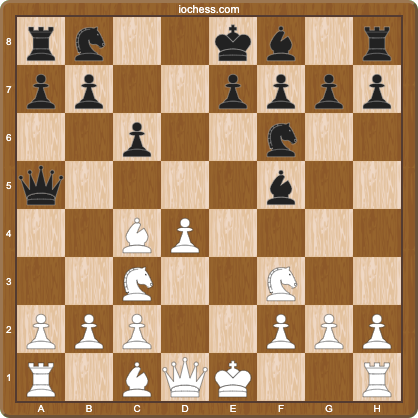
The Mieses-Kotrc (or Mieses-Kotroc) is the historical main line. After 3...Qa5 the queen pins the c3-knight along the a5-e1 diagonal, which is more useful than it looks: it stops Nc3-d5 ideas and prepares queenside castling.
The mainstream sequence runs 3.Nc3 Qa5 4.d4 Nf6 5.Nf3 c6. The move ...c6 is non-negotiable here for two reasons. First, it gives the queen a retreat square on c7. Second - and this is the trap most beginners walk into - it controls b5 and prevents White's Nb5 idea, which after a careless move sequence can win material. Black's typical plan is then ...Bf5 (or ...Bg4), ...e6, ...Nbd7, and queenside castling. The resulting structure resembles a Caro-Kann middlegame with the queen already developed.
Tiviakov Variation: 3...Qd6
The 3...Qd6 retreat (also called the Gubinsky-Melts Defense) has grown into one of the most fashionable Scandinavian lines since the mid-1990s, largely thanks to GM Sergei Tiviakov's work. The queen on d6 looks awkward, but it is harder to attack than on a5 (no Bd2 pin) and it eyes the kingside dark squares. Tiviakov has employed it against world-class opposition including former World Champion Vishy Anand.
The main line runs 3.Nc3 Qd6 4.d4 Nf6 5.Nf3, and now Black has flexible setups: 5...c6 (Tiviakov's long-time main line), 5...a6 (preparing ...b5), or systems with ...g6 and a fianchetto. White's most respected plan is the g3, Bg2, 0-0, Ne5 setup, going for slow positional pressure rather than direct attack. Black sometimes castles queenside and uses the h8-rook on the d-file, doubling pressure on the queen's home square.
If you only want to learn one Scandinavian for a long time, 3...Qd6 is a strong modern choice. It has fewer forced lines than 3...Qa5 and the plans are easier to internalize.
3...Qd8: the Valencian retreat
The oldest line, 3...Qd8, brings the queen back to its starting square. It is the most passive of the three retreats and concedes a tempo to White's development, but it is theoretically sound and avoids any tactics involving the queen. Black plans ...Nf6, ...c6, ...Bf5, ...e6, ...Nbd7. Most modern grandmasters prefer ...Qa5 or ...Qd6, but if you want the lowest-theory option in your response to 1.e4, the Valencian is a defensible practical choice.
Modern Scandinavian: 2...Nf6
After 1.e4 d5 2.exd5 Nf6, White's most testing move is 3.d4. Black recaptures with 3...Nxd5, and now 4.c4 attacks the knight. Black's three replies, each with a different character:
- 4...Nb6 - the most active option per IM Shaun Taulbut. Black continues with ...g6 and a fianchetto, fighting for the long diagonal.
- 4...Nf6 - retreating to f6 is calmer but slightly unusual.
- 4...Nb4!? - the speculative Kiel Variation. Sharp and tactical; not recommended unless you enjoy the chaos.
An alternative on move 3 is 3...Bg4, the Portuguese Variation. Black gives up the d-pawn for fast development. Play often resembles the Icelandic Gambit and is much sharper than the main lines. The Portuguese is fun but theory-heavy - keep it for after you've absorbed the classical 2...Qxd5 lines.
Strategic themes Black should know
- Light-squared bishop activity. Unlike the French, where the c8-bishop is a problem piece, the Scandinavian gets it out via ...Bf5 or ...Bg4 with full freedom.
- Solid pawn structure. Black has no e6/d6 weaknesses. The pawn skeleton with pawns on c6, e6, and the queenside is rock-solid.
- Endgame potential. Trades favor Black. If White spends moves chasing the queen and ends up exchanging pieces, Black is happy to head for an equal endgame.
- Queen-side castling option. Especially in 3...Qa5 and 3...Qd6 lines, Black can castle long and use the h8-rook on the d-file. This is a recurring resource.
- Fight for d5 and e4. The squares Black surrendered on move 2 must be reclaimed. ...Nf6, ...e6, ...Nbd7, ...Re8 is the standard formation.
A common Scandinavian trap to avoid
The most important trap in the 3...Qa5 line illustrates exactly why ...c6 is mandatory. Consider the move-order 1.e4 d5 2.exd5 Qxd5 3.Nc3 Qa5 4.d4 Nf6 5.Bc4 c6 6.Qe2 Bf5 7.Bd2 Nbd7? - and now 8.Nb5! is winning. The threats are Nd6+ forking the king and queen (or Nd6# in some sub-lines), and on 8...Qd8 White plays 9.Nd6#; on 8...Qb6 White wins the exchange with 9.Nd6+ followed by 10.Nxf7 and 11.Nxh8.
The fix is simple: develop the b8-knight to ...Nbd7 only after dealing with the Nb5/Bd2 ideas. The general rule is play ...c6 early, then ...Bf5/Bg4, then ...e6, then ...Nbd7. Mishandle that move-order and the queen on a5 becomes a liability rather than an asset.
How to learn the Scandinavian by rating
- Beginner (under 1000): Stick to 3...Qd8. It is the lowest-theory queen retreat and avoids all tactical landmines. Focus on completing development with ...Nf6, ...c6, ...Bf5, ...e6, ...Nbd7.
- Intermediate (1000-1500): Pick one of 3...Qa5 or 3...Qd6 and learn 8-10 moves of the main line. Memorize the c6 rule. Don't try to learn the Modern 2...Nf6 yet - it adds an entire second opening.
- Club (1500-1800): Master your chosen queen retreat to move 12-15, study three or four model games in depth (Tiviakov is the best source for 3...Qd6), and add a backup line against White's offbeat tries (3.Nf3, 3.d4, 2.Nc3).
- Advanced (1800+): Add the Modern 2...Nf6 as a second weapon to surprise opponents who have prepared against your main line. Consider studying the Portuguese 3...Bg4 if you like sharp positions.
For a deeper look at how much theory each rating band actually needs, see our guide on how deep to learn your openings.
Famous Scandinavian games
One of the most cited modern Scandinavian wins is Karpov-Larsen, Montreal 1979, where Bent Larsen used the opening to defeat the reigning World Champion. The game is widely available in collections of master games and is a model demonstration of Black's light-squared strategy after White over-extends.
For the modern 3...Qd6 system, the canonical reference is GM Sergei Tiviakov's body of work over three decades. His games against world-class opposition - including against Vishy Anand - are the foundation of contemporary 3...Qd6 theory. If you commit to that line, studying Tiviakov's games is the highest-leverage thing you can do.
Magnus Carlsen has used the Scandinavian occasionally as a surprise weapon, including at the 2014 Chess Olympiad, demonstrating that even at the elite level the opening is sound when applied with care.
Common mistakes Scandinavian players make
- Skipping ...c6. The single biggest source of disasters in the 3...Qa5 line. Always play it before ...Nbd7.
- Leaving the queen exposed. If White plays Bd2 in the Qa5 line, the queen needs a path back. Plan ...Qc7 or ...Qd8 in advance, not as an emergency response.
- Castling kingside too early. In many Scandinavian middlegames Black castles queenside. Don't auto-pilot to short castling - check whether 0-0-0 is the better square first.
- Underdeveloping the dark-squared bishop. The c8-bishop usually goes to f5 or g4, but the f8-bishop often gets stuck on e7. Look for chances to put it on d6, c5, or even b4.
- Trading the wrong pieces. Avoid trading your active light-squared bishop for White's c1-bishop. Your bishop is the better minor piece in most Scandinavian middlegames.
For more general opening pitfalls, our 7 common opening mistakes guide covers tactical errors that hit Scandinavian players the same way they hit everyone else.
Quick recap
- Scandinavian Defense (ECO B01): 1.e4 d5, the most direct answer to 1.e4.
- Most popular line: 2...Qxd5 with one of three queen retreats - Qa5 (classical), Qd6 (Tiviakov, modern), or Qd8 (passive but solid).
- Modern alternative: 2...Nf6 with 3.d4 Nxd5 4.c4 Nb6 (or 3...Bg4, Portuguese).
- Critical rule: in any 3...Qa5 line, play ...c6 before ...Nbd7 to avoid Nb5 disasters.
- Suited to: all rating bands. Beginners can play Qd8; club players should pick Qd6 or Qa5; advanced players add the Modern 2...Nf6.
- Strategic identity: active light-squared bishop, solid pawn structure, endgame-friendly trades, optional queenside castling.
Want to add the Scandinavian Defense to your repertoire and drill the key lines automatically? Create a free ChessAtlas account, build your repertoire around 3...Qa5 or 3...Qd6, and import your Lichess or Chess.com games to flag every deviation - the opening trainer will queue exactly the positions you most often forget. For broader repertoire ideas, see our guide on the 5 best openings for club players or how to memorize openings with spaced repetition.
Sources and Further Reading
Last updated: Jun 13, 2026


Comments