
The Caro-Kann Defense: A Solid Choice Against 1.e4

Train the Caro-Kann with spaced repetition
Train every variation (Advance, Classical, Karpov, Exchange), common traps, and ELO-specific tips on our Caro-Kann training page, built for players who want to actually remember their lines.
If you keep getting attacked after 1.e4, you need a reply that cuts the noise. The Caro-Kann Defense starts with 1...c6 and aims for ...d5, trading early tactics for structure and clean plans. It is one of the most popular responses to 1.e4 and consistently scores well for Black at club level. Here is how to play it well, why it scores, and which lines to study first. For a side-by-side comparison with the French Defense, see The 5 Best Chess Openings for Club Players.
Core Ideas and Move Order
After 1.e4 c6, the most common continuation is 2.d4 d5, directly challenging e4 while keeping a healthy structure. After 2...d5, Black can capture on e4 or maintain the tension, steering the game toward positions that favor piece coordination over early gambits.
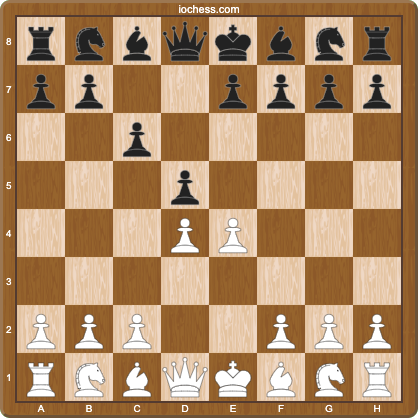
Compared to the French Defense, the key detail is the free light-squared bishop. The Caro-Kann keeps French-style central support with c6 and d5, but develops the c8 bishop outside the pawn chain first, usually with ...Bf5. This eliminates the French's main structural drawback. Still undecided which 1.e4 reply matches your style? Our overview of the best response to 1.e4 by rating level walks through Caro-Kann, French, Sicilian, and 1...e5 options tier by tier.
Key Characteristics
Typical structures place pawns on c6 and e6, with the bishop on f5 and knights heading to d7 and f6. This setup avoids early weaknesses, supports smooth development, and gives good endgames because Black's pawn chain is compact and hard to attack.
Why the Caro-Kann Works
Results and Popularity
The Caro-Kann offers a solid option for Black, capitalizing on White's first-move advantage. Black tends to perform well in terms of wins and draws while steering clear of the sharp tactical risks associated with more aggressive strategies. As documented in its competitive record, top players across generations - including Anatoly Karpov, Viswanathan Anand, Vladimir Kramnik, and Magnus Carlsen - have employed the Caro-Kann Defense at the highest levels, including in World Championship matches.
The Advance Variation: 3.e5
After 1.e4 c6 2.d4 d5 3.e5, Black's recipe is 3...Bf5, developing the light-squared bishop actively before closing the center with ...e6. The main line continues 4.Nf3 e6 5.Be2 Nd7 6.O-O Ne7, with a sound structure and an active bishop on f5.
A second, sharper recipe is 3...c5, attacking d4 immediately, then ...Nc6, ...Bg4 (pinning the knight), and ...e6 to solidify. The key line 3...c5 4.c3 Nc6 5.Nf3 Bg4 gives Black an excellent position: the pin puts pressure on d4, and if White plays 6.Be2, Black continues ...cxd4 7.cxd4 e6 with the plan of ...Nge7-f5.
Black's queen often lands on b6, targeting both b2 and d4 simultaneously: after ...Qb6, White cannot easily defend both pawns. This pattern is one of the most effective weapons in the Advance Caro-Kann.
ELO advice: Below 1400, just remember to develop ...Bf5 on move 3 and aim for ...e6, ...Nd7, ...Ne7. Above 1600, learn both the main 3...Bf5 line and the ambitious 3...c5 alternative, along with how to handle the sharper 4.h4 advance (where White grabs kingside space) versus the quiet Short Variation (4.Nf3 e6 5.Be2, then O-O and c3) named after Nigel Short.
The Classical Variation: 3.Nc3 dxe4 4.Nxe4
Black has three main responses:
- 4...Bf5: the most principled, developing the bishop before ...e6 traps it. After 5.Ng3 Bg6 6.h4 h6 7.Nf3, Black has a solid and well-coordinated position.
- 4...Nd7 (Karpov Variation): solid and flexible. The typical plan is ...Ngf6, ...e6, ...Bd6, ...Qc7, and eventually ...e5.
- 4...Nf6 (Tartakower Variation): natural development; after 5.Nxf6+ exf6, Black accepts doubled f-pawns but gains active piece play and a solid pawn center. The f-pawns cover key central squares and Black retains dynamic counterplay.
The Exchange Variation: 3.exd5 cxd5
The Exchange creates a symmetrical structure. Black's plan: develop with ...Nc6, ...Nf6, ...Bf5, and pressure on the c-file after ...Rc8. White's IQP structures can arise after c4, giving Black targets in the middlegame, while Black's pawn majority often matters in simplified endings.
A key positional trick after the Exchange: play ...Bg4 to pin White's knight and prevent Ne5, then ...Qc7 to support ...e5. This setup, seen in top-level practice, leads to comfortable equality with realistic winning chances.
Modern Variation and Gurgenidze: 3.Nc3 g6
After 1.e4 c6 2.d4 d5 3.Nc3 g6, Black fianchettoes the dark-squared bishop. This solid system avoids much theory and was a favorite of Soviet players. Black's plan: ...Bg7, ...Nf6 (or ...Nh6), and eventually ...dxe4 followed by ...Bf5.
Common Traps in the Caro-Kann
Trap 1: the Qb6/Nxb2 motif (Advance). After 1.e4 c6 2.d4 d5 3.e5 c5 4.c3 Nc6 5.Nf3 Qb6, an unprepared White may play 6.Bd3?!, and Black hits with 6...cxd4 7.cxd4 Nxd4 8.Nxd4 Qxd4, winning the d4 pawn. Even worse, careless moves like 7.O-O? (before addressing the d4 pawn) allow 7...cxd4 8.cxd4 Nxd4 9.Nxd4 Qxd4 with a clean extra pawn and attacking chances along the open c-file.
Trap 2: Fantasy Variation sideline. After 1.e4 c6 2.d4 d5 3.f3, an ambitious Black plays 3...dxe4 4.fxe4 e5, immediately challenging White's center. If White replies 5.Nf3 Bg4!?, White must find 6.Bc4 or 6.c3 to avoid dropping a pawn. Note: claims that the Fantasy loses quickly are overstated. White can safely reach middlegame equality after 3...e6 or 3...dxe4 4.fxe4 e5 5.Nf3. Black's goal is equality with active piece play, not an early refutation.
Trap 3: Exchange Variation Qc7 tactic. After 1.e4 c6 2.d4 d5 3.exd5 cxd5 4.Bd3 Nc6 5.c3 Nf6 6.Bf4 Bg4 7.Qb3 Qd7 8.Nd2 e6 9.Ngf3 Bd6 10.Bxd6 Qxd6 11.O-O O-O, if White carelessly plays 12.Ne5?, Black can reply 12...Nxe5 13.dxe5 Qxe5, winning a pawn. Keep an eye on the b3-b7 diagonal and the Ne5 jumps.
Concrete Plans and Piece Routes
Unlike the French, the Caro-Kann has very clear piece development routes that repeat across all lines:
- Develop the light-squared bishop to f5 (or g4 in some lines) before playing ...e6
- Knight to d7 and then f6 (or g4 via the Karpov setup)
- Castle kingside or delay depending on the structure
- Break with ...c5 (vs. Advance) or ...e5 (vs. Classical)
If you're building a full Black repertoire around the Caro-Kann, consider pairing it with a solid answer to 1.d4, the classic partner is the Queen's Gambit (1.d4 d5 2.c4) complete guide. Together the two form a low-theory, structure-first Black repertoire that covers both main White first moves. For the broader Black-side decision tree across every rating band, see our Best Chess Openings for Black 2026 Guide.
Real-World Examples
Magnus Carlsen and the Caro-Kann at Elite Level
Carlsen has employed the Caro-Kann at the highest level, bringing it to world-class events where its reliability and resilience against deep preparation matter. Top players across generations, from Karpov to Kramnik, have trusted this opening precisely because it leads to solid structures rather than theoretical landmines.
Anatoly Karpov's Positional Blueprint
Karpov turned the 4...Nd7 Classical line into a model, reaching stable middlegames, limiting counterplay, and steering toward favorable endgames. In his games, the typical plan unfolded: pieces behind a sound center, then expansion with ...c5 when pieces were perfectly placed.
Modern Practice: Fantasy Variation Response
Against the Fantasy Variation (3.f3), Black has two clean replies: 3...e6 transposes to French-like structures while keeping d5 supported, and 3...dxe4 4.fxe4 e5 challenges the center directly. After 5.Nf3 Bg4 or 5.dxe5 Qxd1+ 6.Kxd1 Nc6, Black reaches equal middlegames with no long-term problems. The Fantasy is playable for White but has no theoretical sting against accurate play.
Common Misconceptions

Misconception: It is boring and drawish
While positions can be stable, the games are far from sterile. Statistics from large game collections show Black wins frequently and decisive results are common. Caro-Kann middlegames revolve around targeted breaks like ...c5 or ...e5 and sensitive squares on both sides, creating plans that decide the game rather than auto-pilot trades.
Misconception: It is only for defensive players
Black's counterplay is thematic and active, not passive. Typical ideas include ...c5 against e5, ...Qb6 to hit b2 and d4, and a later ...e5 in Classical lines. Top players across generations have used it to outplay opponents, not just to equalize.
Misconception: You must memorize endless theory
The Caro-Kann rewards understanding more than rote memory. Core setups repeat across lines: for example ...Bf5, ...e6, and a timely ...c5 in the Advance, or 4...Nd7 with ...Ngf6 in the Classical. If you know the model pawn breaks and piece routes, you can handle sidelines without digging through dozens of forcing sequences.
Next Steps and Key Takeaways
- Score goals with structure: build c6 and e6, develop ...Bf5 early, and aim for ...c5 or ...e5 when pieces coordinate.
- Know your branches: Advance needs ...Bf5 or ...c5, ...Nc6, ...Bg4; Classical has 4...Bf5 (active), 4...Nd7 (solid), and 4...Nf6 (Tartakower).
- Study proven models: review Karpov's 4...Nd7 games and Carlsen's elite-level choices to see move orders and plans in action.
- Expect real chances: results at all levels show Black achieves winning outcomes, not just draws.
- Punish overreach: watch for Advance-Variation Qb6/Nxb2 motifs, Exchange-Variation Ne5 tactics, and Fantasy sideline traps.
Micro-action: Pick one line, the Advance or Classical, and play ten training games focusing only on its main break, ...c5 or ...e5. After each game, check a database line and one model game to correct your move order. For a structured, long-term study method, see our pillar guide on how to build an opening repertoire that actually sticks, and once you have your lines down, use spaced repetition to lock them in for good.
Start building your Caro-Kann repertoire free, or jump straight into the dedicated Caro-Kann Defense course in the ChessAtlas library to train every main variation with FSRS scheduling.
Sources and Further Reading
- Caro-Kann Defence on Wikipedia documents the opening's history, its competitive record, and the Advance, Classical, and Exchange variations.
- Anatoly Karpov on Wikipedia covers the career of the player who made the 4...Nd7 Classical line a model.
- Magnus Carlsen on Wikipedia records the elite-level practice cited for the opening's modern reliability.
Last updated: Jul 24, 2026


Comments