
How to Beat the London System: A Practical Guide for Black (2026)

Disclosure: ChessAtlas is our product. This guide is Black-perspective repertoire advice; it works with any platform or trainer. Readers should weigh the perspective accordingly.
The London System (1.d4 + Bf4 + e3 + Nf3) frustrates club players because it looks passive and feels solid, so Black drifts into equal-but-boring positions and gets ground down. The fix to beat the London System is not clever theory, it is attacking the d4 center and the b2 pawn before White finishes harmonious development. Three concrete setups accomplish this, all low-theory. Pick one, drill it, never fear the London again.
If you are still building the rest of your Black repertoire, see our London System landing page (written from White's perspective, useful for understanding both sides) and our complete London System guide.
Why the London Frustrates Club Players
The London's typical development, 1.d4, 2.Nf3, 3.Bf4, 4.e3, 5.Bd3, 6.Nbd2, 7.c3, is self-sufficient. It does not require Black to cooperate. White finishes development by move 7, aims for a knight on e5, and starts kingside pressure with Bd3 targeting h7 or a rook lift via Re1-e3. The opening has a long history dating back to the 1922 London tournament, and its self-contained setup wins many club games against Black's passive symmetric formations (...d5, ...e6, ...Nf6, ...Be7).
The solution: do not be symmetric. Attack d4 with ...c5, pressure b2 with ...Qb6, or play a King's Indian-style fianchetto that makes the Bf4 look misplaced. White's setup is only harmonious against passive Black play.
Setup 1: The Classical Counter (...d5, ...c5, ...Qb6)
The most direct answer. It works for club players (under 2000 ELO) without deep preparation, and is theoretically sound up to the master level.
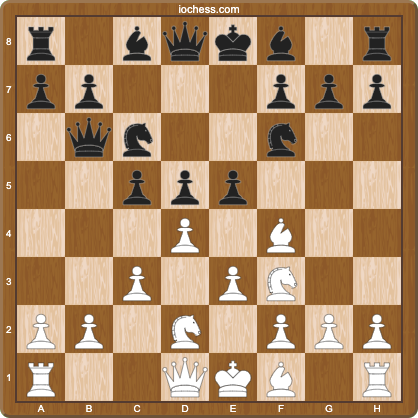
Move sequence: 1.d4 d5 2.Bf4 Nf6 3.e3 c5 4.c3 Nc6 5.Nd2 Qb6!
The main line: 6.Qb3 c4 7.Qxb6 axb6 and Black reaches an endgame with the open a-file, a healthy pawn structure (the c4 pawn restricts White's queenside), and comfortable equality. The queens come off before White's attacking plan materializes, and many London players are caught out of their preferred middlegame.
Important sideline: 6.Qb3 c4 7.Qc2 (avoiding the trade) - reply with 7...Bf5! 8.Qxc4 e5! 9.dxe5 Nxe5, and Black has full compensation for the pawn with active pieces and a strong center. This is theory, but only one branch deep.
If White avoids the queen trade entirely with 6.dxc5 Bxc5, Black has a comfortable IQP-style game with active pieces and free development - far better than the symmetric London structure. (Computer analysis shows 6...Qxb2 is also playable but tactical; 6...Bxc5 is the safer recommendation.)
Setup 2: The Mirror (...Bf5)
A quieter, positional answer. It mirrors White's idea by placing your own bishop outside the pawn chain before locking it in with ...e6.
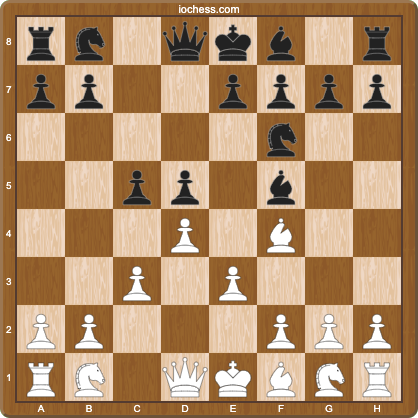
Move sequence: 1.d4 d5 2.Bf4 Nf6 3.e3 c5 4.c3 Bf5! (not ...e6 blocking the bishop). Then ...e6, ...Nc6, ...Be7, castle short, and play for the same ...c5/...Qb6 ideas or a later minority attack on the queenside.
The point: preventing White's Bd3 from staring at h7 on the open diagonal. After ...Bf5, if White plays Bd3, bishops get exchanged, reducing White's attacking potential significantly. White is left with a passive Slav-reversed structure where Black has the easier game. A clean positional answer that requires almost no calculation.
Setup 3: King's Indian Against the London
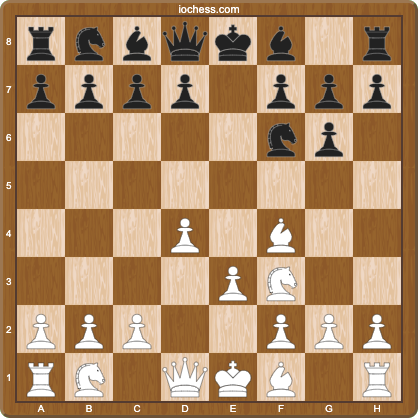
Move sequence: 1.d4 Nf6 2.Nf3 (or 2.Bf4) g6 3.Bf4 Bg7 4.e3 O-O 5.Be2 d6 6.O-O c5 with a KID-structure game. Black pressures d4 with the Bg7 bishop and plans ...c5, sometimes ...e5.
Best against London players who insist on the Bf4 move order. The London's dark-squared bishop has no clear job against a fianchetto structure because Black's pawn chain (d6+e7) does not leave any targets on the a3-f8 diagonal. This setup is also a great choice if you already play the King's Indian against 1.d4 - your repertoire becomes consistent.
Traps and Tactical Resources
- ...Qb6 hitting b2: in many London move orders, b2 becomes a target once White plays c3 and Nd2, because the queen no longer defends it. ...Qb6 is nearly always good when those conditions are met.
- ...Nh5 attacking Bf4: after ...Nh5, White must either trade the bishop with Bg3 Nxg3 hxg3 (wrecking the h-file) or retreat with Be3/Bg5. Either way Black neutralizes the key attacking piece. Time it after castling so the open h-file is not a danger.
- ...Bd6 trade: in the classical setup, after ...Bd6 White has to decide between Bxd6 (giving Black an easy game with the d-file opened) or Bg3 (retreating to a less active square). Both outcomes favor Black's plan.
- Avoid ...Qxb2 unless calculated: the b2 pawn often looks free but White has tactics like Rb1 + Nb3 or Bb5+ exploiting the c6 knight pin. When in doubt, capture with the bishop, not the queen.
Common Mistakes Black Makes Against the London
Playing ...e6 too early (French-style passivity)
After 1.d4 d5 2.Bf4, do not play 2...e6 immediately. This blocks your Bc8 (the one piece the Caro-Kann would have activated) and gives you nothing in return. Play ...c5 and ...Nf6 first, keep the bishop mobile.
Waiting for White to do something
The London is essentially done developing by move 6 or 7. If Black has not started the counterattack by then, White gets Ne5 and Bd3 without resistance. Hit c5 by move 3 or 4, not move 8.
Fearing Bxh7+ sacrifices
Bxh7+ works only if Black castles kingside without defending h7 and the Ne5 is in the attack. In the setups above (especially with ...Bf5 or ...g6 fianchetto), the sacrifice does not work because either the bishops have been exchanged or h7 is covered by the king on g7. Castle with confidence.
Rating-Specific Recommendations
- Under 1500: stick to Setup 1 (Classical with ...c5 and ...Qb6). One plan, clear targets, and the queen-trade endgame catches most club Londoners off guard.
- 1500-1800: add Setup 2 (...Bf5 mirror) for variety. Both are low-theory and complementary - choose between them based on whether you want a sharp queen trade or a quiet positional game.
- 1800+: learn the 2.Nf3 vs 2.Bf4 move-order distinctions and the Jobava London (2.Nc3). At this level, opponents start to know the ...Qb6 endgame, so add the Bf5/c4-Qc2 sideline and consider Setup 3 for variety.
What About the Jobava London (2.Nc3)?
Some London players use 1.d4 Nf6 2.Nc3 hoping to avoid ...c5-based counters. The Jobava London, associated with GM Baadur Jobava, has gained popularity since the 2010s. Black's clean answer: 2...d5 3.Bf4 a6 (preparing ...c5 without allowing Nb5 tricks) or 3...Bf5 directly. The Jobava is sharper than the standard London because of fast Bxf6 ideas to wreck Black's structure, but with ...a6 and patient development Black equalizes and keeps the better pawn structure. Be ready for a long positional fight rather than a quick refutation.
Tools to Drill Your London Defense
Once you pick a setup, drill it. ChessAtlas with FSRS scheduling handles the 8 to 12 key positions for Setup 1 in about 10 minutes of daily review, and flags any deviation if your opponent plays an unexpected move so you can update your repertoire. Free alternatives: Chessdriller (open-source, manual scheduling) or Lichess Studies for the PGN. For the full tools landscape see Best Chess Opening Trainers 2026.
Your 4-Step Action Plan Today
- Pick Setup 1 (Classical ...c5 + ...Qb6) if you face the London at least once a week at the club level.
- Memorise the 8 moves: 1.d4 d5 2.Bf4 Nf6 3.e3 c5 4.c3 Nc6 5.Nd2 Qb6 6.Qb3 c4 7.Qxb6 axb6.
- Drill the position 5 times today using a physical board or a spaced-repetition trainer like ChessAtlas.
- Add the Bf5/Qc2 sideline within a week so you are not surprised when White avoids the queen trade.
Next time a London player sits across from you, the first seven moves will feel automatic - and the resulting endgame will catch them well outside their preparation.
For the full Black repertoire against 1.d4, see the QGD, King's Indian, and Nimzo-Indian landing pages, plus our Best Chess Openings for Black 2026 Guide for the full Black-side decision tree by rating. For the broader study framework, see How to Build a Chess Opening Repertoire That Actually Sticks and how deep to study by rating. Or create a free ChessAtlas account and start drilling the queen-trade endgame today.
Sources and Further Reading
Last updated: Jul 24, 2026


Comments