The Ruy Lopez: Complete Guide for Club Players (1200-2000)

Table of contents
Disclosure: ChessAtlas is our product. This is a balanced guide to the Ruy Lopez for both colors, not a partisan pitch. Readers should weigh the perspective accordingly.
The Ruy Lopez (also known as the Spanish Opening or Spanish Game) starts with 1.e4 e5 2.Nf3 Nc6 3.Bb5 and is one of the oldest and most extensively analysed 1.e4 openings in chess. Named after the 16th-century Spanish priest Ruy Lopez de Segura, it has been a primary White weapon of nearly every World Champion from Lasker to Carlsen. At club level the Ruy Lopez rewards patient strategic play: it produces rich middlegames where understanding beats memorisation. This guide covers the three main variations you will face (Morphy, Berlin, Exchange) and the core plans for both sides.
For the complete opening breakdown with variations, traps, and ELO tips, see our Ruy Lopez landing page.
A short history
The Ruy Lopez is named after Spanish priest Ruy Lopez de Segura, who analysed it in his 1561 book Libro de la invencion liberal y arte del juego del Axedrez. The opening became dominant at top level by the late 19th century thanks to Steinitz, Tarrasch, and later Lasker and Capablanca, who refined the strategic ideas of the Closed Spanish. In the modern era Karpov, Kasparov, Anand, Kramnik, and Carlsen have all used it extensively at world-championship level (Wikipedia: Ruy Lopez). Carlsen has continued to play it in classical events through the 2020s, and the Berlin Defence and Marshall Attack remain heavily contested at the top of the rating list.
Why 3.Bb5 Matters
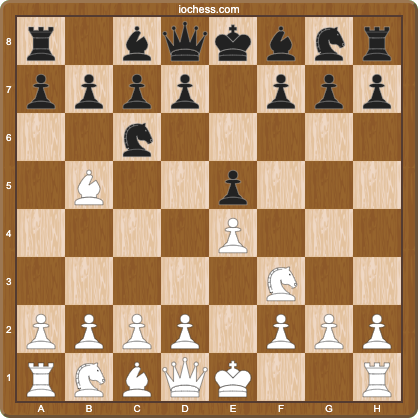
The Bb5 serves three purposes: it threatens Bxc6 to damage Black's pawn structure, it increases control of the central squares d4 and e5, and it supports the eventual c3+d4 plan. Unlike 3.Bc4 (Italian Game), the Bb5 does not commit to attacking f7 prematurely. This makes the Ruy Lopez a positional opening with deep strategic resources. For a side-by-side comparison of these two 1.e4 systems, see our Italian Game vs Ruy Lopez guide. If you want a more direct, central-tension alternative to the Ruy Lopez, see our Scotch Game guide - the natural 3.d4 break that bypasses the Closed Spanish theory load entirely. For the broader White repertoire decision (Italian, Scotch, London, Queen's Gambit, and where the Ruy fits), see our Best Chess Openings for White 2026 Guide.
Morphy Defense (3...a6): The Main Line
Far and away the most common Black response. After 3...a6, White almost always retreats with 4.Ba4, declining to trade on c6 immediately.
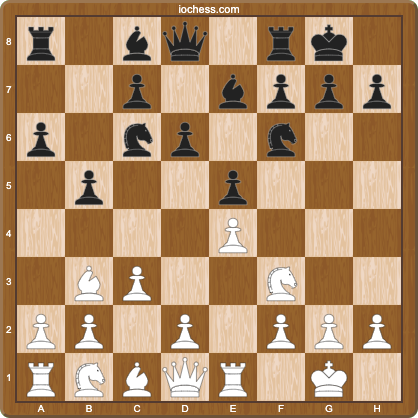
Main line: 4.Ba4 Nf6 5.O-O Be7 6.Re1 b5 7.Bb3 O-O 8.c3 d6 9.h3 (preventing ...Bg4 pins) with slow manoeuvring. White plans Nb1-d2-f1-g3, eventually d4 breaking the center. Black reroutes pieces with ...Na5-c6-e7 or the Breyer setup ...Nb8-d7 to prepare ...c5.
Key sub-variations
- Classical (8...d6): most common, solid. Leads to rich positional middlegames.
- Marshall Attack (8...d5): Black sacrifices a pawn for a kingside attack. Sharp and theoretical. Avoidable with 8.a4 or 8.h3 anti-Marshall move orders.
- Chigorin Defence (9...Na5, after 9.h3): Black hits the b3 bishop and prepares ...c5 with queenside expansion. The classical workhorse of Spanish theory.
- Breyer Defence (...Nb8-d7): reroute the queen's knight for flexibility. A favourite of Spassky, Kasparov, and Anand at world-championship level.
- Zaitsev (...Re8+...Bf8): another Karpov-era Black setup with long-term pressure.
The Marshall Attack mainline
The Marshall Attack arises from 1.e4 e5 2.Nf3 Nc6 3.Bb5 a6 4.Ba4 Nf6 5.O-O Be7 6.Re1 b5 7.Bb3 O-O 8.c3 d5!? Black sacrifices a pawn for a powerful kingside attack. Main continuation: 9.exd5 Nxd5 10.Nxe5 Nxe5 11.Rxe5 c6 with rich attacking chances. Many White players sidestep with anti-Marshall systems like 8.h3 or 8.a4.
Other defences you might face
Black has additional principled defences worth knowing:
- Schliemann Defence (3...f5): An aggressive gambit. White's safest reply is 4.Nc3 fxe4 5.Nxe4 with a clear advantage.
- Open Spanish (3...a6 4.Ba4 Nf6 5.O-O Nxe4): Black grabs the e-pawn temporarily. White plays 6.d4 b5 7.Bb3 d5 8.dxe5 Be6 with active piece play on both sides.
- Steinitz Defence (3...d6): Old but solid. Black gives up central space for a rock-solid setup.
Berlin Defence (3...Nf6): The "Berlin Wall"
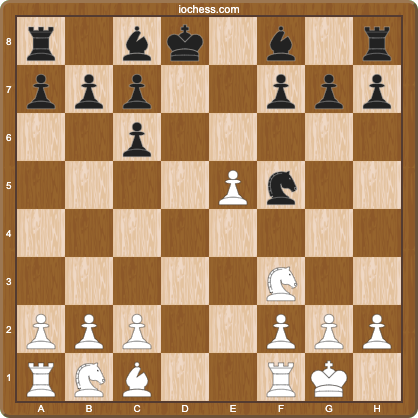
Main line: 4.O-O Nxe4 5.d4 Nd6 6.Bxc6 dxc6 7.dxe5 Nf5 8.Qxd8+ Kxd8 and Black has traded queens early. White aims for activity and endgame technique; Black relies on the bishop pair and structural solidity. Kramnik's use of the Berlin Defence to hold the 2000 Classical World Championship against Kasparov is widely credited with reviving the line at the top level.
Anti-Berlin shortcut: the most popular avoidance at club level is 4.d3 (instead of 4.O-O), keeping queens on and steering into slow positional games. Simpler to play, less theory.
Exchange Variation (4.Bxc6 after 3...a6)
Main line: After 3...a6, White can play 4.Bxc6 dxc6 immediately. White gives up the bishop pair for a better pawn structure (Black's c-pawns are doubled) and aims for favourable endgames.
Typical plan: 5.O-O f6 (protecting e5) 6.d4 exd4 7.Nxd4 with a small positional edge. Fischer used the Exchange as his anti-Ruy weapon when he wanted to avoid Marshall theory and scored well with it. The structural imbalance (4-vs-3 White kingside pawn majority versus Black's 4-vs-3 queenside, with a doubled c-file) defines the strategic plan: trade pieces, push the kingside majority, and aim for a winning king-and-pawn or rook endgame.
The Core Plans for Both Sides
White's plans
- Nb1-d2-f1-g3 manoeuvre: reroute the queen's knight to attack Black's kingside. Slow but devastating.
- d4 break: after c3 preparation. Opens the center when Black is uncoordinated.
- a4 probe: challenges Black's queenside expansion with ...b5. Creates hooks.
- Bishop reroute Bb3-c2: aims the bishop at h7 for kingside attacks.
Black's plans
- ...Na5 hitting Bb3: forces Bb3-c2 and can exchange Black's "worst minor" knight for the bishop.
- ...d5 or ...c5 breaks: freeing pawn moves. Timing is everything.
- Bishop redeployments: light-squared bishop redeployment to b7 in Breyer setups; dark-squared bishop fianchettoed via ...g6 Bg7 in some Closed Spanish lines.
- Marshall Attack (...d5 move 8): sharp pawn sacrifice for a kingside attack. Rewards preparation.
Famous Games
The Ruy Lopez has been a testing ground in World Championship matches for over a century. The game below is a strong illustration of typical Spanish strategic themes: quiet manoeuvring, piece coordination, and slow positional pressure.
Rating-Specific Advice
- Under 1800 (as White): Consider the Italian Game instead. The Ruy Lopez demands a lot of preparation for the rating you face. See our Italian vs Ruy Lopez guide and our list of the 5 best openings for club players (1200-1800 ELO).
- 1800 to 2000 (as White): Start with the Exchange Variation (4.Bxc6) to avoid Berlin and Marshall theory. Solid, positional, low maintenance.
- 2000+ (as White): Commit to the Closed Ruy Lopez. Learn your response to Berlin (4.d3 Anti-Berlin or the full endgame), Marshall (8.a4 or 8.h3 avoidance), and Classical. Expect a substantial preparation load.
- As Black at any level: 3...a6 + Classical 8...d6 is the most forgiving. Berlin Defence (3...Nf6) works if you are comfortable in the queenless endgame. If you want to broaden your toolkit against 1.e4, see our best response to 1.e4 guide and the Sicilian Defense as a sharper alternative.
Common Mistakes
Many of the errors below are part of a broader pattern of opening misjudgments. For more, see our 7 common opening mistakes that cost you games.
White: rushing d4 without preparation
Playing d4 before c3 sets up tactics for Black. The c3 pawn is essential to support the d4 push in the main lines.
Black: playing ...Na5 too early
...Na5 hitting Bb3 only makes sense when you are ready to follow up with ...c5 and the knight has a home on c6 or c4. Premature ...Na5 leaves the knight stranded on the queenside.
White: missing the Nb1-d2-f1-g3 manoeuvre
The slow knight reroute is the Ruy Lopez's signature positional idea. Skipping it and playing "normal developing moves" gives Black easy equality via ...Na5+...c5.
White: fearing the Marshall Attack
If you play the Ruy Lopez as White and fear the Marshall (8...d5), play 8.h3 or 8.a4 instead of 8.c3. A simple move-order trick that avoids the entire Marshall complex.
Study Plan for the Ruy Lopez
- Week 1: Learn the three tabiyas (Closed after 9.h3, Berlin endgame, Exchange). Play through one master game per tabiya to absorb the typical plans before drilling moves.
- Week 2: Drill the first 12 moves of your chosen line with a spaced-repetition trainer. Create a free ChessAtlas account to drill your Ruy Lopez lines automatically with FSRS scheduling.
- Week 3: Play 10 rapid games as each color in your Ruy Lopez. Import them and analyse the deviations - that is where your real repertoire gaps live.
- Week 4: Add sidelines based on what opponents actually played. See our deviation detection workflow for the full feedback loop.
Your Micro-Action Today
Pick one side (White or Black) and one variation (Closed Main Line or Exchange for White; Classical or Berlin for Black). Write down the first 10 moves from this guide. Pull up a master game in that line, click through it twice with the engine off, and note any move you would not have played. Drill those moves tomorrow morning before your first online game.
For broader context see our beginner repertoire guide and our rating-by-rating depth guide. Or create a free ChessAtlas account and drill your Ruy Lopez lines with automatic spaced repetition.
Sources and Further Reading
Last updated Jun 13, 2026