
The Scotch Game: A Dynamic Alternative to the Ruy Lopez

The Scotch Game tends to score well for White in master games, and White's direct play creates immediate central tension. If the Ruy Lopez feels like a maze of theory, the Scotch creates open lines and active piece play from the first dozen moves.
You will learn the key move orders, typical plans, and common traps, plus why Kasparov and Carlsen trusted the Scotch in top events. The focus is practical: active piece play, clear patterns, and less memorization than the Ruy Lopez. If you are still deciding between classical 1.e4 systems, see our companion piece Italian Game vs Ruy Lopez: Which Opening Should You Play, and for the deep dive on the system the Scotch is meant to bypass, our complete Ruy Lopez guide for club players.
What Is the Scotch Game?
Opening moves: 1.e4 e5 2.Nf3 Nc6 3.d4. After 3...exd4 4.Nxd4, White challenges e5 immediately and develops quickly, often gaining tempo on Black's queen or pieces. The opening is named after the 1824 Edinburgh-London correspondence match in which it featured prominently.
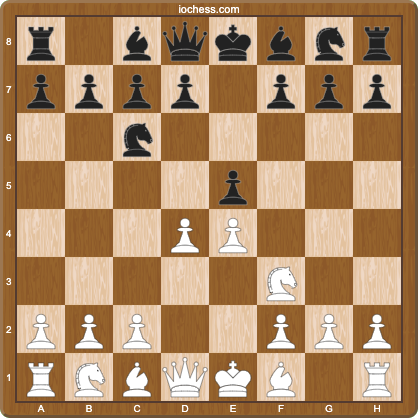
The Scotch Game is classified as C45 in the Encyclopaedia of Chess Openings, with the Scotch Gambit (4.Bc4) and Goring Gambit (4.c3) under C44. It was popular in the 19th century, then declined at the top by 1900 as the Ruy Lopez rose, and stayed common in club play because of its straightforward plans.
The central idea: White trades the d-pawn for Black's e-pawn, aiming for fast control of central squares. This contrasts with the Ruy Lopez (3.Bb5), which keeps tension, and the Italian Game (3.Bc4), which often delays d4.
Typical positions feature an open center, free piece movement, and early tactics. White often gains time by attacking Black's pieces, while Black must choose accurate setups to avoid structural issues or lagging development.
Why Does the Scotch Game Matter?

The Scotch removes Black's e5-pawn early and gives White clear central play with simple development. Garry Kasparov revived it at the elite level in the 1990s, treating it as a targeted reply to 1...e5 that avoids the most theory-heavy Ruy Lopez branches. Magnus Carlsen, Hikaru Nakamura, and many other top players continue to use it in classical and rapid events, which keeps it firmly in the modern mainstream rather than relegating it to a historical curiosity.
The Scotch tends to score well for White in master games, holding a respectable result in the main 4.Nxd4 lines.
Study efficiency is a major draw. Instead of learning the Berlin, Marshall, Open, and Closed Ruy Lopez branches (mapped out in detail in our Ruy Lopez guide for club players), you can grasp core Scotch themes and apply them across 4...Nf6, 4...Bc5, and related lines. That frees time for middlegame and endgame training. If you are still building your first repertoire, the Scotch fits neatly alongside the systems we recommend in The 5 Best Chess Openings for Club Players (1200-1800 ELO) and Best Chess Openings for Beginners.
How Does the Scotch Game Work?
After 1.e4 e5 2.Nf3 Nc6 3.d4 exd4 4.Nxd4, White places a knight in the center, opens lines, and removes Black's e5 pawn. This often forces Black to react precisely to avoid time loss or structural damage.

Black's main choices are 4...Nf6 (Schmidt), 4...Bc5 (Classical), and 4...Qh4 (Steinitz). Each creates different middlegames, yet all feature an open center and chances for direct tactics.
The Main Strategic Ideas
White usually plays Nc3, Bc4 or Be2, and castles kingside. The d4-knight controls key squares and can trade on c6 to damage Black's structure. The Scotch prizes fast development and clear plans over long theory trees.
In the Schmidt line, 4...Nf6 5.Nxc6 dxc6 leads to doubled c-pawns for Black and an open b-file. Black gains the bishop pair and activity, while White keeps structural targets and a simple plan of pressure on c6 and the center.
Mieses Variation (4...Nf6 5.Nxc6 bxc6 6.e5)
Kasparov's preferred line and the sharpest theoretical battleground. Main continuation: 6...Qe7 7.Qe2 Nd5 8.c4 Nb6 with rich, double-edged play. Black accepts a slightly worse pawn structure for active piece play. White generates dynamic play in the center and on the kingside while Black develops queenside counterplay around the bishop pair and the half-open b-file.

Tactical Themes and Traps
The open center invites discovered attacks on files and diagonals, plus frequent knight forks from c6, d5, and e4 squares. Watch tactics on e-file pins, c2-c7 forks, and tactics against f7 when bishops aim at the king.
The Scotch Gambit (4.Bc4 instead of 4.Nxd4) sacrifices a pawn for development and attacks on f7 and the e-file. The Goring Gambit (3...exd4 4.c3) is the other classical Scotch sideline, sacrificing a pawn for rapid development and open lines. Compared with the Ruy Lopez, critical positions arrive earlier, so understanding motifs often matters more than memorizing long sequences.
A common Scotch trap to know
After 1.e4 e5 2.Nf3 Nc6 3.d4 exd4 4.Nxd4 Qh4 (the aggressive Steinitz idea), one of White's principled tries is 5.Nf5, hitting the queen on h4 and threatening Nxg7+. Black's only credible answer is 5...Qxe4+ followed by 6.Be2 and a forced retreat that costs serious time. The point: the queen sortie 4...Qh4 looks aggressive but lets White gain tempi for development. Mainstream theory considers 4...Qh4 playable but inferior to the Schmidt and Classical lines.
Real-World Examples of the Scotch Game in Action

Garry Kasparov's Championship Weapon
Kasparov first revived the Scotch at top level in his 1990 World Championship match against Karpov (notably Game 14, Lyon-New York), and continued using it in his 1993 and 1995 matches. His Scotch results in elite practice were strong, and he used it specifically to dodge the Marshall Gambit and other heavy Ruy Lopez lines while keeping initiative.
His games showed how an open center and quick development create pressure even against elite defenders. By steering opponents away from memorized Ruy Lopez theory, he demanded precise calculation early and converted small edges into wins.
Magnus Carlsen's Practical Success
Magnus Carlsen has employed the Scotch in elite events throughout his career, treating it as a serious main weapon rather than a surprise. He often uses it to simplify preparation while keeping tactical options in clear structures.
Carlsen's approach highlights three benefits: a forced open center after 3...exd4, immediate piece activity, and fewer branching sidelines to memorize. That balance suits rapid and classical events alike.
Club-Level Dominance
At club level, many players prepare the Berlin or Marshall in the Ruy Lopez but have little knowledge against the Scotch. This preparation gap often yields quick time advantages and recurring tactical chances for White. One of the sharpest lines after 4.Nxd4 Nf6 5.Nxc6 bxc6 6.e5 (the Mieses Variation, Kasparov's choice) gives White an early space advantage and immediately pressures Black's development.
Modern engines rate the resulting positions as slightly favorable for White. Understanding the typical ideas (pressure on c6, quick rook to d1, and piece activity on the kingside) makes this a reliable practical weapon even without deep memorization.
Common Misconceptions About the Scotch Game
Misconception: The Scotch Is Only for Beginners
Top grandmasters have used it for decades. Besides Kasparov and Carlsen, players like Vladimir Kramnik, Levon Aronian, and Sergei Rublevsky have employed Scotch lines in elite events with success.
Misconception: Trading in the Center Gives Away White's Advantage
Results disagree. White scores well in the main Scotch lines across master games. The edge shifts from a long structural battle to development and piece activity, which often decides practical games.
Misconception: Black Easily Equalizes
Black must answer precisely from move three. Inaccurate play allows doubled c-pawns after Nxc6, or delays development that White can attack with rooks on open files. Assuming "Black easily equalizes" is one of the classic preparation errors we cover in 7 Common Opening Mistakes That Cost You Games.
The Scotch rewards clear principles over giant theory files, which makes it efficient to learn and apply in real games.
For practical study, focus on two main branches first: 4...Nf6 and 4...Bc5. Drill typical tactics like c7 forks, e-file pins, and ideas after Nxc6 dxc6. Then add the Scotch Gambit as a surprise weapon for rapid or blitz.
Action Plan: Add the Scotch in Two Weeks
- Day 1 to 3: Memorize the move order 1.e4 e5 2.Nf3 Nc6 3.d4 exd4 4.Nxd4 and Black's three main replies (4...Nf6, 4...Bc5, 4...Qh4). Know which one you face most often at your level.
- Day 4 to 6: Study the Mieses Variation (4...Nf6 5.Nxc6 bxc6 6.e5) for 8 to 10 moves of theory, including 6...Qe7 7.Qe2 Nd5 8.c4 Nb6.
- Day 7 to 9: Study the Classical (4...Bc5) main line: 5.Nxc6 Qf6 6.Qd2 dxc6 7.Nc3 with quick castling.
- Day 10: Review the 4...Qh4 Steinitz with the 5.Nf5 line; know the queen-time-loss pattern.
- Day 11 to 13: Play 10 online games as White, 15+10 or 30+0 time control. Tag deviations.
- Day 14: Annotate two of your own games and two Kasparov Scotch wins; compare the plans.
Quick Recap
- Early central exchange after 3.d4 removes Black's e5-pawn and speeds development for direct play.
- Main replies, 4...Nf6 and 4...Bc5, lead to open centers with recurring tactics and clear plans.
- Kasparov and Carlsen used the Scotch successfully, proving it works well beyond club level.
- The Mieses Variation (4...Nf6 5.Nxc6 bxc6 6.e5) is the sharpest theoretical battleground and Kasparov's main weapon.
- Study time is efficient, with fewer heavy branches than common Ruy Lopez defenses.
Want to add the Scotch Game to your repertoire and drill the key positions with spaced repetition? Create a free ChessAtlas account to start building your repertoire, or read the broader hub Best Chess Openings for White: 2026 Guide to see how the Scotch fits next to the Italian, Ruy Lopez, London, and Queen's Gambit.
Sources and Further Reading
Last updated: Jul 10, 2026


Comments