Für Schwarz· ECO C20· Anfänger

Parham-Angriff

Die weiße Dame kommt schon im zweiten Zug heraus. Decke e5 und f7, entwickle dich mit Tempo gegen die Dame und übernimm die Initiative.

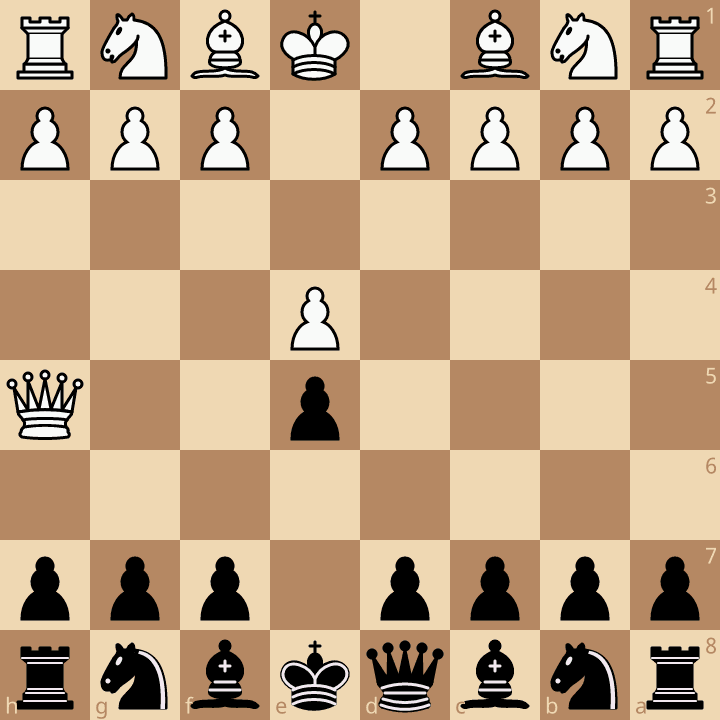
1.e4 e5 2.Qh5

Parham-Angriff: Ausgangsstellung nach 1.e4 e5 2.Qh5

Was ist Parham-Angriff?

Der Parham-Angriff (1.e4 e5 2.Dh5), im Englischen Wayward Queen Attack und manchmal Patzer-Eröffnung genannt, bringt die weiße Dame im zweiten Zug ins Spiel, um den Bauern e5 und, sobald der Läufer auf c4 steht, den Bauern f7 anzugreifen. Bekannt ist er vor allem als Weg zum Schäfermatt, doch er ist eine echte Eröffnung, die manche starke Spieler im Online-Blitz als Überraschung einsetzen. Die Aufgabe von Schwarz ist einfach: zuerst e5 und f7 decken (2...Sc6, dann 3...g6 oder 3...De7), dann sich entwickeln und dabei die Dame mit ...g6, ...Sf6 und ...Sd4 jagen. Engines bewerten die Stellung als gut für Schwarz, sogar leicht besser, doch 2.Dh5 ist nicht widerlegt: Wer nur passiv verteidigt, gibt Weiß eine normale Partie.

Hauptvarianten

Jede Variante unten kommt mit einem Diagramm und dem Hauptplan. Klicken Sie auf „Diese Eröffnung trainieren“, um jede Linie mit Spaced Repetition zu trainieren.

Möchten Sie Parham-Angriff aus dem Gedächtnis spielen? Im kostenlosen Eröffnungstraining üben Sie Zug für Zug und kehren dann zu den Varianten zurück, die Sie verfehlt haben.

Main defense: 3...g6 and 4...Nf6

1.e4 e5 2.Qh5 2...Nc6 3.Bc4 g6 4.Qf3 Nf6
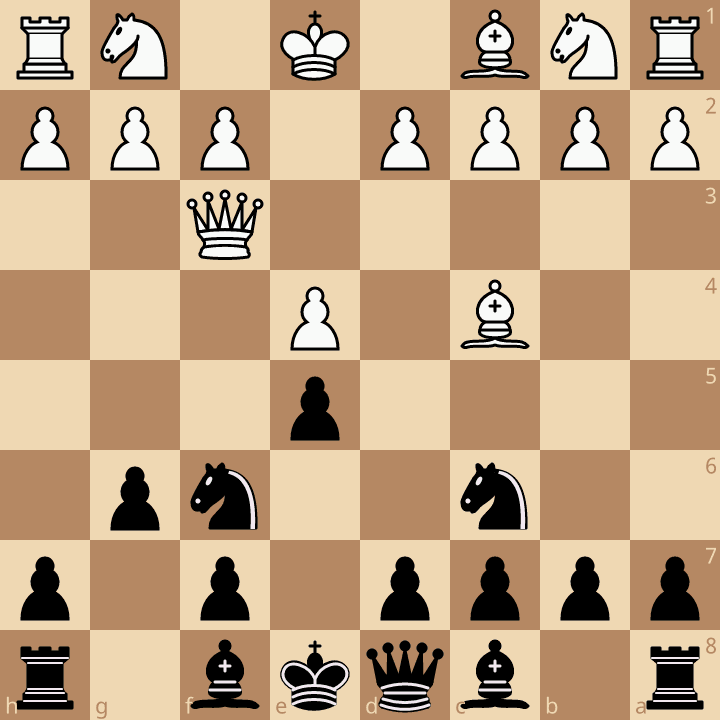
Parham-Angriff Main defense: 3...g6 and 4...Nf6 nach 2...Nc6 3.Bc4 g6 4.Qf3 Nf6
Hauptlinie: 5.Ne2 Bg7 6.Nbc3 d6 7.d3 O-O

The standard plan. 2...Nc6 guards e5, 3...g6 kicks the queen, and when 4.Qf3 renews the threat on f7, 4...Nf6 blocks the f-file while developing. Black continues with ...Bg7, ...d6 and castles; White usually settles for Ne2, Nbc3 and d3, and Black is at least equal.
Queen guard: 3...Qe7

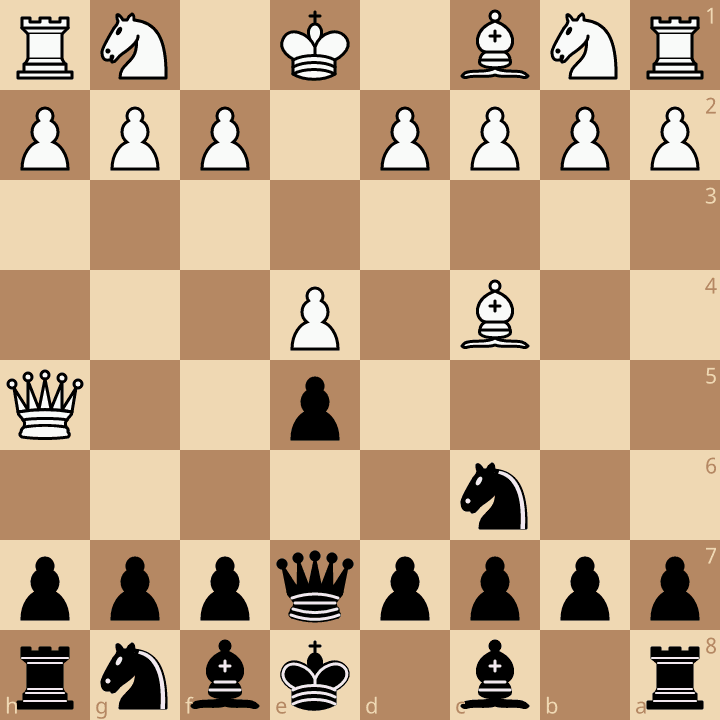
1.e4 e5 2.Qh5 2...Nc6 3.Bc4 Qe7

Parham-Angriff Queen guard: 3...Qe7 nach 2...Nc6 3.Bc4 Qe7
Hauptlinie: 4.Nc3 Nd4 5.Qd1 c6

A simpler defense: the queen covers f7 and e5 at once, without the ...g6 weakening. Black then aims ...Nd4 at c2 and plays ...Nf6 with tempo on the queen. The queen blocks the f8 bishop for a while, so Black untangles later with ...c6, ...d6 or ...g6.

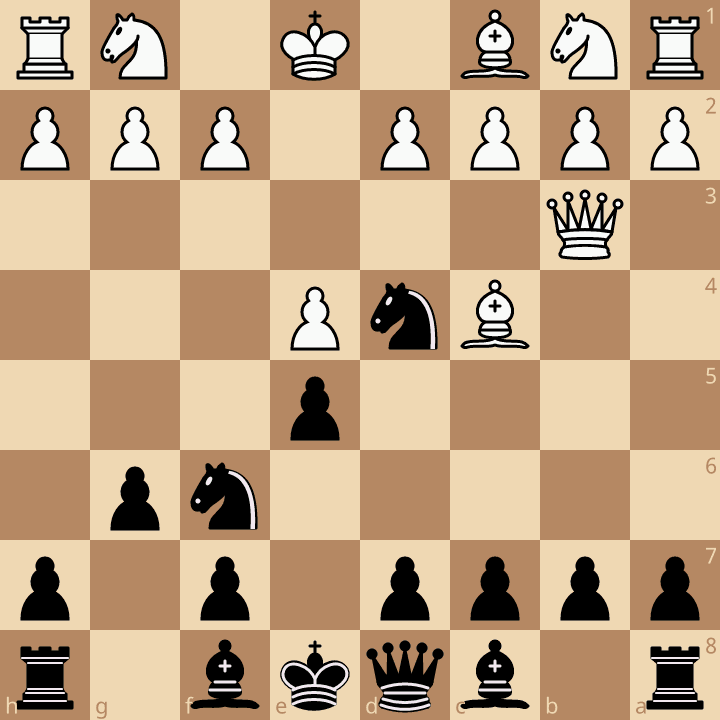
Punishing 5.Qb3?: 5...Nd4!

1.e4 e5 2.Qh5 2...Nc6 3.Bc4 g6 4.Qf3 Nf6 5.Qb3 Nd4

Parham-Angriff Punishing 5.Qb3?: 5...Nd4! nach 2...Nc6 3.Bc4 g6 4.Qf3 Nf6 5.Qb3 Nd4
Hauptlinie: 6.Bxf7+ Ke7 7.Qc4 b5

Renewing the attack on f7 with 5.Qb3? is a common club mistake. 5...Nd4! hits the queen and the c2 pawn. If White grabs the pawn with 6.Bxf7+ Ke7 7.Qc4, then 7...b5! attacks the queen while the king attacks the f7 bishop, and Black wins a piece.

Häufige Fallen

Sehen Sie sich die Falle auf dem Brett an oder gehen Sie sie Zug für Zug durch. Das sind Muster, die Sie in Ihren eigenen Partien bestrafen können.

Scholar's Mate: 3...Nf6??

The trap every beginner meets: 3...Nf6?? develops and attacks the queen but ignores the threat, and 4.Qxf7 is mate. Against an early queen, check what the queen and the c4 bishop attack together before every move.

1.e4 e5 2.Qh5 Nc6 3.Bc4 Nf6 4.Qxf7#

0/7

Start position

2...g6?? loses the rook

Kicking the queen too early backfires: 2...g6?? leaves e5 undefended and opens the long diagonal, so 3.Qxe5+ forks the king and the h8 rook. Play 2...Nc6 first, so e5 is protected, and only then ...g6.

1.e4 e5 2.Qh5 g6 3.Qxe5+ Qe7 4.Qxh8

0/7

Start position

Counter-trap: 5.g4? Nd4!

White sometimes pushes 5.g4 to chase the f6 knight. 5...Nd4! hits the queen and c2, and after 6.Qd1 d5! Black opens lines against a king still stuck in the centre, with the g4 pawn hanging. Engines give Black a winning position.

1.e4 e5 2.Qh5 Nc6 3.Bc4 g6 4.Qf3 Nf6 5.g4 Nd4 6.Qd1 d5

0/12

Start position

Wie tief sollten Sie diese Eröffnung studieren?

Below 1000

Learn one set-up and stick to it: 2...Nc6, 3...g6, 4...Nf6. Before each move, check whether f7 is attacked twice.

1000–1400

Use the queen as a target: ...g6, ...Nf6 and ...Nd4 all gain time. Know the 5.Qb3? Nd4! and 5.g4? Nd4! punishments, they come up often at this level.

1400+

Expect sensible play (Ne2, Nbc3, d3). Don't overreach: develop, castle, and use your extra time for a central break with ...d5 when it is safe.

Häufig gestellte Fragen

Is the Wayward Queen Attack the same as Scholar's Mate?

No. Scholar's Mate is the four-move checkmate 4.Qxf7# that can arise from it. The Wayward Queen Attack is the opening 1.e4 e5 2.Qh5 itself, which goes on for many moves once Black defends correctly. Our blog has a dedicated guide to stopping Scholar's Mate; this page covers the opening and how to exploit the early queen.

Is 2.Qh5 a bad opening?

It is dubious but not losing. Engines rate the position as roughly equal or slightly better for Black: the queen comes out early and gets chased, but White has no structural weakness. Against careful defense it leads to a normal game, which is why it survives as a surprise weapon in blitz.

What is the best defense against 2.Qh5?

2...Nc6, defending e5, is the most common and sound reply. Then 3.Bc4 g6 4.Qf3 Nf6, or 3...Qe7. Avoid 2...g6?? (3.Qxe5+ wins the rook) and 3...Nf6?? (4.Qxf7 mate).

Can Black answer 2.Qh5 with 2...Nf6?

2...Nf6 3.Qxe5+ Be7 gives up the e5 pawn for quick development, and engines consider it playable, but it is a gamble you don't need: 2...Nc6 keeps the material and still gains time on the queen.

How do I practise the defense?

Drill the three or four lines on this page until the replies are automatic. ChessAtlas uses spaced repetition, so each line comes back just before you would forget it, and you meet 2.Qh5 over the board already knowing the punishment.

Bereit, Parham-Angriff zu trainieren?

Jede Variante oben ist eine Übung auf ChessAtlas. Verteilte Wiederholung plant jeden Zug so, dass Sie nie wieder eine Linie vergessen. Gratis zum Starten, keine Kreditkarte.