Englund Gambit Main Line
1.d4 e5 2.dxe5 Nc6 3.Nf3 Qe7
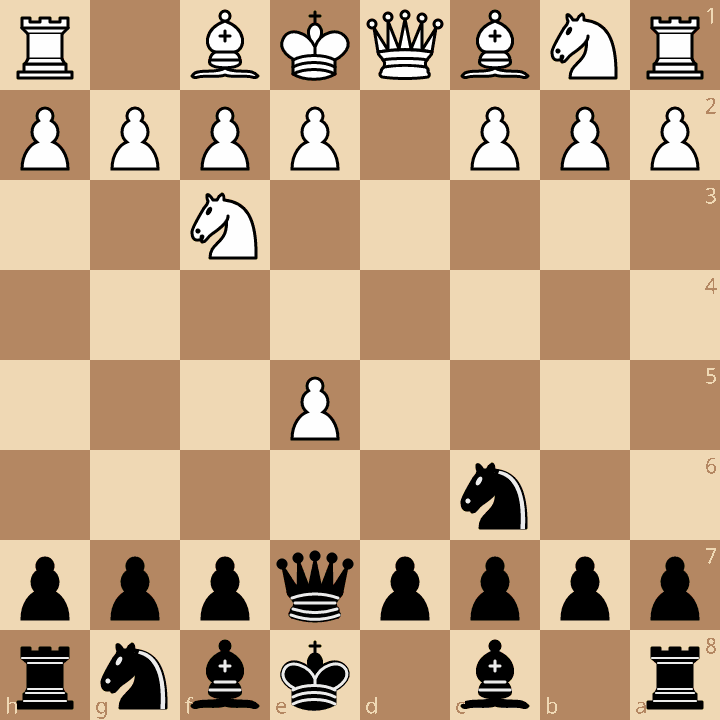
Black develops the queen early, attacking e5. White's cleanest refutation is 4.Nc3! Nxe5 5.Nxe5 Qxe5 6.Nd5! threatening a fork on c7 — Black is simply worse.
Das Schockgambit gegen 1.d4: Opfer des e5-Bauern, legendäre Db4+-Falle und null Theorie.
1.d4 e5
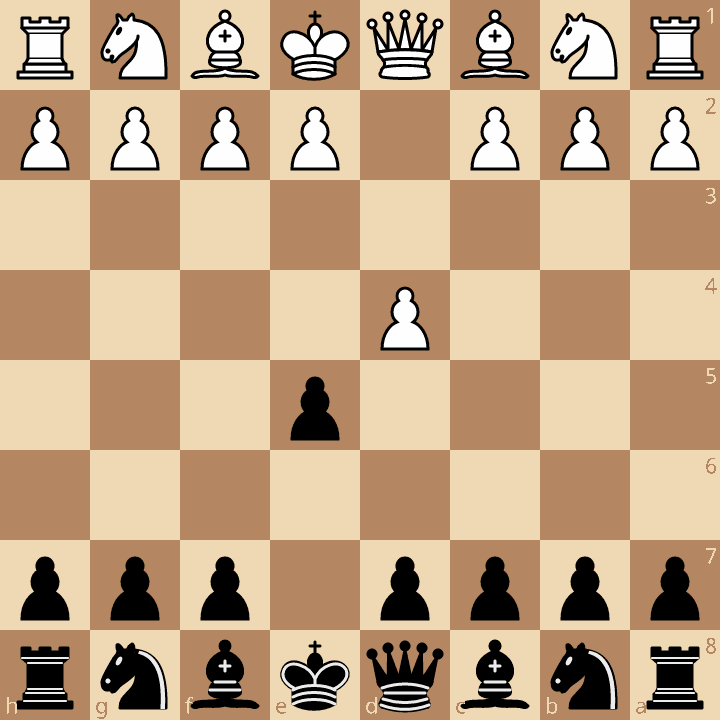
Das Englund-Gambit (1.d4 e5) versucht, die weiße Zentrumskontrolle sofort zu brechen, indem der e5-Bauer geopfert wird. Nach 2.dxe5 Sc6 3.Sf3 De7 4.Lf4 Db4+ bereitet Schwarz die berühmte taktische Rückgewinnungsfolge mit Doppelangriff auf b2 und den Läufer auf f4 vor. Objektiv bei präziser Verteidigung zweifelhaft (Weiß gewinnt mit 5.Sc3 Dxb2 6.Ld2!), bleibt das Englund eine gefürchtete Überraschungswaffe auf Klubebene (bis etwa 1800 Elo), weil wenige 1.d4-Spieler die richtige Antwort kennen. Auf schwarzer Seite null Theorie.
Jede Variante unten kommt mit einem Diagramm und dem Hauptplan. Klicken Sie auf „Diese Eröffnung trainieren“, um jede Variante mit Spaced Repetition zu trainieren.
Möchten Sie Englund-Gambit aus dem Gedächtnis spielen? Im kostenlosen Eröffnungstraining üben Sie Zug für Zug und kehren dann zu den Varianten zurück, bei denen Sie Fehler gemacht haben.
1.d4 e5 2.dxe5 Nc6 3.Nf3 Qe7
Black develops the queen early, attacking e5. White's cleanest refutation is 4.Nc3! Nxe5 5.Nxe5 Qxe5 6.Nd5! threatening a fork on c7 — Black is simply worse.
1.d4 e5 2.dxe5 d6
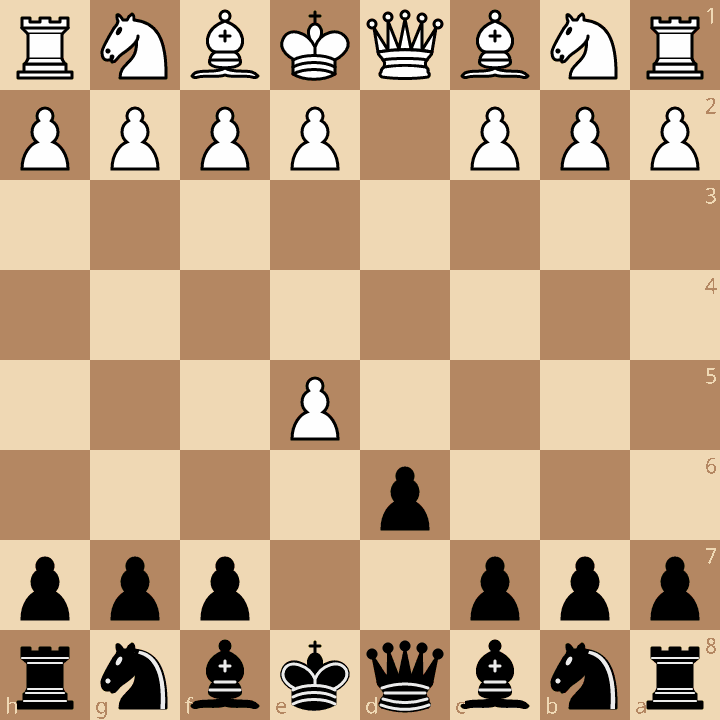
An alternative to the main line. Black plays for quick development and central play. After 3.exd6 Bxd6, Black has active pieces but is still down a pawn.
Sehen Sie sich die Falle auf dem Brett an oder gehen Sie sie Zug für Zug durch. Das sind Muster, die Sie in Ihren eigenen Partien bestrafen können.
Black's queen raid on b2 looks strong until 6.Nc3! hits back: ...Bb4 pins nothing (the c3 knight is defended), 7.Rb1! evicts the queen and 8.Nd5! attacks both the queen and the bishop. Black loses the queen for insufficient material. This is why strong players don't play 5...Qxb2.
1.d4 e5 2.dxe5 Nc6 3.Nf3 Qe7 4.Bf4 Qb4+ 5.Bd2 Qxb2 6.Nc3! Bb4 7.Rb1! Qa3 8.Nd5!
Start position
At club level the Englund scores surprisingly well. Know the main trap sequence (Qe7, Qb4+, Qxb2) and the queen traps that result.
Use the Englund as a surprise weapon in rapid/blitz. Don't rely on it in classical games, strong opponents know the defensive moves.
The Englund is unsound at this level. White simply plays 2.dxe5 and keeps the pawn with precise defense. Use a mainstream 1.d4 defense instead.
No, the Englund is objectively losing with correct play from White. After 2.dxe5 Nc6 3.Nf3 Qe7 4.Qd5 (or 4.Bf4 with precise play), Black has no real compensation for the pawn.
As a surprise weapon at club level. Many opponents don't know the defensive moves and fall into the Qe7+Qb4+Qxb2 trap. In rapid/blitz especially, the Englund wins games on confusion alone.
After 1.d4 e5 2.dxe5 Nc6 3.Nf3 Qe7 4.Bf4 Qb4+ 5.Bd2 Qxb2, Black wins the b-pawn and often traps White's rook. If White plays carefully (4.Qd5 or correct 4.Bf4 lines), the trap is avoided.
Never in serious classical chess. Occasionally in rapid/blitz as a joke or surprise weapon by players like Magnus Carlsen. It's a pure club-level surprise, not a theoretically sound defense.
Only as a surprise weapon in online blitz/rapid against unprepared opponents. For a serious Black repertoire, choose the QGD, King's Indian, Nimzo-Indian, or Slav Defense.
Die soliteste und am häufigsten gespielte Verteidigung gegen 1.d4, klassische Strategie in ihrer besten Form.
Die scharfe Waffe von Fischer und Kasparow gegen 1.d4: asymmetrischer Gegenangriff mit Fianchetto und ...e5.
Ein universelles Schema gegen alle schwarzen Verteidigungen: wenig Theorie, wiederverwendbare Pläne, moderne Waffe Ding Lirens.
Jede Variante oben ist eine Übung auf ChessAtlas. Verteilte Wiederholung plant jeden Zug so, dass Sie nie wieder eine Variante vergessen. Gratis zum Starten, keine Kreditkarte.