Englund Gambit Main Line
1.d4 e5 2.dxe5 Nc6 3.Nf3 Qe7
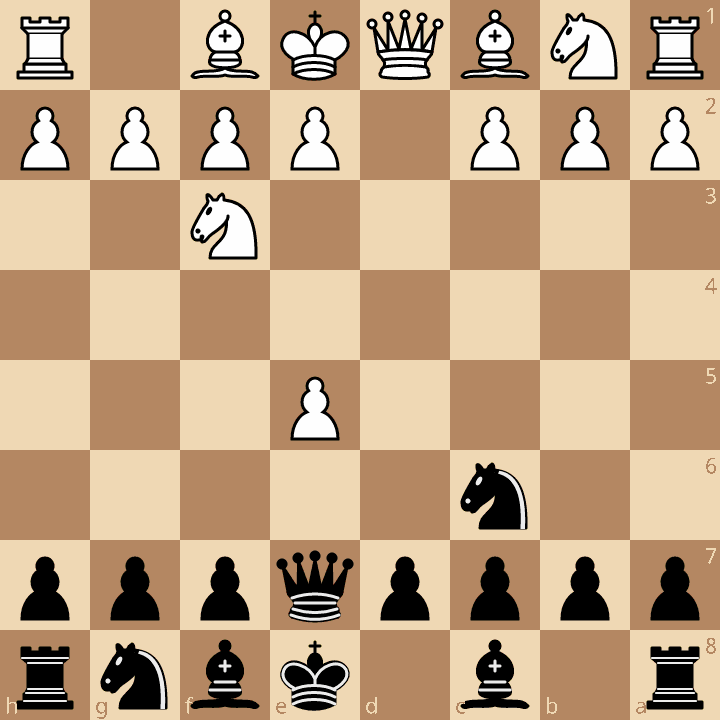
Black develops the queen early, attacking e5. White's cleanest refutation is 4.Nc3! Nxe5 5.Nxe5 Qxe5 6.Nd5! threatening a fork on c7 — Black is simply worse.
An unusual surprise gambit against 1.d4. Pure tactics and zero theory.
1.d4 e5
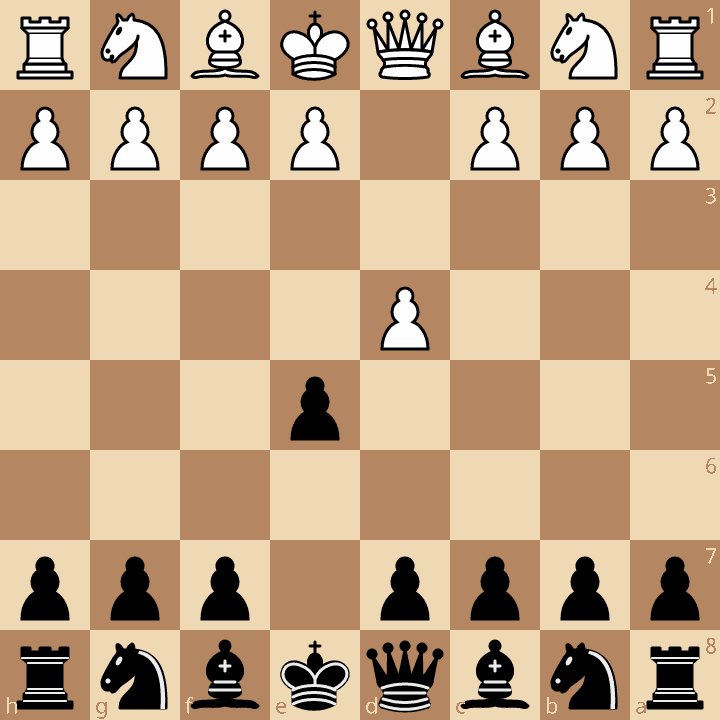
The Englund Gambit (1.d4 e5) is one of chess's most unusual openings. Black offers the e5 pawn immediately, hoping for tactical tricks or a misplayed defense. The gambit has a poor reputation at the grandmaster level, White should simply take with 2.dxe5 and keep the extra material. But at club level, it's a surprisingly effective surprise weapon. Black's typical plan is 2...Nc6 3.Nf3 Qe7 threatening to regain e5 and, if White defends inaccurately with 4.Bf4? Qb4+ 5.Bd2?? Qxb2 6.Bc3??, ...Bb4! pins the bishop and wins. If White knows the right defensive moves, the Englund is simply down a pawn with no compensation.
Each variation below comes with a diagram and the main plan. Click "Train this opening" to drill every line with spaced repetition.
1.d4 e5 2.dxe5 Nc6 3.Nf3 Qe7
Black develops the queen early, attacking e5. White's cleanest refutation is 4.Nc3! Nxe5 5.Nxe5 Qxe5 6.Nd5! threatening a fork on c7 — Black is simply worse.
1.d4 e5 2.dxe5 d6
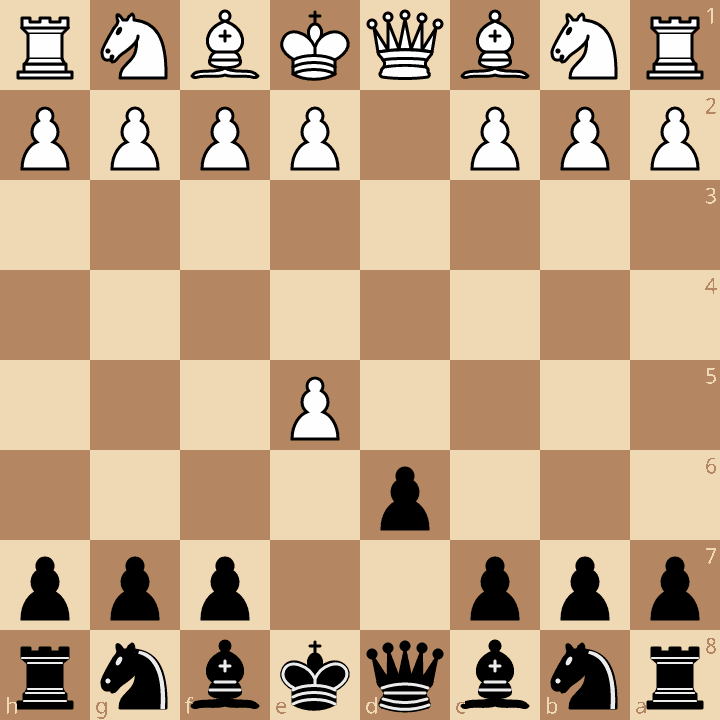
An alternative to the main line. Black plays for quick development and central play. After 3.exd6 Bxd6, Black has active pieces but is still down a pawn.
Watch the trap unfold on the board, or step through move by move. These are patterns you can punish in your own games.
Black's queen raid on b2 looks strong until 6.Nc3! hits back: ...Bb4 pins nothing (the c3 knight is defended), 7.Rb1! evicts the queen and 8.Nd5! attacks both the queen and the bishop. Black loses the queen for insufficient material. This is why strong players don't play 5...Qxb2.
1.d4 e5 2.dxe5 Nc6 3.Nf3 Qe7 4.Bf4 Qb4+ 5.Bd2 Qxb2 6.Nc3! Bb4 7.Rb1! Qa3 8.Nd5!
Start position
At club level the Englund scores surprisingly well. Know the main trap sequence (Qe7, Qb4+, Qxb2) and the queen traps that result.
Use the Englund as a surprise weapon in rapid/blitz. Don't rely on it in classical games, strong opponents know the defensive moves.
The Englund is unsound at this level. White simply plays 2.dxe5 and keeps the pawn with precise defense. Use a mainstream 1.d4 defense instead.
No, the Englund is objectively losing with correct play from White. After 2.dxe5 Nc6 3.Nf3 Qe7 4.Qd5 (or 4.Bf4 with precise play), Black has no real compensation for the pawn.
As a surprise weapon at club level. Many opponents don't know the defensive moves and fall into the Qe7+Qb4+Qxb2 trap. In rapid/blitz especially, the Englund wins games on confusion alone.
After 1.d4 e5 2.dxe5 Nc6 3.Nf3 Qe7 4.Bf4 Qb4+ 5.Bd2 Qxb2, Black wins the b-pawn and often traps White's rook. If White plays carefully (4.Qd5 or correct 4.Bf4 lines), the trap is avoided.
Never in serious classical chess. Occasionally in rapid/blitz as a joke or surprise weapon by players like Magnus Carlsen. It's a pure club-level surprise, not a theoretically sound defense.
Only as a surprise weapon in online blitz/rapid against unprepared opponents. For a serious Black repertoire, choose the QGD, King's Indian, Nimzo-Indian, or Slav Defense.
The bulletproof answer to 1.d4. Rock-solid structure and World Championship pedigree.
The ultimate fighting defense. Give White the center, then storm the kingside.
The ultimate low-maintenance opening. One setup against everything.
Every variation above is a drill on ChessAtlas. Spaced repetition schedules each move so you never forget a line again. Free to start — no credit card.