
The King's Indian Attack: A Flexible System for White

Disclosure: ChessAtlas is our product. We've aimed for a fair, accurate guide.
The King's Indian Attack (KIA) is a flexible system opening for White that mirrors the King's Indian Defense played one tempo down. Instead of memorizing dozens of sharp, theory-heavy lines, you build the same setup almost every game: knight to f3, pawn to g3, bishop to g2, castle short, pawn to d3, knight to d2, then push e4. Classified as ECO A07-A08, the KIA suits players who'd rather spend study time on tactics, endgames, and middlegame plans than on chasing the latest theoretical novelties. Bobby Fischer used it heavily in his early career, especially as an anti-French weapon, and it remains a reliable choice for club players facing 1...e6, 1...c5, or 1...d5 setups. This guide walks through the standard move order, the three main Black replies, the typical attacking plans, and how to study the KIA at your rating level.
What is the King's Indian Attack?
The KIA is a system opening, meaning the move order matters less than the resulting setup. Whether you start with 1.Nf3 or 1.e4, you steer the game toward the same pawn skeleton: pawns on d3 and e4, knights on f3 and d2, bishop on g2 after fianchetto, king tucked safely on g1. A standard sequence runs 1.Nf3 d5 2.g3 Nf6 3.Bg2 e6 4.O-O Be7 5.d3 O-O 6.Nbd2 c5 7.e4, reaching the canonical KIA position.
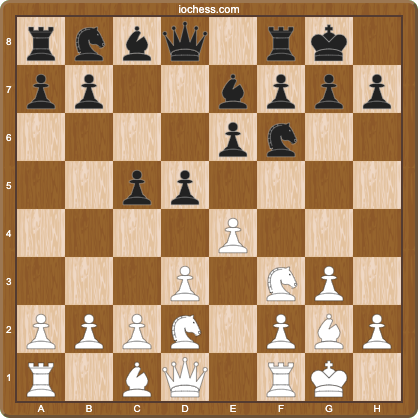
The genius of the system is that it transposes well. Against 1...e6 you play 1.e4 first; against 1...c5 you steer with 2.Nf3; against 1...d5 you start with 1.Nf3 to avoid an early ...d5 commitment. Once you reach the standard structure, the plans are similar across all three.
The standard KIA setup
White's pieces target the kingside. The fianchettoed bishop on g2 pressures the long diagonal, the e-pawn pushes from e4 to e5 to lock down Black's center, and the d2 knight reroutes through f1 to either g3 or h2-g4 to join the attack. The queen typically goes to e2 or e1, and the f1 rook lifts to e1 to support e5 and prepare ideas like Nh4-f5 or h4-h5.
If you've ever studied the King's Indian Defense, you'll recognise the shape immediately - it's the same setup with colors reversed and one tempo extra. That extra tempo lets White dictate the timing of the attack instead of reacting to it.
KIA vs the French Defense (1.e4 e6 2.d3)
This is the most famous KIA setting and the one Fischer made his trademark. After 1.e4 e6 2.d3 d5 3.Nd2 Nf6 4.Ngf3 c5 5.g3 Nc6 6.Bg2 Be7 7.O-O O-O 8.e5 Nd7 9.Re1, White locks the center with the e5 pawn and prepares a kingside attack while Black expands on the queenside.
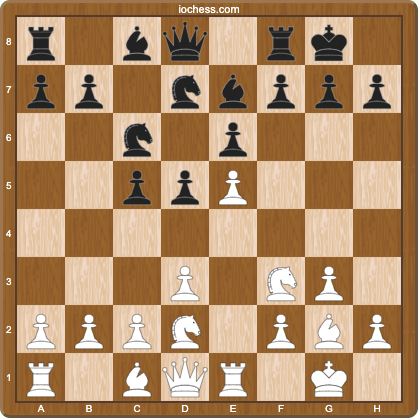
White's plan from here is concrete: Nf1 (re-routing the d2 knight), h4, Nh2, Ng4, then h5 to crack open the kingside. Black's counterplay runs on the opposite wing with ...b5, ...a5, and ...Bb7 or ...Ba6, hammering at b2 and the a2-g8 diagonal. Both sides race - whoever lands their attack first wins.
If you usually play against the French Defense with the Advance or Tarrasch, the KIA is a natural sidestep that takes Black completely out of preparation.
KIA vs the Sicilian (1.e4 c5 2.Nf3)
You can also use the KIA to dodge the entire Open Sicilian. After 1.e4 c5 2.Nf3 Nc6 3.d3 g6 4.g3 Bg7 5.Bg2 e6 6.O-O Nge7 7.Re1 (or 7.c3), White builds a slow, solid setup that completely cuts off Black's Najdorf, Sveshnikov, or Dragon preparation.
This is slower than 2.Nc3 or the Open Sicilian, but it's a practical weapon if you don't want to memorize 25 moves of theory in five different Sicilian variations. Compare it with the Sicilian Defense from Black's side to see how much theory you're sidestepping.
Typical plans here include c3 followed by d4 at the right moment to claim the center, or quiet maneuvering with Nbd2, Qe2, and e5 if Black plays a slow setup. The h-pawn push (h4-h5) also works against ...g6 setups when Black has fianchettoed.
KIA vs 1...d5 (Reti move order)
Starting with 1.Nf3 is the most flexible move order. After 1.Nf3 d5 2.g3 Nf6 3.Bg2 c6 (or ...e6) 4.O-O Bf5 (or ...Bg4) 5.d3 e6 6.Nbd2 Be7 7.Qe1 (or simply 7.e4), White finishes the standard setup and prepares e4. The choice between Qe1 (Pirc-style) and direct e4 depends on how active Black's bishop is on f5 or g4.
This is where the KIA brushes against the Reti Opening - same opening moves, different intent. The Reti commits to c4 early to pressure d5; the KIA stays with d3 and aims for a kingside attack instead.
Typical White plans
- The e5 lock: push e4-e5 when Black has played ...d5 to gain space and freeze Black's f6 knight on a passive square. This is the foundation of the kingside attack.
- The Nf1-h2-g4 maneuver: reroute the d2 knight via f1 to either g3 (controlling f5 and e4) or h2-g4 (joining the kingside attack via f6 or h6).
- The h4-h5 break: with the king safely castled and the dark-squared bishop still on c1 or g5, push h4 then h5 to crack open the h-file. Especially strong against ...g6 setups.
- The c3 / a3 prep: before launching the kingside attack, secure the d3-e4 chain with c3 and stop Black's queenside expansion with a3 or a4.
- Queen lift to h4 or g4: in some lines White swings the queen via e1-h4 or e2-g4 to stack pressure on the h-file before sacrificing on h7 or h6.
Famous King's Indian Attack games
The most-cited KIA game is Fischer vs Myagmarsuren, Sousse Interzonal 1967. Fischer used the KIA against the French move order, locked the center with e5, ran a textbook Nf1-h2-g4 maneuver, and finished with a kingside attack that ended in checkmate on move 31 (the game is documented on Bobby Fischer's Wikipedia entry and in standard anthologies of his work). It remains the model for how the KIA's themes connect: pawn lock on e5, knight reroute to the kingside, then a coordinated piece attack.
Fischer used the system several other times in the 1960s, especially in tournament play before he switched almost exclusively to 1.e4 with main-line theory. Other notable practitioners through the decades include Vasily Smyslov, Tigran Petrosian, Leonid Stein, and Mikhail Botvinnik, who all dipped into the KIA when they wanted to take a sharp opponent out of preparation. Among modern grandmasters, Egyptian GM Bassem Amin is one of the most frequent high-level practitioners.
How to study the KIA by rating
- Beginner (under 1200): learn the seven-move setup - Nf3, g3, Bg2, O-O, d3, Nbd2, e4 - and play it against everything except 1.d4 setups (where you'd transpose to a different system). Don't worry about Black's specific reply yet. Spend your study time on tactics instead. See best chess openings for beginners for context on why system openings work at this level.
- Club player (1200-1800): add the e5 lock and the Nf1-g3 reroute. Drill the KIA-vs-French line above and the KIA-vs-Sicilian setup. The 5 best openings for club players guide explains why low-theory systems shine in this rating band.
- Advanced (1800+): study Fischer's KIA games for the kingside attack patterns, learn the c3 vs c4 timing decisions, and add a separate plan against ...g6 setups. At this level, knowing when not to play e5 (when Black's structure rewards a slow build instead) is the key skill.
Common mistakes
- Pushing e5 too early without Nf1 support, allowing Black to undermine with ...f6 and break up White's center before the attack is ready.
- Forgetting that Black can play ...d4 in some KIA-vs-d5 lines, locking the center and neutralizing White's main attacking idea. When Black plays ...d4, switch to slow queenside play with c3 and a4 instead of forcing the kingside.
- Confusing the KIA with the Reti: they share moves but differ in timing of c4. The Reti plays c4 to challenge d5; the KIA stays on d3 and attacks the kingside. Mixing the two leaves you with a passive position.
- Castling kingside, then attacking the kingside without preparation: the KIA attacks where the king lives, so the king's safety must be secured first. Don't push h4 unless your bishop is on g2 (covering h1) and the f1 knight has rerouted.
- Tactical trap to know: after 1.e4 e6 2.d3 d5 3.Nd2 c5 4.Ngf3 Nc6 5.g3 Nf6 6.Bg2 Be7 7.O-O O-O 8.e5 Nd7 9.Re1 b5 10.Nf1 a5 11.h4 b4, White can play 12.Bf4 threatening 13.N1h2 and 14.Ng4; if Black grabs the h-pawn carelessly with ...Nxh4?, then 13.Nxh4 Bxh4 14.Qd2 wins the bishop because of the threat to h6.
Quick recap
- The King's Indian Attack is a White system: Nf3, g3, Bg2, O-O, d3, Nbd2, e4.
- ECO codes A07-A08 (sometimes C00 against the French move order).
- Low theory, high replayability - the same setup works against most Black moves.
- Fischer's favorite anti-French weapon in the 1960s, with the Sousse 1967 game vs Myagmarsuren as the model.
- Best for time-constrained club players who want a flexible 1.Nf3 or 1.e4 weapon with attacking plans.
- Three main attacking ideas: e5 lock, Nf1-g3 reroute, h4-h5 break.
Want to drill the King's Indian Attack with FSRS spaced repetition? Create a free ChessAtlas account and import your Lichess or Chess.com games to find every deviation from your KIA repertoire automatically. Or compare it against a 1.d4 system like the London System if you'd rather avoid 1.e4 setups entirely.
Sources and Further Reading
Last updated: Jun 5, 2026


Comments