
How to Beat the King's Indian Defense: White's Best Setups Against Black's Favorite Attack

Disclosure: ChessAtlas is our product. This is a White-perspective repertoire article against the King's Indian Defense; it works with any platform. Readers should weigh the perspective accordingly.
The King's Indian Defense (KID) is one of Black's most combative answers to 1.d4. Fischer, Kasparov, Nakamura, Radjabov, and many others used it extensively in their careers. The classical idea is provocative: Black lets White build a broad center (c4, d4, e4), then locks it with ...e5 and launches a kingside pawn storm with ...f5-f4, ...g5-g4, and knight sacrifices on h3 or g3. At club level this wins White many games because White does not know the correct plan.
The antidote is not a secret refutation, it is the queenside race. White attacks on the queenside with c5 + b4 while Black attacks on the kingside. Whoever arrives first tends to win. This article covers the four main setups, in order of practical value for club players.
For Black's perspective, see our King's Indian Defense landing page.
The Four Main White Setups
1. Classical Mar del Plata (5.Nf3 with 9.b4 Bayonet): mainstream choice
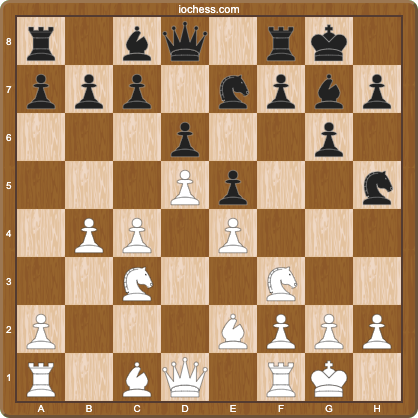
Main line: 1.d4 Nf6 2.c4 g6 3.Nc3 Bg7 4.e4 d6 5.Nf3 O-O 6.Be2 e5 7.O-O Nc6 8.d5 Ne7 9.b4 (the Bayonet Attack). White plans c5, b4-b5, and cxd6 opening the c-file; Black plays ...Nh5, ...f5, ...f4, ...g5-g4-g3.
Pros: One of the most ambitious lines theoretically. It has been employed at the World Championship level, including by Kramnik. The Bayonet Attack (9.b4) gained popularity in the 1990s as a way for White to play for an edge. Beating a well-prepared Bayonet Attack is genuinely hard for Black.
Cons: Heavy theory. Requires 15+ moves of memorization per Black sideline (Kramnik's Nh5/Nd7 setups, the Petrosian 9...a5, and newer engine-aided Black resources). Opposite-side attacks mean one tempo can decide.
Recommended for: 1800+ players willing to invest in theory.
2. Sämisch Variation (5.f3): positional anti-KID
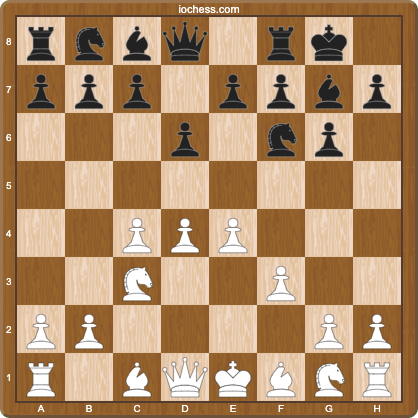
Main line: 1.d4 Nf6 2.c4 g6 3.Nc3 Bg7 4.e4 d6 5.f3 O-O 6.Be3 e5 (or 6...c5 Benoni-style) 7.d5 or 7.Nge2 with slower maneuvering. The Sämisch Variation, named after Friedrich Sämisch, often sees White castle queenside and play g4-h4 for a kingside attack of their own.
Pros: Lower theory than the Mar del Plata. Denies Black the ...f5 break because the f3 pawn keeps e4 locked. Positional, predictable plans. Good for players who dislike tactical chaos.
Cons: Slower. Can become passive if White does not commit to a wing plan. Black has clear counterplay with ...c5 Benoni-style structures.
Recommended for: 1600 to 2000 positional players.
3. Fianchetto Variation (3.Nf3 g6 4.g3): neutral, quiet
Main line: 1.d4 Nf6 2.c4 g6 3.Nf3 Bg7 4.g3 O-O 5.Bg2 d6 6.O-O with a quiet positional game. The Bg2 neutralizes Black's fianchettoed bishop and the position often converts to a small White edge.
Pros: Restrains Black's attacking plans. Clean structural game. Minimal theory to memorize. Used by Kramnik and many strategic-style GMs.
Cons: Black equalizes with accurate play. Frustrating if you want to play for a win with White.
Recommended for: 1500+ strategic players who prioritize solidity.
4. Four Pawns Attack (5.f4): aggressive central expansion
Main line: 1.d4 Nf6 2.c4 g6 3.Nc3 Bg7 4.e4 d6 5.f4 O-O 6.Nf3 c5 7.d5 (or 7.Be2) with White claiming a large space advantage via the e4+d4+c4+f4 pawn formation.
Pros: The most aggressive of the four. If Black plays inaccurately, White can build a dominant center. Visually impressive.
Cons: Double-edged. The center can collapse if White overextends, especially against 5...c5 counterattacking immediately. Requires calculation.
Recommended for: 1800+ tactical players who have studied the typical structures.
Anti-KID Move-Order Trick
If you want to avoid the Mar del Plata but still play a mainstream setup, try starting 1.d4 Nf6 2.Nf3 (delaying c4). Black often commits to ...g6 before you decide between c4 and Bf4. If Black plays ...g6, you can choose 3.Bf4 (London-style against a fianchetto) and avoid the entire Classical KID theory. This is not better theoretically, but it lets you play a system-style game instead of a theory race.
Typical Black Plans You Need to Prepare Against
- ...f5-f4 kingside storm (Mar del Plata): the main KID idea. Black follows with ...g5-g4 and knight sacrifices on h3 or g3. White's defense: speed queenside (c5+b4-b5), sometimes g3+h3 to slow Black's h-pawn.
- Knight regrouping ...Nh5 or ...Ne8-g7: setting up ...f5. Meet with g3 preventing Nf4 or direct c5 breaking first.
- ...c5 Benoni structure: after d5, Black plays ...c5 and gets Benoni-type position. Different middlegame: Black plays for ...b5 queenside breaks, White plays for piece activity and Nc4.
- Queenside defense ...a6 + ...Rb8: in Bayonet lines, Black may try to defend the queenside rather than race the kingside. White expands with a4+a5 to fix weaknesses.
Common White Mistakes
Castling kingside too early in the Mar del Plata
If you castle short (O-O) and Black gets the ...f5-f4-g5-g4 attack rolling, your king is in the firing line. In the Bayonet Attack, you accept the kingside risk because your queenside attack is genuinely faster. Commit to the race: c5 must land within 2 to 3 moves of Black's ...f5.
Not playing c5 fast enough
In the Bayonet, if you drift and play prophylactic moves instead of c5, Black's kingside attack arrives first. The rule of thumb: if Black is one move away from ...f4, you must be one move away from c5. No tempo for extra development.
Forgetting the Nd2-Nc4 or Nb5 maneuvers
In Bayonet lines, a well-placed knight on c4 hits d6 and supports b5. In the Sämisch, Ne2-c3-b5 maneuvers target c7 after ...c5 is played. These are standard patterns, not improvisations. Drill the knight routes.
Over-defensive play with g3 early
Playing g3 defensively to stop ...Nh5 weakens the dark squares around your king (h3, f4). The King's Indian bishop on g7 loves dark-square weaknesses. Use g3 only as a specific defensive resource in the Bayonet, not as a general strategy.
Rating-Specific Recommendation
- 1600 to 1800: Play the Fianchetto Variation (5.g3) or Sämisch (5.f3). Low theory, positional clarity, avoids the sharpest Mar del Plata theory.
- 1800 to 2000: Move to the Classical Mar del Plata with the Bayonet Attack (9.b4). Learn to move 15 in the main Nh5 line.
- 2000+: Full Mar del Plata theory plus the Four Pawns Attack for variety. Study recent GM games, especially with engine-aided novelties.
Tools to Drill Your Anti-KID
15 to 20 key positions covering your chosen system. FSRS-based drilling (ChessAtlas or Chessdriller) is especially valuable for the Mar del Plata because the exact move orders matter enormously. See Best Chess Opening Trainers 2026 for the full landscape.
Your Micro-Action Today
Pick one system based on your rating and style. Write down the first 12 moves of the main line. Play through a Lichess master database game in that line. Drill those 12 moves tomorrow. Your next KID opponent is the test.
For broader context see How to Build a Chess Opening Repertoire That Actually Sticks and our rating-by-rating depth guide. Or create a free ChessAtlas account and start drilling your anti-KID lines with automatic FSRS scheduling.
Sources and Further Reading
Last updated: Jul 24, 2026


Comments