FSRS vs SM-2 for Chess: Why FSRS Wins by 20-30%

Table of contents
Disclosure: ChessAtlas is our product, and we use FSRS as our default scheduler. We have aimed for a fair, source-backed comparison, but readers should weigh our perspective accordingly.
By Antoine Tamano, building ChessAtlas. Last updated August 2026.
You memorise the Ruy Lopez Closed to move 12. You drill it for a month. On game day, your opponent plays a move-order you only saw twice in your prep, and the position you thought you knew slips away. This is not a motivation problem, it is a scheduling problem. The algorithm deciding when to show you a position is the difference between lines that stick and lines that vanish under time pressure. Both algorithms below are applications of the spaced repetition principle, which exploits the spacing effect in human memory.
Most chess opening trainers still run on SM-2, the spaced-repetition algorithm Piotr Wozniak published in 1987 for SuperMemo. A newer algorithm, FSRS (Free Spaced Repetition Scheduler), was released for Anki in late 2022 and built into Anki since version 23.10 (October 2023). FSRS is now the recommended scheduler for new decks. Per the open-spaced-repetition benchmark across 500+ million review logs and the official Anki team's testing, FSRS requires roughly 20 to 30 percent fewer reviews at the same retention level.
What Are FSRS and SM-2?
Both algorithms schedule reviews to maximise long-term memory while minimising wasted effort. In chess, they decide whether you see a critical Najdorf branch tomorrow, next week, or next month based on how accurately you played it last time.
SM-2: The 1987 Heuristic Still Running Most Chess Trainers
SM-2 uses fixed multipliers and an "ease factor" that moves up or down based on your Hard / Good / Easy rating. It treats every user identically, which was the only option given the compute and data available in 1987. The common failure mode, widely documented in the Anki community, is ease hell: rate a card Hard too many times and the ease factor collapses, forcing the card to return daily long after you have actually mastered it. In chess, this happens regularly with tight move orders (Winawer French, Mar del Plata King's Indian, Botvinnik Semi-Slav) where you fumble early, rate Hard, and then never escape the short interval.
SM-2 powers Chessable's MoveTrainer, Anki's legacy scheduler, and Chess Position Trainer's custom variant. It works - it is simply not tuned to what 40 years of spaced-repetition data have since revealed.
FSRS: Scheduling Trained on Real Anki Reviews
FSRS was built by Jarrett Ye and the open-spaced-repetition organisation, released as an Anki add-on in December 2022, and integrated into core Anki since version 23.10 (October 2023). The algorithm and its parameter sets are developed openly in the FSRS4Anki repository. Ongoing releases through 2024 and 2025 (FSRS 4.5, FSRS 5, FSRS 6) refined the parameter set further. Default parameters are fit on hundreds of millions of reviews from tens of thousands of Anki users. FSRS models memory with three variables:
- Retrievability (R): probability you recall a position right now
- Stability (S): days required for retrievability to drop from 100% to 90%
- Difficulty (D): how hard this specific position is for you
You also set an explicit target retention (often 85 to 95 percent). FSRS schedules intervals to meet that target on a per-card basis. The Expertium benchmark, last updated through 2025 against 500M+ Anki review logs, consistently puts FSRS ahead of SM-2 in prediction accuracy by log-loss for 99.5% of users tested. Community migrations - the official Anki team's testing, third-party tool migrations - report this translates to roughly 20-30% fewer reviews at equal retention.
Why FSRS Matters Specifically for Chess Opening Retention
Chess openings form deeply interdependent trees. A single choice on move three shapes the playable options five moves later, and one memory lapse collapses the line. A serious club-level repertoire typically runs to a few thousand cards once transpositions and opponent sidelines are included. The following four properties of FSRS map directly onto these demands.
1. Per-Card Adaptation Between Forced and Strategic Positions
Some positions stabilise fast in your memory once understood, because the only correct continuation is forced. Others remain fragile for weeks because several plausible-looking moves exist and only one is best. FSRS tracks difficulty and stability separately per card, so those two end up on very different intervals; SM-2 applies the same multipliers to both.
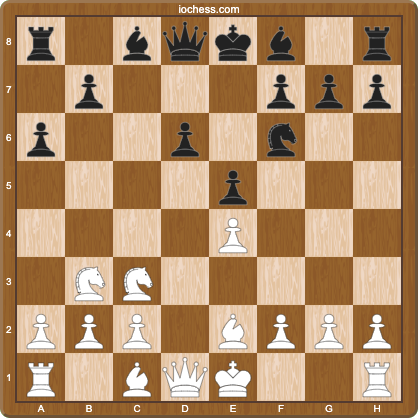
By contrast, a pure tactical refutation - punishing an early ...Qh4 with Nc3 in some lines - tends to stabilise within a handful of correct recalls. FSRS widens the interval on that card quickly, freeing review time you would otherwise waste.
2. Escape from Ease Hell on Sharp Lines
With SM-2, repeatedly rating a complex Grünfeld or Mar del Plata line as Hard drops the ease factor, forcing daily reviews long after you have internalised the position. FSRS recalibrates stability every time you recall correctly, so once the line clicks, the interval stretches out. Reviews follow your actual learning curve rather than punishing you for the weeks you struggled. For the broader retention strategy this enables, see our complete FSRS guide for chess openings.
3. Configurable Retention for Tournament Prep
Before a weekend open, you may want 95% retention on your main lines and accept 85% on sidelines. FSRS lets you set an explicit retention target and adjusts intervals to hit that goal. SM-2 has no equivalent dial. In ChessAtlas the target is set per course, from the course menu.
4. Transpositions, and What Counts as One Card
Two different move orders can reach the same tabiya, and how a trainer handles that decides how much you actually drill. This is a design choice of the tool, not a property of FSRS: some trainers key their scheduling on the position, others on the line. ChessAtlas schedules one card per variation - a full line drilled move by move - so transpositions are something you merge while building the repertoire rather than something the scheduler collapses for you. Neither cut is wrong, but they produce very different deck sizes, so check which one your trainer uses before comparing review counts with anyone else.
How FSRS Works Under the Hood
After each review, FSRS updates stability (S), difficulty (D), and retrievability (R) for that specific card. The next interval is computed so that R drops to your target retention at exactly that time, tracing each card's own forgetting curve. The key difference from SM-2 is that the card's accumulated memory state informs the next interval, not just the last rating: SM-2 picks the next interval from the latest rating alone, so if you blew the card three weeks ago and have nailed it five times since, it cannot weigh those signals against each other.

FSRS ships with default parameters fit on the large-scale public Anki dataset, so it performs well from day one. Anki additionally lets you re-run an optimiser that refits those parameters to your own review history, in deck settings. ChessAtlas does not run that optimiser: it uses the default parameter set and exposes the dials that matter in practice - desired retention, maximum interval, interval fuzzing - per course.
Where the grade comes from
FSRS needs a rating for every review. In a general-purpose flashcard app you press it yourself; that is what the Hard / Good / Easy buttons are. ChessAtlas has no rating button: the drill already knows what you did, so the grade is derived from the share of moves you played correctly on the first attempt. This only applies to modes that hide the move - a guided first pass through a new line, where the app shows you the moves, always counts as a normal recall rather than a perfect one.
What Changed When Chess Trainers Switched to FSRS
Anki: FSRS is Built-In and Recommended
FSRS has been integrated into Anki since version 23.10 (October 2023) as a built-in scheduler option. Anki recommends it for new decks, and the FSRS optimiser can be run once you have around 200 reviews of history. Older versions need an upgrade - the legacy FSRS add-on is no longer needed.
Third-party migrations
Several chess and language-learning trainers migrated from SM-2 (or in-house variants) to FSRS during 2024-2025 and reported lower review loads at equal retention - consistent with the open-spaced-repetition benchmark. Users with deep, sharp repertoires (Sicilian, King's Indian) tend to see the largest gains because their cards include more "ease hell" candidates that FSRS handles cleanly.
ChessAtlas: FSRS from Day One
ChessAtlas ships with FSRS as the default scheduler, and pairs it with automatic Lichess and Chess.com game import plus Deviation Finder. When Deviation Finder flags a position you left your prep in a real game, that card is pushed to the review queue with FSRS scheduling. The feedback loop between study and real games stays tight.
For how these tools stack up in detail, see our 2026 trainer comparison.
Quick Comparison: FSRS vs SM-2 at a Glance
| Feature | SM-2 (1987) | FSRS (2022) |
|---|---|---|
| Trained on real user data | No, fixed heuristic | Yes, hundreds of millions of reviews |
| Parameters refittable to one user | No | Yes, where the tool exposes an optimiser (Anki does) |
| Explicit retention target | No | Yes (often 85 to 95%) |
| Escapes "ease hell" | Manual workarounds only | Yes, stability recalibrates |
| Memory model variables | Ease factor only | Retrievability, Stability, Difficulty |
| Review reduction at same retention | Baseline | ~20 to 30% fewer |
| Used by | Chessable, Anki (legacy), CPT | Anki 23.10+ (built-in), ChessAtlas, recent Anki migrations |
Common Misconceptions
"FSRS only helps if I have thousands of cards"
Default FSRS parameters already improve scheduling on small decks thanks to the global training data. Configurable retention and dynamic intervals reduce waste from the first review. If your repertoire has 500 to 1,000 positions, the configurable retention dial alone is worth the switch.
"SM-2 is obsolete"
SM-2 still works. Chessable has shipped world-class courses on SM-2 for years and players legitimately memorise openings with it. The argument is not that SM-2 is broken, it is that FSRS is measurably more efficient and the switching cost is low. If a tool you love uses SM-2, stay; if you are picking a new trainer, pick FSRS.
"Switching scheduler resets my progress"
Migrations in Anki preserve review history. FSRS seeds initial parameters from your past ratings, then calibrates over a few weeks of reviews. You keep intervals and accuracy signals rather than starting from scratch.
Which Tools Use Which?
- FSRS by default: ChessAtlas, Anki 23.10+ (built-in option, recommended for new decks)
- FSRS opt-in: Older Anki decks (enable in deck options), community tools like Chessdriller
- SM-2 still: Chessable MoveTrainer, Chess Position Trainer (legacy custom scheduler close to SM-2)
- No spaced repetition at all: ChessBase (database tool), Lichess Opening Explorer, most engine analysis tools
For the broader repertoire-tools landscape, see our repertoire-builder buyer's guide and free and low-cost ways to train chess openings.
Action Plan
- If you use Anki, upgrade to 23.10 or later and toggle FSRS on in Deck Options. Set desired retention to 90% to start.
- If you use Chessable and your repertoire is large, export the PGN and drill it in parallel in a FSRS-based tool like ChessAtlas.
- Give any scheduler at least two weeks before judging it - intervals only start to spread out from the second or third repetition.
- Track two metrics for the next month: daily review count and subjective recall under time pressure. The 20 to 30% review reduction shows up clearly within four weeks.
- Adjust desired retention up before tournaments (95%) and back down after (85-90%) to manage drill load between events.
For the broader study framework this algorithm plugs into, read how to build your first repertoire, why spaced repetition works for chess, and how to memorize chess openings and actually remember them. Or create a free ChessAtlas account and start drilling with FSRS in two minutes.
Sources and Further Reading
Last updated Aug 1, 2026