The Best Chess Endgame Practice Tools in 2026, Compared

Table of contents
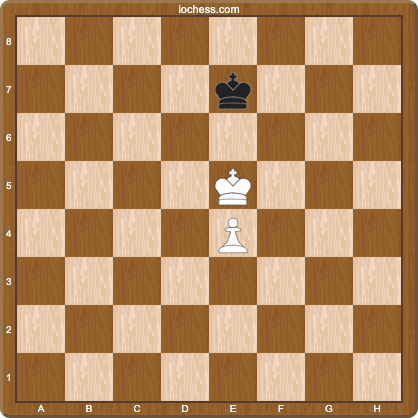
You can memorize your openings perfectly and still lose the point in a technically won rook ending. Endgames are where converted advantages quietly evaporate, and they are the one phase most players never actually practice, they only read about them. This guide compares the best chess endgame practice tools in 2026, sorted by how you learn best: playing positions out, drilling puzzles, or memorizing the key theoretical positions.
Disclosure: the team behind this blog also builds ChessEndings, the tool ranked first below. We have listed the main alternatives with their real trade-offs so you can compare and judge for yourself.
How we compared them
Endgame tools fall into two camps. One camp helps you memorize the theory, the exact sequence that wins a Lucena or holds a Philidor. The other makes you play the position out against resistance, which is the skill that actually transfers to a real game where the opponent fights. We weighted practice-against-resistance most heavily, because knowing the theory and executing it under pressure are different skills.
1. ChessEndings: best for playing endings out against real resistance
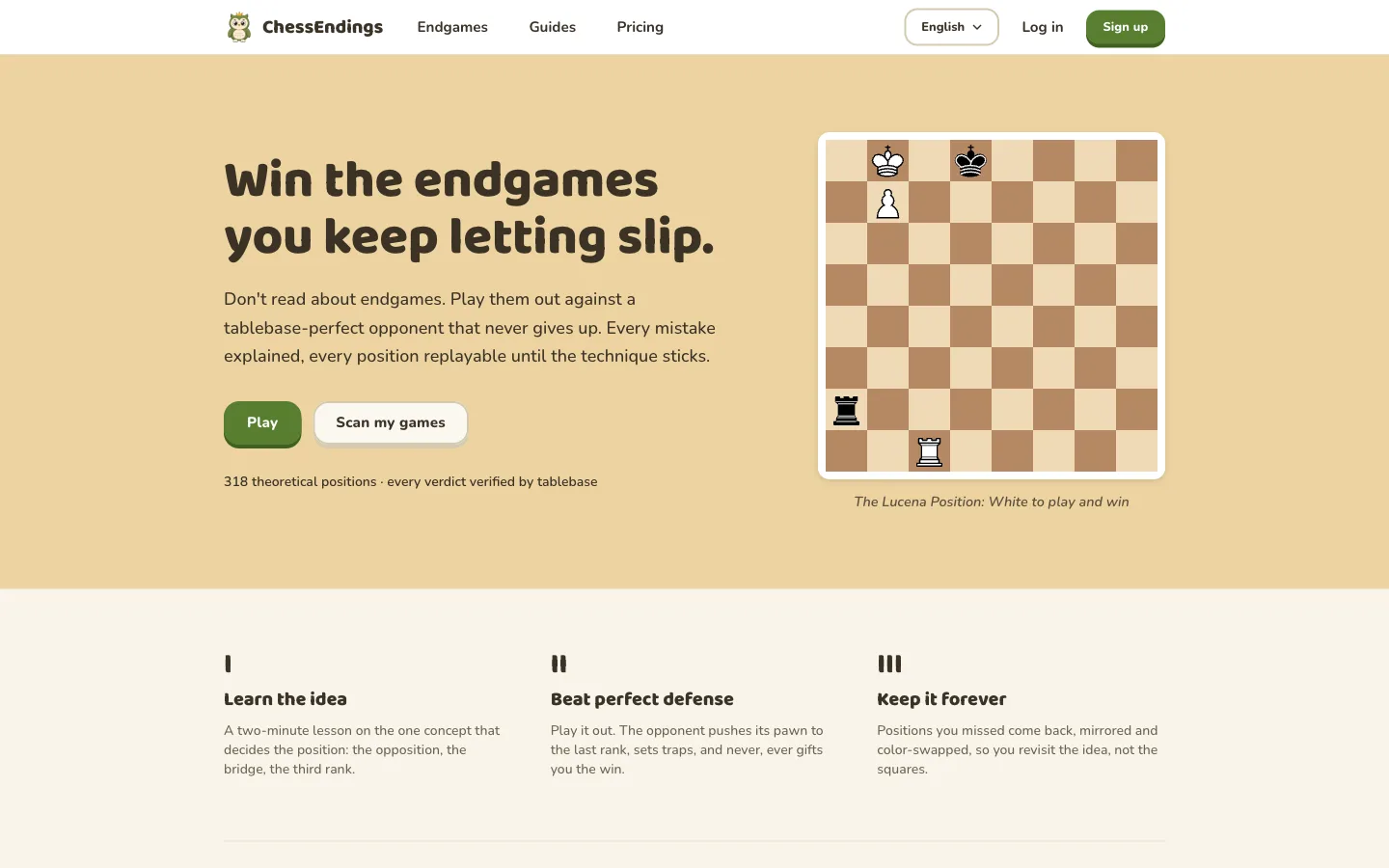
ChessEndings is built around the practice gap. Instead of a lesson you read, you play each theoretical position out against a tablebase-perfect opponent that never resigns, pushes its pawn to the last rank, and sets the hardest practical traps. The loop is learn the idea in two minutes, beat perfect defense, then keep it forever, because missed positions come back mirrored and color-swapped so you learn the idea rather than the squares. It also scans your own online games to surface the winning endgames you actually drew or lost.
This is the tool for the player who knows the theory but keeps butchering it over the board. The full first-tier curriculum is free, built on 261 tablebase-verified positions.
Approach: play the ending out against a fighting opponent.
Platforms: Web.
Pricing: Free tier (full Foundations curriculum, 5 advanced drills per day); Pro is a one-time 39 EUR, no subscription.
Best for: players who know the theory but lose won endgames in real games. Practice endgames free.
2. Chessable: best for memorizing the essential theory
If your gap is knowledge rather than execution, Chessable is the place to fix it. Its flagship endgame course, 100 Endgames You Must Know (based on Jesus de la Villa's book), pairs the core theoretical positions with the MoveTrainer spaced-repetition engine, so you drill each one until it is automatic. It is tablebase-supported and recognizes equivalent moves.
The trade-off is that Chessable trains recall, not resistance: you rehearse the correct line, but you are not forced to find it against an opponent trying to trick you. It pairs perfectly with a play-it-out tool.
Approach: memorize curated theory with spaced repetition.
Platforms: Web, iOS, Android.
Pricing: Paid per course, plus an optional Pro subscription.
Best for: players who want to learn the essential theoretical positions cold.
3. ChessTempo: best for endgame puzzle volume
ChessTempo offers dedicated endgame training built from positions taken from real games, with an adaptive difficulty system and a separate endgame rating so you can track progress precisely. There is a large library of positions across piece counts, which makes it strong for high-volume, rated practice.
It is puzzle-shaped rather than a play-the-whole-thing trainer, and the interface is utilitarian, but for sheer volume and analytics it is one of the strongest options.
Approach: rated endgame puzzles from real games.
Platforms: Web, iOS, Android.
Pricing: Free tier (limited daily); paid membership unlocks more.
Best for: players who want high-volume, rated endgame drilling.
4. Chess.com: convenient drills inside the big platform
Chess.com bundles endgame training into the platform you may already use: its Endgame Drills let you play set positions out against the computer, and its lessons cover the fundamentals. For casual practice without leaving your main account, it is convenient.
The drills are solid but shallower than a purpose-built curriculum, the computer is not tuned for maximum practical resistance, and the deeper material sits behind a premium membership.
Approach: play-out drills plus lessons.
Platforms: Web, iOS, Android.
Pricing: Free tier; premium tiers unlock more.
Best for: existing Chess.com users who want light endgame practice in one place.
5. Lichess: the best free option
Lichess is free, open-source, and ad-free, and it covers endgames from several angles: an endgame puzzle theme, curated Practice lessons on the basic checkmates and pawn endings, community studies, and a built-in tablebase in the analysis board. Combined, that is a remarkable amount of free endgame material.
There is no single structured path from beginner to mastery and no adaptive opponent tuned for resistance, so you self-direct, but for a zero budget it is unbeatable value.
Approach: free puzzles, practice lessons, studies, and tablebase.
Platforms: Web, iOS, Android.
Pricing: Free, donation-supported.
Best for: self-directed players who want free endgame material.
Side-by-side comparison
| Tool | Approach | Platforms | Pricing |
|---|---|---|---|
| ChessEndings | Play endings out vs perfect defense | Web | Free; Pro 39 EUR one-time |
| Chessable | Memorize theory (spaced repetition) | Web, iOS, Android | Per course + optional Pro |
| ChessTempo | Rated endgame puzzles | Web, iOS, Android | Free tier; paid membership |
| Chess.com | Drills vs computer + lessons | Web, iOS, Android | Free; premium tiers |
| Lichess | Free puzzles, practice, tablebase | Web, iOS, Android | Free (donation) |
Which one should you pick?
If you keep drawing or losing endgames you know are winning, the fix is playing them out against resistance, so start with ChessEndings. If your gap is knowledge, learn the essential positions on Chessable first, then drill them against a fighting opponent. For rated puzzle volume, add ChessTempo, and if your budget is zero, Lichess covers a surprising amount for free.
The most effective setup is the pairing: memorize the key theory once, then practice converting it against an opponent who refuses to help. That second half is the one almost everyone skips, and it is exactly where rating points hide. Once you start converting, the habit of reviewing your own games will show you which endings to drill next.
Last updated Jul 24, 2026